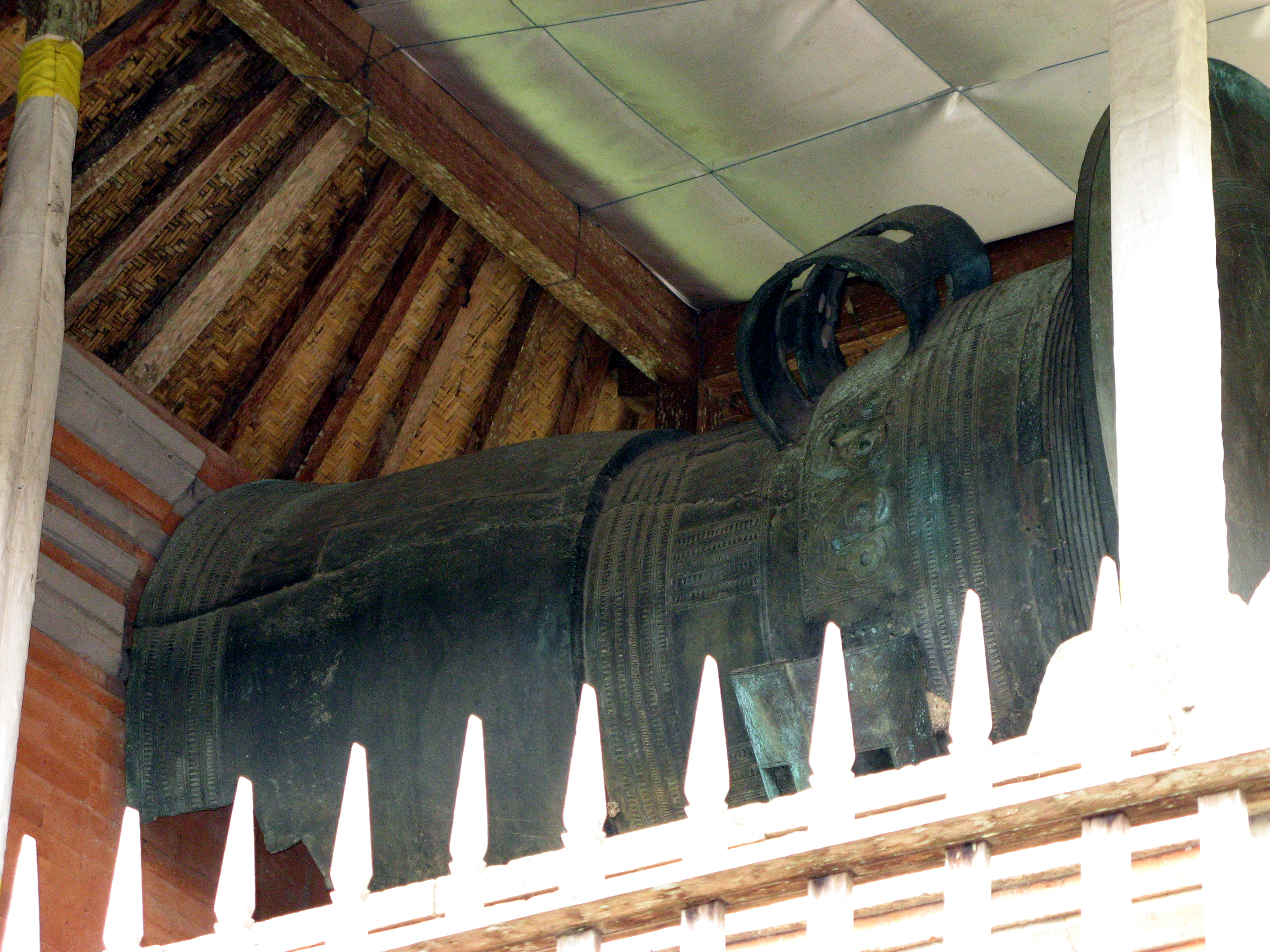
The Moon of Pejeng: A Fallen Wheel from the Chariot of the Sky
A thief killed the moon. That is the Balinese version, anyway. According to legend, a luminous wheel once detached from the chariot that pulled the real moon across the sky and fell into a tree in the village of Pejeng, where it glowed so brightly it lit up the night. A thief, annoyed that the radiance made his work impossible, climbed the tree and urinated on the object. He died instantly for his sacrilege. The glow faded. What remained was a massive bronze drum, nearly two meters tall and over a meter and a half across, which the villagers of Pejeng have treated as sacred ever since. Two thousand years later, the Moon of Pejeng still hangs in its pavilion at Pura Penataran Sasih, the largest single-cast bronze kettle drum ever found anywhere in the world.
Bronze from a Vanished Culture
The drum was cast around 300 BC by the Dong Son people, a Bronze Age culture centered in what is now northern Vietnam whose influence rippled across maritime Southeast Asia through trade, migration, and the movement of sacred objects. Dong Son bronze drums have been found scattered across the Indonesian archipelago, from Java to Bali, but none approaches the Pejeng Moon in size. At 186.6 centimeters tall with a tympanum 160 centimeters in diameter, it dwarfs every other known example. The mold used to cast it was discovered on Bali itself, confirming that this was not an import but a local creation -- produced by artisans who had mastered the Dong Son technique and then exceeded its scale. Whatever ceremony demanded a drum this large has been lost to time, but its ambition speaks for itself.
Rain, Rice, and Ritual
Researcher A. Calo has argued that Dong Son drums in Bali were not merely prestigious objects but functional instruments in rice cultivation rituals. The evidence is geographic: most of the drums discovered on the island were found near sources of irrigation water -- lakes, springs, or weirs in rivers. Their shapes and decorative patterns echo modern representations of female deities associated with rice and water, figures that originate in a pre-Hindu Balinese culture and were later absorbed into the Hindu-Balinese pantheon. Even today, ritual ceremonies honoring these water deities take place at bedugul -- the points where irrigation water first enters the rice fields -- and at the volcanic crater lakes that serve as the highest sources. The Moon of Pejeng may have once presided over exactly such ceremonies, its deep bronze resonance calling rain from the mountains to the paddies below.
An Object That Resisted Collection
The Western world first learned of the Pejeng Moon through G.E. Rumphius, the German-born Dutch naturalist who catalogued the wonders of the Indonesian archipelago in The Ambonese Curiosity Cabinet, published in 1705. European collectors and colonial administrators spent the next two centuries documenting objects like these -- and frequently shipping them to museums in Amsterdam, Leiden, and Berlin. The Moon of Pejeng stayed put. The villagers who guard it never allowed it to be moved, and it remains where it has been for centuries: elevated in a pavilion at Pura Penataran Sasih, too sacred to touch, too large to easily steal. In 1997, a smaller Dong Son drum was discovered in Manikliyu on the western edge of Bangli Regency, buried in an unusual funerary context previously unknown in Indonesian archaeology. That drum went to a museum. The Moon of Pejeng stayed in its temple.
Still Sacred, Still Guarded
Pura Penataran Sasih, the temple that houses the drum, was once the state temple of the Pejeng kingdom, one of the earliest Hindu polities on Bali. The drum hangs high in its own pavilion, visible but elevated beyond casual reach. Visitors can enter the temple complex, but the Moon itself occupies a space between artifact and deity -- gazed upon but not handled, studied but not reduced to mere object. Local people consider it highly sacred. Scholars call it the largest known relic from Southeast Asia's Bronze Age period. Both descriptions are accurate, and neither is sufficient. The Moon of Pejeng is what happens when an object survives long enough to accumulate more meaning than any single framework can contain: it is instrument, relic, deity, and national treasure, all suspended in the same bronze shell.
From the Air
Pejeng (8.51S, 115.29E) sits near Ubud in Bali's Gianyar Regency. Ngurah Rai International Airport (WADD/DPS) lies 27km to the south with runway 09/27 (3,000m). The temple area is not distinctively visible from altitude, but the surrounding Ubud rice terrace landscape is identifiable. Mount Agung (3,142m) rises to the northeast. Tropical climate, wet season November-March, afternoon convection common.