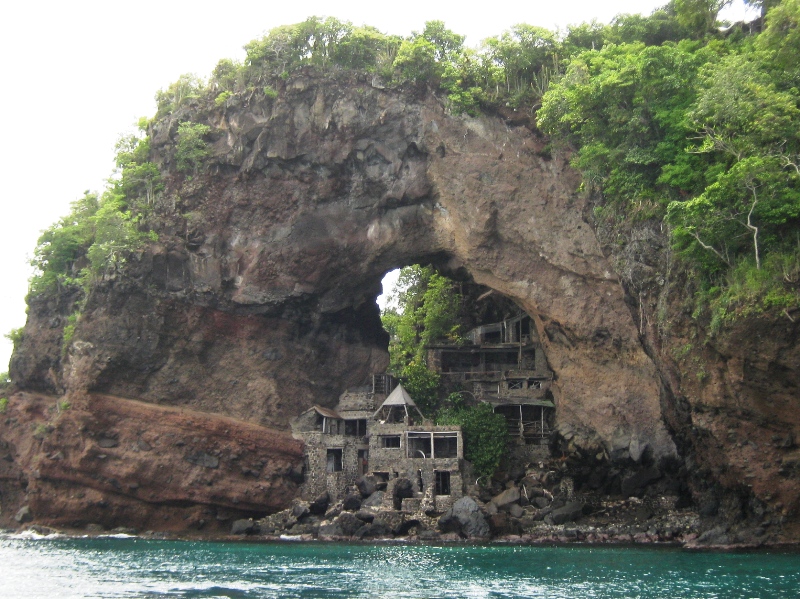
Moonhole
The bar is made from a humpback whale's jawbone. The master bath has a tree growing up through a hole in the roof. There are no walls to speak of, just plexiglass panes that lower into place when the trade winds blow too hard. This is Moonhole, a community of fifteen homes clinging to the volcanic cliffs at the western tip of Bequia, where a couple from New York's advertising world retired in the late 1960s and decided that the boundary between indoors and outdoors was a convention worth abandoning.
Beneath the Arch
Thomas and Gladys Johnston chose their building site with a poet's eye. A massive natural arch in the volcanic rock frames the setting moon on certain nights, and beneath that arch they built their first home with the help of local masons from the nearby village of Paget Farm. The materials came from the landscape itself: whalebones scavenged from Bequia's long whaling tradition, native hardwoods cut from the hillsides, and objects recovered from the sea. Without wells, they collected rainwater from the roofs and stored it in cisterns. Without electricity, they lived by the rhythms of the sun. In the early years there was no road to the peninsula at all, and villagers walked the trail from Paget Farm each day carrying fruit and freshly baked bread.
Architecture Without Boundaries
The homes the Johnstons built, and that others later added, blur every line between structure and landscape. Large rooms open directly to the sea, their stone walls rising from the volcanic rock as if they had always been there. Windows face the prevailing trade winds, designed not to block the breeze but to channel it. The New York Times, visiting in 2004, described the development as "a quirky 19-home ecologically oriented development built of native stone, with whalebone accents." The whalebones, remnants of Bequia's aboriginal whaling tradition, are large enough to serve as stair railings and structural elements. Solar electricity, rainwater cisterns, and propane tanks keep each house self-sufficient. The effect is less a neighborhood than an inhabitable sculpture garden, where every surface tells a story about what the sea offered up.
A Legacy Carved in Stone
The Johnstons donated the approximately 30-acre property to the Moonhole Company Limited, a trust structure designed to outlast them. Tom bequeathed his controlling interest to a conservation trust dedicated to preserving the architecture, the lifestyle, and the wildlife of the peninsula. The Thomas and Gladys Johnston Moonhole Conservation Trust protects not just the buildings but the birds and marine life that share the headland. Today eleven homes are privately owned and four belong to the company, some available for rent throughout the year. Guests arrive expecting a Caribbean vacation and find something stranger and more compelling: a place where human habitation has been shaped entirely by what the land and sea provide, where comfort exists without convenience, and where a whale's jawbone can hold up a roof.
The View from the Cliff
From the water, Moonhole's homes are nearly invisible, their stone walls merging with the volcanic cliffs. From inside, the Caribbean stretches to the horizon without a single pane of glass to interrupt the view. The name itself captures the drama: on the right nights, the moon drops through the arch and into the sea, and the people who live beneath it watch from rooms that have no walls. It is an experiment in radical simplicity that has lasted more than half a century, built by two people who traded Manhattan for a volcanic headland and never looked back. The Johnstons proved something that most architects would deny: that a house can be stronger for having no doors, and more beautiful for being built from bones.
From the Air
Moonhole is located at the narrow western tip of Bequia at 12.99N, 61.28W. The volcanic arch and cliff-side homes are best viewed from the south or west at 1,000-2,000 feet AGL. The nearest airport is J.F. Mitchell Airport (TVSB) on Bequia, about 2 nautical miles east. Mustique Airport (TVSM) is approximately 10 nautical miles to the south. The arch formation is visible as a distinctive gap in the rocky headland. Trade winds from the east are common; approach from the Caribbean side for the best perspective on the homes built into the cliff face.