Moore Theatre
In 1990, a young band called Alice in Chains filmed their Live Facelift concert video inside a theater that had been built for Gilded Age socialites eighty-three years earlier. Two years later, Pearl Jam shot the music video for "Even Flow" on the same stage. Soundgarden had already recorded their Fopp EP there in 1988. Before Seattle's grunge explosion had a name, it had a venue: the Moore Theatre, an 1,800-seat hall of Byzantine arches and terra-cotta flourishes sitting two blocks from Pike Place Market, where the ceiling plasterwork of 1907 looked down on the mosh pits of the 1990s without a trace of disapproval.
A Developer's Grand Gesture
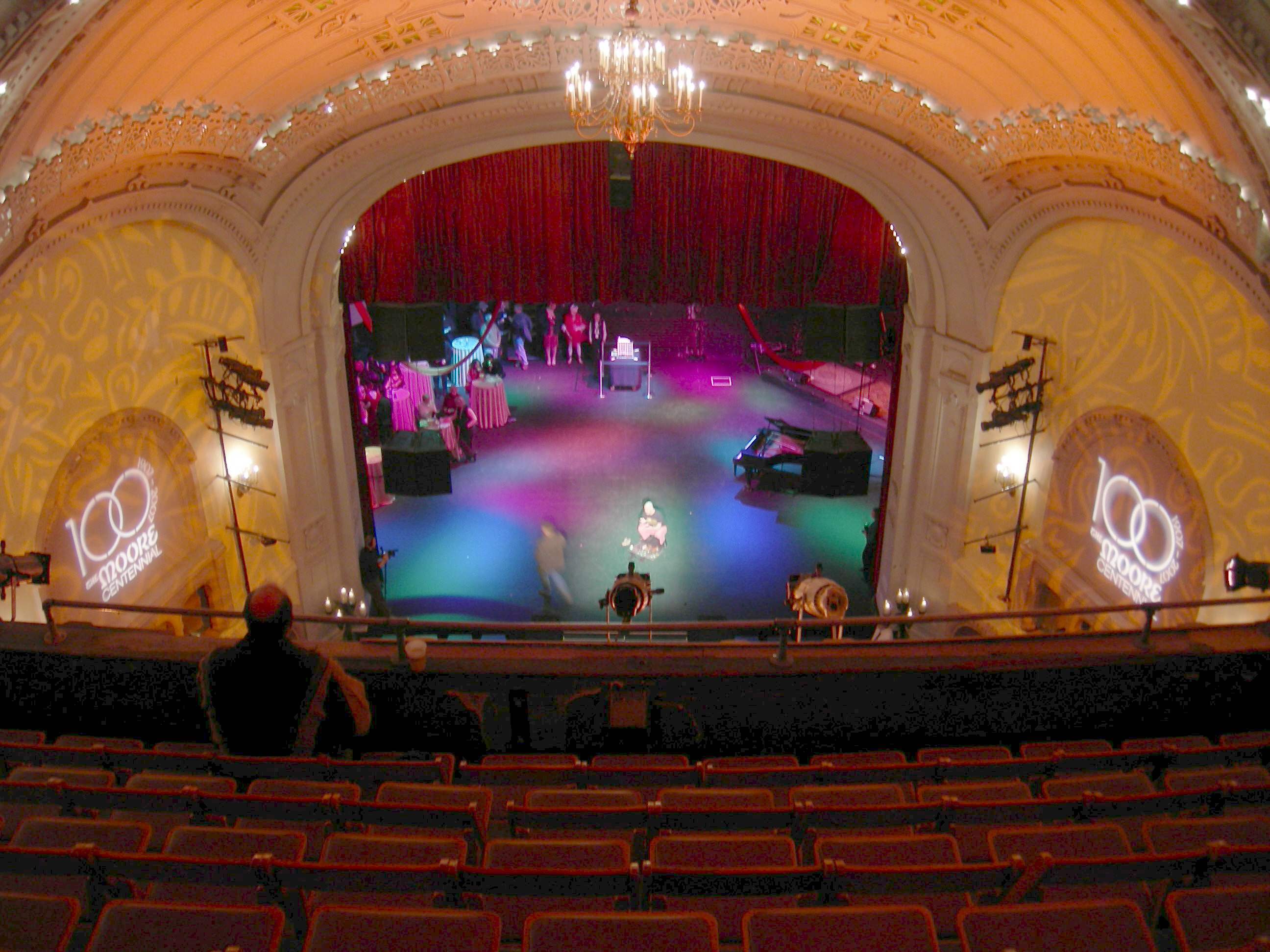
Seattle real estate magnate James A. Moore commissioned the theater as a statement of civic ambition. Designed by architect E. W. Houghton, the Moore Theatre and its adjoining Moore Hotel were built partly to accommodate tourists expected for the Alaska-Yukon-Pacific Exposition, originally planned for 1907 but ultimately postponed to 1909. The theater opened on schedule anyway, in late 1907, and immediately became one of the largest in the United States, seating 2,436 in its original configuration. Houghton crafted the building from reinforced concrete faced with white ceramic tile and terra-cotta, blending Byzantine and Italianate elements into an exterior that was deliberately restrained compared to the lavish interior. An enormous steel girder spans the full width of the house, carrying the weight of the balcony without a single support column -- a feat of engineering that Houghton would repeat in the smaller Seeley Theatre in Pomeroy, Washington.
Splendor and Segregation
Inside, the Moore was a showcase of luxurious materials and sumptuous decoration. The staging area was the largest in Seattle, fitted with an electrical system that was state-of-the-art for 1907 and an unusually generous number of dressing rooms. The theater was initially operated by John Cort, who would later found a major Broadway venue in New York. But the grandeur came with a shadow. The upper balcony, while well-appointed, was originally racially segregated from the rest of the hall. It had separate entrances for Black patrons, and to this day retains a separate staircase connecting it to just inside the front door -- a physical reminder of the exclusionary norms that Seattle's early cultural institutions upheld even as they proclaimed their sophistication.
Reinvention on the Brink
Programming ran steadily through the 1930s, but by the 1970s the Moore was fighting for survival as entertainment habits shifted. In 1975, Dan Ireland and Darryl MacDonald took over the lease and rechristened it the Moore Egyptian, borrowing the name from the chain of Egyptian Theaters across North America to give the aging venue fresh allure. They transformed it into a movie palace, and in 1976 it became the birthplace of the Seattle International Film Festival, now one of the longest-running and largest film festivals in the country. Projectionist Dennis Nyback ran the booth. When the owners declined to renew the lease in 1981, Ireland and MacDonald moved to a Masonic Temple on Capitol Hill, taking the Egyptian name with them. The Moore Theatre reverted to its original identity, was placed on the National Register of Historic Places in 1974, and pivoted to touring musicians and theatrical productions.
Grunge's Living Room
The Moore's place in rock history is written across a dozen album credits and concert films. The Who's rock opera Tommy received its first full stage production here in 1971, mounted by the Seattle Opera with a cast that included Bette Midler as the Acid Queen and Mrs. Walker. Then came the grunge era. Soundgarden's Fopp EP was recorded at the Moore in 1988. Alice in Chains filmed Live Facelift in 1990. Pearl Jam's "Even Flow" video captured a 1992 concert in the hall. Mad Season's Live at The Moore was filmed in 1995. Progressive metal band Queensryche shot both Mindcrime at the Moore and Live Evolution here. Jeff Tweedy of Wilco used Moore footage in his concert film Sunken Treasure. More recently, comedians have claimed the stage: Wanda Sykes filmed Sick and Tired, Patton Oswalt recorded Finest Hour, Jo Koy shot Live from Seattle in 2017, and Bill Burr filmed Drop Dead Years in 2024.
Still Standing at Second and Virginia
Today the Moore seats about 1,800 people, down from its original 2,436, and is operated by the Seattle Theatre Group alongside the 2,803-seat Paramount Theatre and the Neptune Theatre. It remains Seattle's oldest continuously active theater, a distinction that carries weight in a city whose oldest buildings rarely predate the Great Seattle Fire of 1889. The white terra-cotta facade still anchors the corner of 2nd Avenue and Virginia Street, two blocks from the fish-throwing spectacle of Pike Place Market. Inside, the steel girder still holds the balcony aloft without columns, the Byzantine detailing still gleams under stage lights, and performers still step onto a stage that has held everything from Gilded Age vaudeville to the birth of grunge to a Bill Burr stand-up set. The Moore does not merely survive. It adapts, absorbs, and keeps the curtain rising.
From the Air
The Moore Theatre sits at 47.6118N, 122.3413W in downtown Seattle, at the corner of 2nd Avenue and Virginia Street, two blocks east of the waterfront and two blocks north of Pike Place Market. From the air, it is embedded in the dense downtown grid and not individually distinguishable at altitude, but the waterfront piers and Pike Place Market neon sign provide strong orientation landmarks. Nearest major airport is Seattle-Tacoma International (KSEA), roughly 11nm south. Boeing Field (KBFI) is approximately 4nm south. Recommended viewing altitude: 1,500-2,500 feet AGL. The building is on the National Register of Historic Places (added 1974).