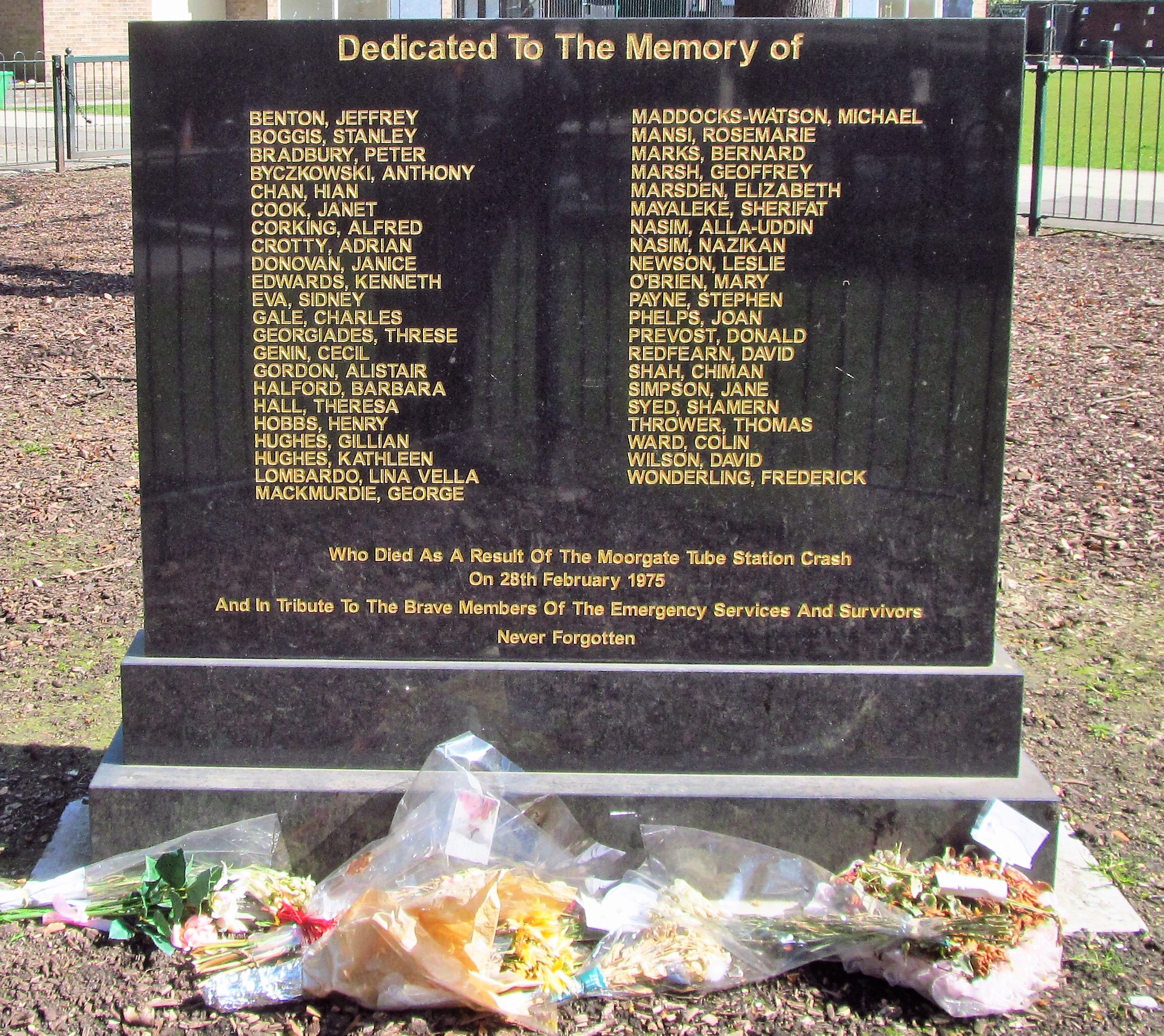
Moorgate Tube Crash
Moorgate station sits at the southern terminus of what was then the Northern City Line, where the tunnel simply ends in a wall. On 28 February 1975, at 8:46 in the morning, train number 272 entered the station at roughly twice the normal speed. It did not slow down. It passed through the platform without stopping, overran the sand drag beyond the buffers, and drove straight into the blank concrete wall at the end of the overrun tunnel. Forty-three people died, including the driver. Seventy-four were injured. No mechanical fault was ever found with the train, no signal was misread, no track defect was discovered. After the most exhaustive investigation in London Underground history, the cause remained a single, unexplained human action.
Into the Dead End
The train had left Drayton Park, the previous station, running normally. Multiple witnesses at Moorgate itself saw the train enter the platform at speed, between 30 and 40 miles per hour. The normal approach speed was around 15 miles per hour. A porter on the platform saw the train pass and noticed the driver sitting upright in his cab, hands on the controls, eyes open, staring straight ahead. He did not appear to be slumped or incapacitated. The train struck the hydraulic buffers at the end of the platform, overran the 66-foot sand drag, and slammed into the end wall. The force of the impact concertinaed the first three carriages into a space barely half their original length. The tunnel filled with thick dust and darkness.
Rescue in the Depths
What followed was one of the most gruelling rescue operations London had ever seen. The crash site was underground, in a tunnel barely wider than the train itself. Temperatures in the wreckage rose above 49 degrees Celsius as rescuers worked with cutting equipment in the confined space, surrounded by shattered metal, dust, and the cries of trapped passengers. The Fire Brigade spent four days extracting the living and the dead from the compressed carriages. The driver, Leslie Newson, was the last body recovered, his remains so tightly embedded in the wreckage that it took nearly a week to free him. Thirteen fire stations responded to the emergency, and many of the firefighters who worked the scene carried psychological scars for the rest of their careers.
The Mystery of Leslie Newson
The Department of the Environment inquiry, led by accident investigator Colonel Ian McNaughton, tested every conceivable mechanical explanation. The train's brakes, motors, and controls were all found to be in working order. Track conditions were normal. There was no obstruction, no signal failure, no power surge. Attention turned inevitably to the driver. Leslie Newson was 56 years old, an experienced motorman with a clean record and no history of medical problems. His post-mortem revealed no evidence of heart attack, stroke, epilepsy, or any other condition that might have caused sudden incapacitation. Blood alcohol was zero. There were no drugs in his system. He had no known personal troubles, no financial difficulties, no reason anyone could find for him to have driven deliberately into a wall. The inquiry concluded that Newson's actions caused the crash but could not determine why.
The Moorgate Legacy
The disaster led directly to the development and installation of what became known as Moorgate protection, a system of train stops that automatically applies the brakes if a train approaches a dead-end terminal too fast. This technology, now standard on the London Underground and adopted on other metro systems worldwide, ensures that no driver's unexplained action, or inaction, can produce another Moorgate. The system operates independently of the driver and the train's own braking controls. It is one of those safety measures born entirely from catastrophe, a mechanical answer to a human question that was never satisfactorily resolved. Almost five decades later, the crash remains the worst peacetime accident in London Underground history, and the question of what happened to Leslie Newson in those final seconds remains open.
From the Air
Located at 51.519N, 0.089W at Moorgate station in the City of London. The station is underground and not directly visible from altitude, but Moorgate street and the surrounding financial district are identifiable. Nearest airports: EGLC (London City, 5nm E), EGLL (Heathrow, 15nm W). Best viewed at 2,000-3,000 ft AGL.