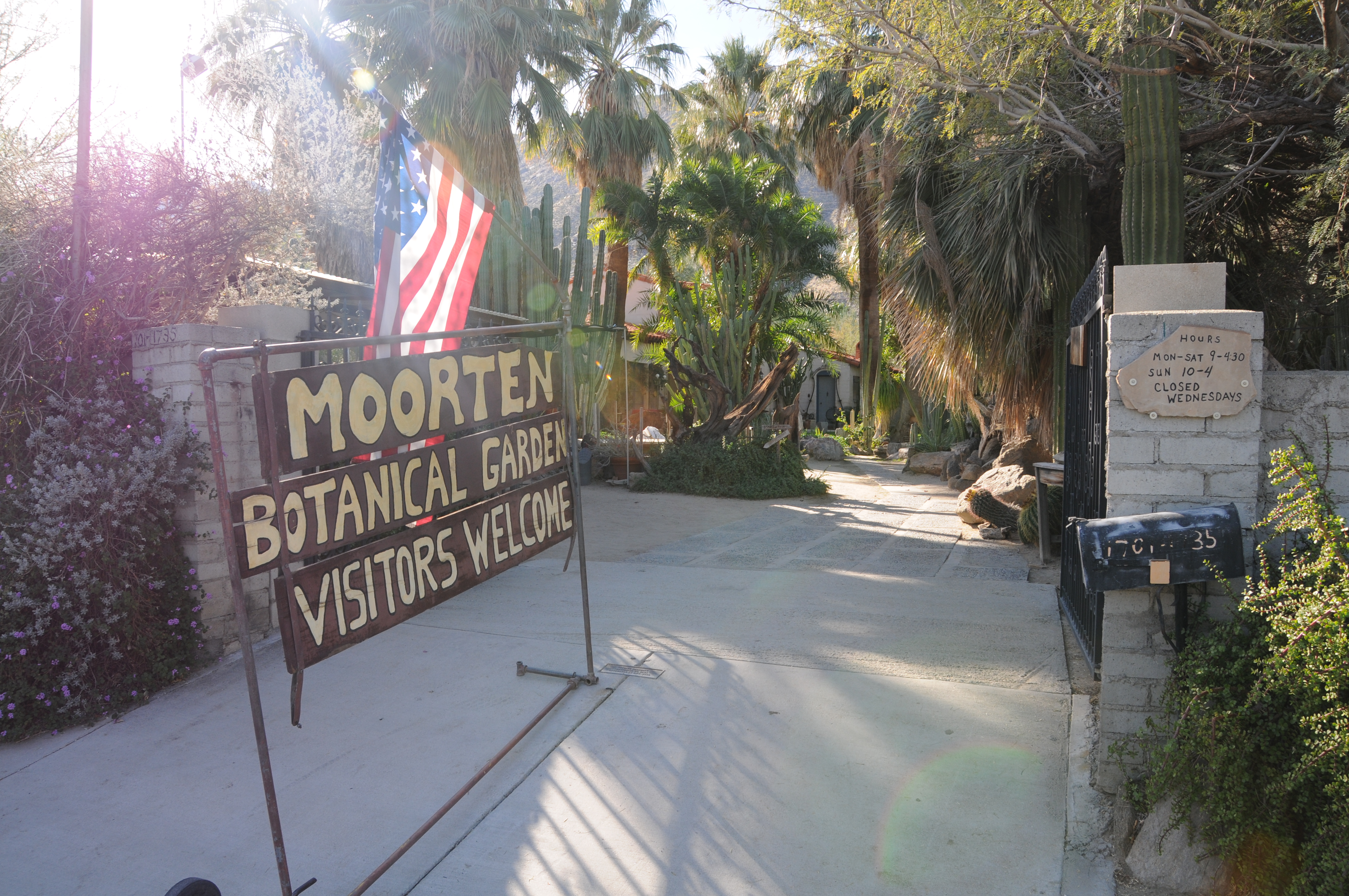
Moorten Botanical Garden and Cactarium
Chester 'Cactus Slim' Moorten had already been a silent film comedian — one of the original Keystone Cops, and a star of the 1927 film *Two Flaming Youths* — before he and his wife Patricia turned their attention to the desert around Palm Springs. In 1939 they established what would become the Moorten Botanical Garden and Cactarium, a one-acre collection of desert plants on South Palm Canyon Drive. The combination of a slapstick comedian's sensibility and a botanist's passion for the strange and resilient produced something that has outlasted most of what Hollywood made in those years.
A Keystone Cop Meets the Cactus
Chester Moorten's career trajectory was unusual even by Hollywood standards. The Keystone Cops were the slapstick ensemble films created by Mack Sennett, and appearing in them required the particular kind of physical commitment — pratfalls, chases, elaborate mechanical chaos — that left little room for botanical contemplation. Yet Moorten found his way to the desert, perhaps drawn by the same quality that draws many people to extreme landscapes: the sense that where things are harder, what grows there is more honest. He and Patricia began collecting desert plants with the methodical enthusiasm of people who have found their true subject, building the garden as a nursery that happened to contain one of the most comprehensive collections of desert flora in California.
Three Thousand Plants, Eight Deserts
The garden contains approximately 3,000 desert plants drawn from more than eight global desert regions — not just the Sonoran and Mojave deserts of the American Southwest, but arid ecosystems from South America, Africa, Madagascar, and beyond. Walking through the Cactarium — the enclosed greenhouse section — the visitor encounters forms that seem improbable even when they are directly in front of you: columns and spheres, paddles and needles, plants that look like they were designed by an engineer working from principles that have nothing to do with familiarity. The collection reflects both the Moortens' decades of acquisition and the extraordinary diversity of strategies that plants have evolved for surviving in places where water is unreliable.
A Family Garden
The Moorten Botanical Garden has remained family-owned and operated since its founding, a continuity unusual in an era when most attractions of this kind have been absorbed by larger organizations or converted to other uses. The garden's intimate scale — one acre is not large — and its personal character reflect an institution that has been shaped by individual taste rather than institutional planning. Patricia and Chester Moorten were recognized with Golden Palm Stars on the Palm Springs Walk of the Stars, an acknowledgment of their contribution to the city's cultural identity. The garden they created is still a working nursery as well as a tourist destination, maintaining the dual character the Moortens established from the beginning.
Slow Time, Spines, and Silence
What the Moorten Botanical Garden offers that few other Palm Springs attractions do is unhurried time with living things. Cacti and succulents grow slowly; the oldest specimens in the collection have been in place for decades. The garden's pace is calibrated to this: visitors are invited to move at the plants' speed rather than the city's. The San Jacinto Mountains rise to the west, visible above the garden walls, providing the same dramatic backdrop they give to all of central Palm Springs. In a city built substantially on speed — the pace of celebrity, of resort hospitality, of real estate transactions — a place where the main activity is looking carefully at something that has been growing for twenty years is, quietly, radical.
From the Air
Located at 33.80°N, 116.55°W on South Palm Canyon Drive in Palm Springs, California. Palm Springs International Airport (ICAO: KPSP) is approximately 2 miles to the northeast.