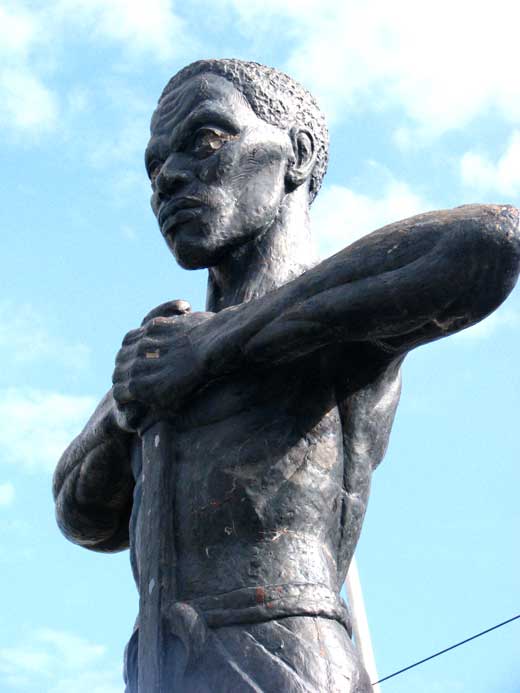
Morant Bay Rebellion
In August 1865, a black Baptist deacon named Paul Bogle led a group of peasants on an 87-kilometer march from the parish of St. Thomas-in-the-East to Spanish Town, Jamaica's capital, hoping to meet with Governor Edward John Eyre. They wanted to discuss poverty, land inequality, and the high poll taxes that prevented most freedmen from voting. The governor refused to see them. Two months later, Bogle would lead hundreds of people back to a courthouse -- this time in Morant Bay -- and the events of that single day would end elected government in Jamaica for nearly a century.
A Colony on the Edge
By the mid-1860s, Jamaica was a society stretched to breaking. Slavery had been abolished in 1838, but freedom had not delivered prosperity. In the election of 1864, fewer than 2,000 black men were eligible to vote out of a total population exceeding 436,000 -- a ratio that left the black majority, which outnumbered whites 32 to 1, effectively voiceless. Floods in 1864 ruined crops. A decade of cholera and smallpox epidemics had ravaged the population. A two-year drought preceding 1865 pushed survivors of slavery and their descendants deeper into poverty, while sugar industry bankruptcies eliminated jobs and widened the economic gulf. Rumors circulated among freedmen that white planters intended to restore slavery. George William Gordon, a mixed-race politician and one of two representatives from St. Thomas-in-the-East, criticized Governor Eyre's draconian punishments -- flogging and the penal treadmill for crimes as minor as stealing food. "If we are to be governed by such a Governor much longer," Gordon warned, "the people will have to fly to arms and become self-governing."
The Courthouse Steps
On October 7, 1865, a black man was tried at the Morant Bay courthouse for trespassing on a long-abandoned sugar plantation. The charge crystallized everything the parish's poor Black residents resented about land inequality. Bogle led a march on the courthouse. The demonstration was peaceful until a spectator named James Geoghegon angrily denounced the proceedings. When police tried to seize him, a fight erupted. Two policemen were beaten; Geoghegon was convicted and imprisoned. Arrest warrants followed for several men, including Bogle, but his followers prevented the police from taking him. Four days later, on October 11, Bogle marched to Morant Bay again -- this time with hundreds of peasant-laborers. The marchers had taken oaths to "cleave to the black and leave the white." What began as protest became insurrection. Violence broke out at the courthouse, and Governor Eyre declared martial law.
The Killing Time
What followed was the most severe suppression of unrest in the history of the British West Indies, exceeding anything that had occurred even during the years of slavery. Troops hunted down the rebels indiscriminately, killing people who had no involvement in the courthouse riot. Soldiers killed 439 black Jamaicans outright. Another 354 were arrested -- including Paul Bogle -- and executed, many without proper trials. Bogle was hanged on October 24, alongside 14 others, including his brother Moses. More than 600 men and women, some of them pregnant, were flogged. Soldiers burned thousands of homes belonging to black Jamaicans, leaving families homeless across the parish. Among those executed with only perfunctory trials -- or none at all -- were seven women: Letitia Geoghegan, Mary Ann Francis, Judy Edwards, Ellen Dawkins, Justina Taylor, Sarah Francis, and Mary Ward. "We slaughtered all before us," one soldier later recalled, "man or woman or child." Historian Gad Heuman has described it as a reign of terror.
Gordon's Trial and the Question of Law
Governor Eyre believed that George William Gordon had orchestrated the rebellion -- a conviction rooted in the widespread white assumption of the time that black Jamaicans could not have organized such events on their own. Eyre had Gordon arrested, brought under martial law jurisdiction, and tried by military court. The trial began on October 21. Two days later, Gordon was hanged. The speed and legality of his execution outraged many in Britain, raising a fundamental constitutional question: should British dependencies be governed by the rule of law or by military license? The controversy split Victorian England's intellectual elite. An Eyre Defence Committee formed in August 1866, backed by Thomas Carlyle, John Ruskin, Alfred Tennyson, Charles Kingsley, and Charles Dickens. On the opposing side, those who saw Eyre's actions as tyrannical pressed for criminal prosecution.
From Rebellion to Crown Colony
Eyre was replaced by Governor John Peter Grant in August 1866, but the rebellion's most lasting consequence was constitutional. Eyre persuaded the Jamaican House of Assembly to renounce its charter, ending two centuries of elected representation in the colony. Jamaica became a Crown Colony under direct rule from London. Paradoxically, this produced measurable improvements for the black majority: education spending jumped from a negligible 0.067 percent to 5.2 percent of the budget, health expenditure rose from 4.1 to 6.3 percent, and infrastructure investment climbed from 2.5 to 10 percent. The Crown administration built roads connecting isolated communities to markets, established a public school system, and expanded health services. In 1969, Jamaica honored the rebellion's legacy by naming Paul Bogle and George William Gordon as National Heroes -- the highest distinction the nation can bestow. The courthouse steps where it all began now mark a place where injustice ignited a transformation that reshaped an entire island's future.
From the Air
Morant Bay sits at 17.88N, 76.41W on Jamaica's southeastern coast in St. Thomas Parish. From altitude, look for the small coastal settlement at the mouth of the Morant River, with the Blue Mountains rising to the northwest. The courthouse where the rebellion began stands near the town center. The nearest major airport is Norman Manley International (MKJP) in Kingston, roughly 30 miles to the west along the coastal road. Best viewed at 3,000-5,000 feet to appreciate Morant Bay's position between the mountains and the sea, and the isolation of St. Thomas Parish that contributed to the tensions of 1865.