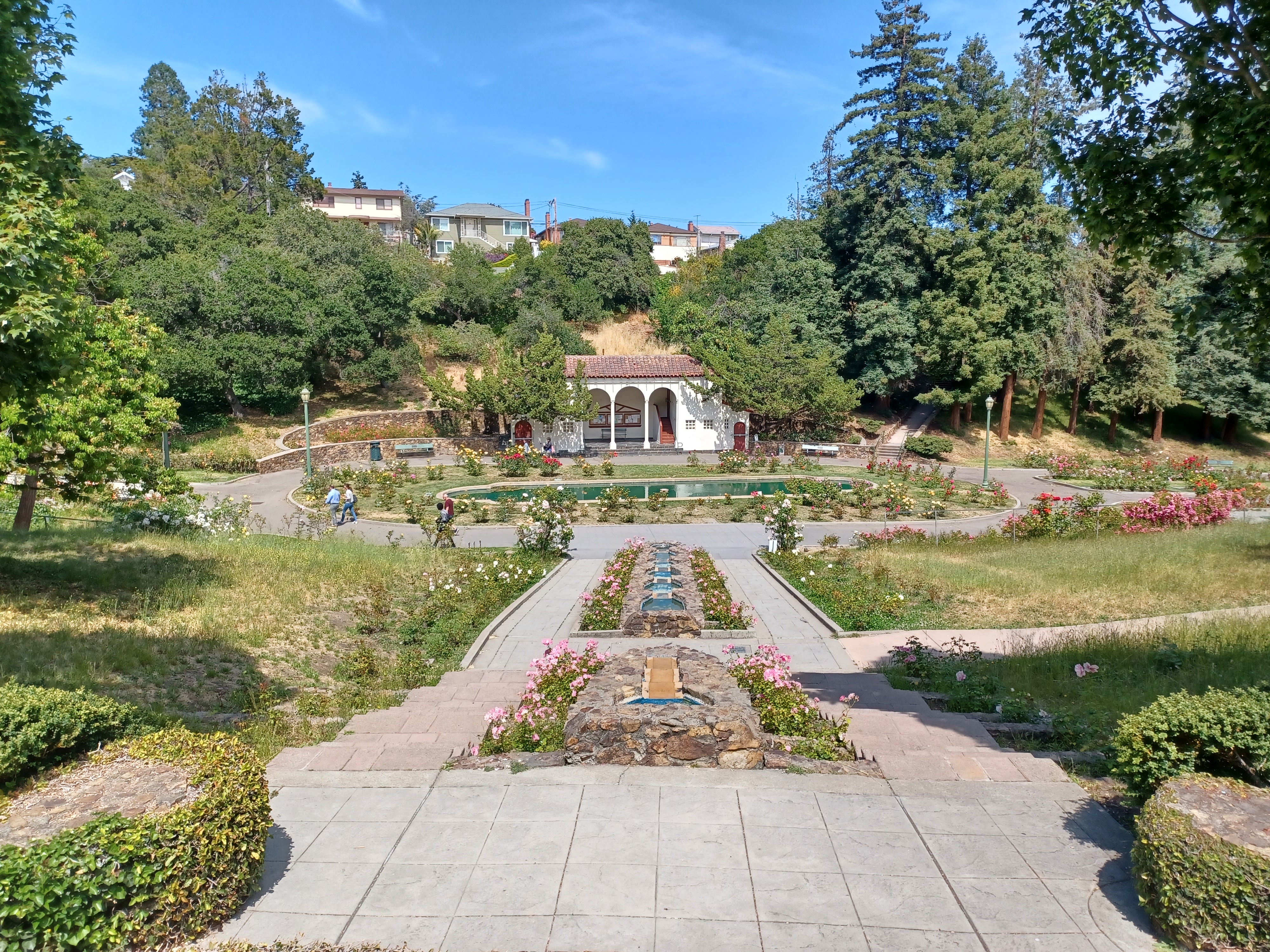
Morcom Rose Garden
A dentist designed it. Relief workers built it. And for nearly a century, the city has mostly forgotten who deserves the credit. The Morcom Rose Garden sits in a natural bowl in the Oakland foothills, a Florentine fantasy of terraced rose beds, stone colonnades, and a 14-step cascade that would look at home in Tuscany. But the plaque at the entrance gets the history wrong, and the historical marker nearby gets the date wrong, and almost everyone who visits assumes the Works Progress Administration built the place. None of that is true.
A Dentist's Italian Dream
The story begins with Dr. Charles Vernon Covell, a dentist and member of the Oakland Businessmen's Garden Club who looked at a modest public park called Linda Vista and saw something grander. The city had purchased the hillside site in 1915, but Covell envisioned a formal rose garden inspired by the gardens of Italy. He enlisted fellow club member Arthur Cobbledick to draw up the plans, and by 1930 the conversion was underway. Cobbledick's design made the most of the terrain, a sloping bowl that lent itself to terracing. He divided the garden into three distinct sections: a classical curved colonnade at the south entrance backed by stone walls, a central reflecting pool with rose beds and an elegant cascade spilling down the western hillside, and a large Florentine oval at the north end with flower beds rising on every side, held in place by rock walls. An octagonal stone wedding terrace crowns the cascade, and a Mediterranean-style loggia faces the reflecting pool from the east. The ambition was remarkable for a volunteer project in a city that could barely afford improvements.
The Agency History Forgot
Construction began around 1931, and by 1934 only the Florentine oval was finished. Then the New Deal arrived, though not in the form most people assume. The Oakland Tribune reported in June 1934 that the State Employment Relief Administration had offered $29,460 in labor if the city matched it with $14,600 in materials. SERA, funded by the Federal Emergency Relief Administration, put unemployed workers to the task of completing Cobbledick's vision. The WPA, which launched in mid-1935, had nothing to do with it. Yet the Oakland Heritage Alliance credits the WPA. An historical marker near the entrance places the date in 1932, before the New Deal even existed. The garden's own brass plaque makes no mention of federal aid at all. The Tribune itself contradicted its own reporting, declaring the gardens complete in January 1935 while publishing stories that April about SERA laborers still working on the cascade. The truth is quieter than any plaque suggests: anonymous relief workers, grateful for a paycheck during the Depression, laid the stone and planted the roses.
Roses, Mayors, and Mothers
When the garden opened, Oakland's mayor Fred N. Morcom planted the first rose. Twenty years later, in 1954, the city honored him by renaming it the Morcom Amphitheater of Roses. That same year, a new tradition began: each Mother's Day, a ceremony honored women whose names were inscribed on plaques along a garden path. The Mother's Walk, created during a renovation in the early 2000s, runs from the reflecting pool to the Florentine oval, with brass plaques set into the ground marking decades of honorees. For earlier years, wooden placeholders stand in for brass. Some of the garden's roses are themselves living history. During refurbishments in the 1950s and 1990s, horticulturists discovered varieties dating back to the nineteenth century. Rather than replace them, they regrafted the old cultivars onto new rootstock, preserving genetic lines that predate the garden itself.
The Dedicated Deadheaders
A garden of more than 2,400 rose bushes was originally meant to have eight full-time caretakers. By the early 2000s, the city could afford one worker, one day a week. The irrigation lines went unrepaired. Weeds crept between the stone terraces. The roses, left unpruned, grew leggy and sparse. Then a lead city gardener did something simple: she asked for help. The volunteers who answered called themselves the Dedicated Deadheaders, a name that doubles as a horticultural term and a statement of purpose. Deadheading, the removal of spent blooms to encourage new growth, is tedious, repetitive work that makes all the difference between a garden that thrives and one that merely survives. The group weeds, prunes, maintains irrigation, and documents the garden through photographs shared online. What eight city employees once did, a rotating crew of volunteers now manages with clippers and determination. The roses, by all accounts, have never looked better.
From the Air
Located at 37.82N, 122.25W in the Oakland foothills near the Piedmont border. The garden occupies a natural bowl visible as a green depression in the residential grid. Best viewed at 2,000-3,000 feet AGL. Nearest airports: KOAK (Oakland International, 7nm south), KHWD (Hayward Executive, 10nm southeast). The garden is directly east of the Piedmont Avenue commercial strip and roughly 1nm southeast of Mountain View Cemetery.