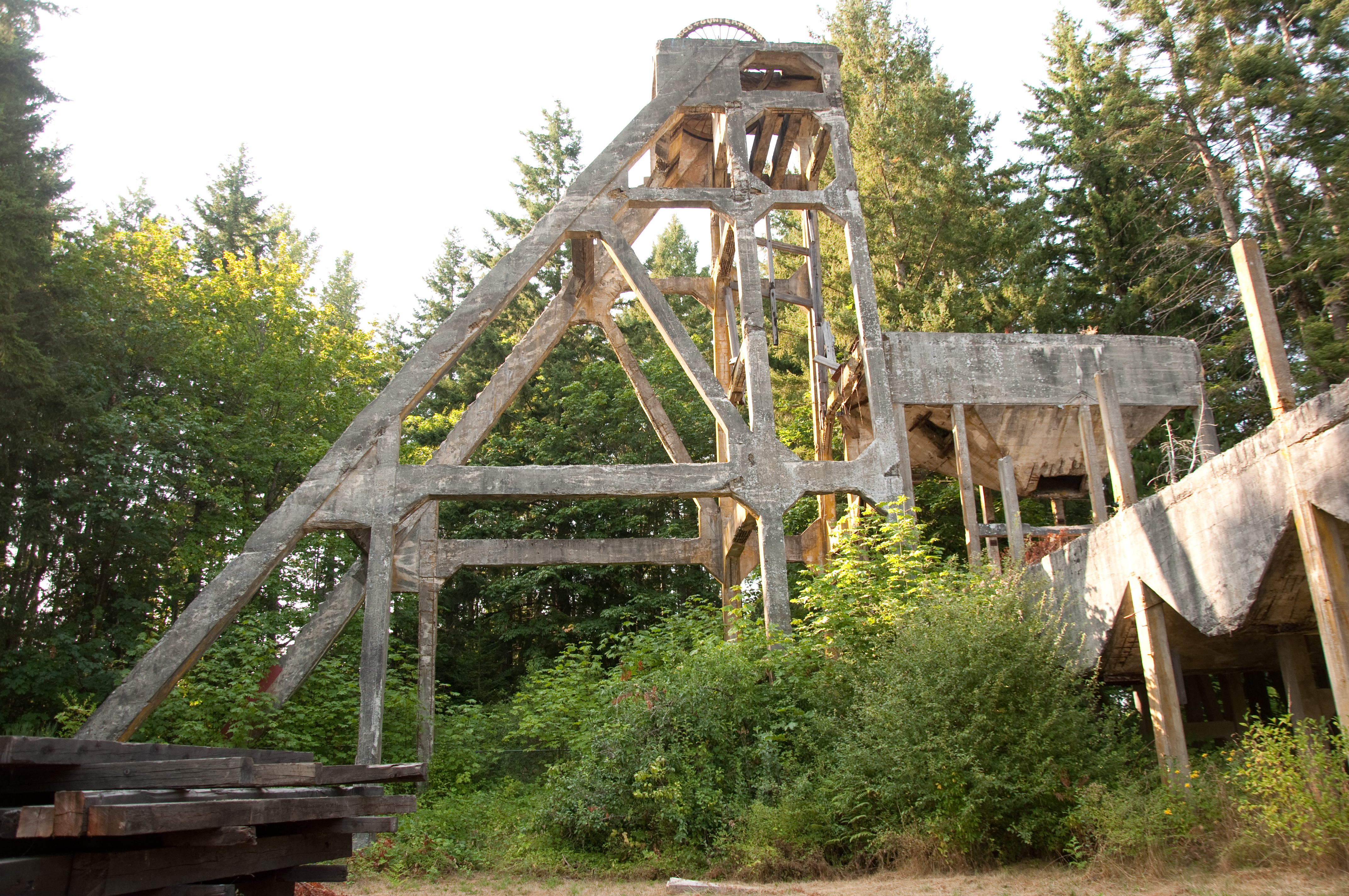
Morden Colliery: The Last Headframe Standing
Seven storeys of weathered timber and steel rise above the forest south of Nanaimo, the last visible skeleton of an industry that once defined Vancouver Island. The Morden Colliery headframe and tipple is one of only two such structures surviving in North America - the other stands in Muddy, Illinois. That this one survives at all is a story of community stubbornness: a volunteer group called the Friends of Morden Mine spent over a decade fighting to save a structure that was rotting behind a chain-link fence, nearly gave up in 2015, and then secured a $1.4-million provincial grant that made restoration possible.
Coal and Catastrophe
The Pacific Coast Coal Mining Company opened a standard-gauge railway from Fiddick's Junction on the Esquimalt and Nanaimo Railway to Boat Harbour in 1909, extending it the next year to the Fiddick Colliery. The coal moved by rail to the coast and into the holds of waiting ships. In early 1915, disaster struck: 19 men drowned in the Fiddick mine. By late 1916, all production had ceased at Fiddick and operations transferred 2.6 kilometers southeast to the Morden Colliery. Morden's miners dug the same dangerous seams, extracting coal from beneath the island until the mine too eventually closed. Three men died at Morden during its operational years - part of the estimated 1,000 miners who lost their lives in Vancouver Island coal mines over the decades.
After the Coal Ran Out
When the mine closed, the settlement around it did not disappear. Logging sustained the community through the 1940s and 1950s, and gradually the area transformed into a bedroom community for Nanaimo, located just 10 kilometers to the north. The mine infrastructure decayed. The railway right-of-way grew over. But the headframe - the towering wooden structure that once hoisted ore cars from the depths and tipped their contents into railway cars below - remained standing, too massive to easily demolish, too neglected to maintain. In 1972, the site was recognized as a National Historic Site and designated a provincial park, but for decades the day-use park remained largely undeveloped, the headframe deteriorating behind fencing.
Shipping Containers and Second Chances
In 2003, the Friends of Morden Mine organized to save the structure. For twelve years they advocated, fundraised, and watched the headframe continue to rot. By 2015, the society was on the verge of giving up. Then in 2019, a $1.4-million grant from the British Columbia government changed everything. The restoration team used an ingenious approach borrowed from post-earthquake recovery in Christchurch, New Zealand: they temporarily stabilized the seven-storey structure with 16 shipping containers, stacking them against the frame while repairs were carried out above. The technique was unconventional but effective, keeping the headframe upright long enough for proper restoration work to proceed.
Walking the Old Railway
Since 1995, the Regional District of Nanaimo has been developing a trail eastward through the park along the former Pacific Coast Coal Mining Company railway right-of-way to the Nanaimo River. Interpretive plaques along the route tell the story of the mines, the railway, and the people who worked them. In 2017, a cairn was erected to memorialize the three men who died at Morden and the estimated 1,000 miners killed across Vancouver Island's coal mines. The trail is an easy walk through second-growth forest, quiet now except for birdsong and the occasional creak of the restored headframe overhead - a reminder that beneath this peaceful landscape, men once worked in darkness.
From the Air
Morden Colliery Historic Provincial Park is at 49.10°N, 123.87°W on the east coast of southern Vancouver Island, about 10 km south of Nanaimo along BC Highway 19. From altitude, the park is a small forested area near the coast; the seven-storey headframe may be visible as a vertical structure among the trees. The Nanaimo River flows nearby to the east. Nanaimo Airport (CYCD) is approximately 5 km to the southeast. The park is roughly 102 km northwest of Victoria by road.