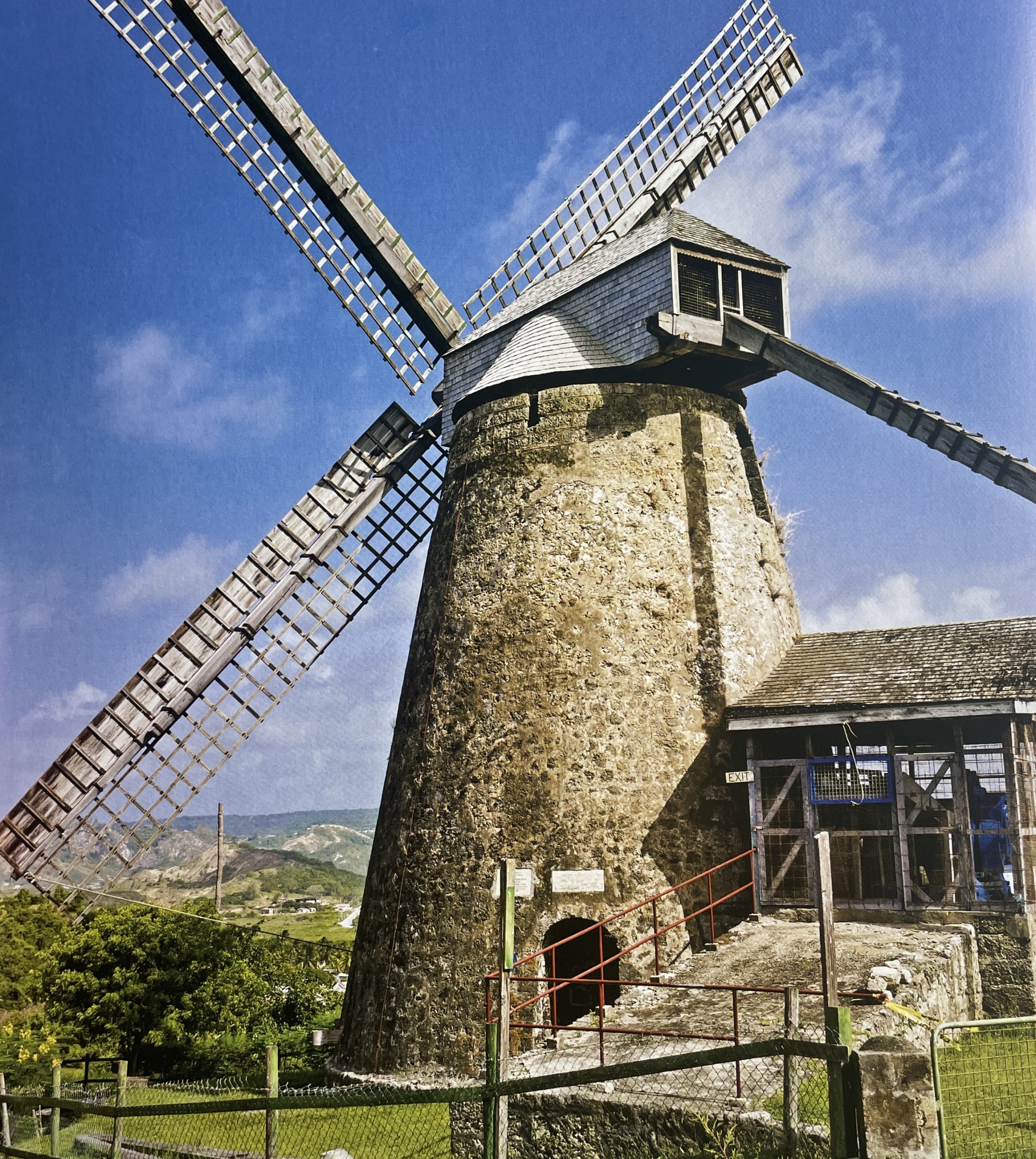
Morgan Lewis Sugar Mill
On certain Sundays between February and July, the sails of a stone windmill in the Barbadian hills begin to turn, and fresh cane juice flows from machinery that last operated commercially in 1947. Morgan Lewis Sugar Mill is the largest and only surviving complete sugar windmill in the Caribbean. It grinds cane today as a demonstration, but for centuries the mill and others like it across Barbados ran on the forced labor of enslaved Africans, whose hands fed the cane and whose lives sustained an industry that made this small island one of the wealthiest colonies in the British Empire.
The Machine That Built Barbados
Sugar transformed Barbados. By the mid-seventeenth century, the island had become the engine of England's Caribbean wealth, and windmills like Morgan Lewis were the literal machinery of that transformation. These mills crushed harvested cane between heavy rollers to extract juice, which was then boiled, crystallized, and shipped to European markets. The wind that powered the sails was free; the labor was not. Enslaved people did every part of the work, from planting and cutting the cane under Caribbean sun to feeding it into the mill's rollers, a process so dangerous that arms were regularly crushed and amputated. Morgan Lewis stands in St. Andrew, on the windward side of the island where the trade winds blow most reliably. Its hilltop position was chosen not for the view but for consistent wind.
Silence After 1947
The mill stopped operating in 1947, as centralized sugar factories replaced the scattered plantation mills across Barbados. Cane that was once ground on site began to be trucked to large processing facilities like the Portvale Sugar Factory, eight miles away. For fifteen years, Morgan Lewis sat idle. Then in 1962, its owner Egbert L. Bannister donated the mill to the Barbados National Trust, recognizing that what he possessed was not merely an old building but the last complete example of a technology that had once defined the Caribbean landscape. Without Bannister's act, the mill would likely have crumbled like every other sugar windmill in the region.
Rescued from the Watch List
By the 1990s, even preserved landmarks can deteriorate. In 1996, the World Monuments Fund placed Morgan Lewis on its World Monuments Watch, a list that identifies cultural heritage sites at risk. The Barbados National Trust began restoration the following summer. American Express provided financial support for emergency repairs in 1997. The mill was carefully dismantled, its original working parts catalogued and preserved, then reassembled and reopened in 1999. When the sails turned again for the first time in over half a century and cane juice flowed from the rollers, it was proof that the engineering had been sound all along. The wind still blows reliably across the St. Andrew hills, and the machinery still works as it was designed to.
On the Two-Dollar Bill
Since 2013, Morgan Lewis Sugar Mill has appeared on the reverse of the Barbadian two-dollar bill, a recognition that places this windmill alongside the island's most significant symbols. Inside the mill wall, a museum displays plantation artifacts and old photographs that document the sugar era. Visitors can climb to the top for views across the Scotland District, the rugged eastern landscape that looks nothing like the calm west coast beaches most tourists see. The mill stands as a reminder of what sugar cost and who paid for it. Barbados built its economy on the backs of enslaved people, and Morgan Lewis is where that history is most tangible. The sails turn, the cane is crushed, and the juice runs clear, exactly as it did when the people who did this work had no choice in the matter.
From the Air
Morgan Lewis Sugar Mill sits at 13.268N, 59.575W in the parish of St. Andrew, on the windward eastern side of Barbados. From the air, the stone tower is visible on a hilltop in the Scotland District, the island's most rugged terrain. Look for the distinctive windmill structure amid green hills. Grantley Adams International Airport (TBPB) is approximately 20 km to the south. The eastern coast's trade winds are constant, which is precisely why the mill was built here. Approach from the east for the most dramatic perspective over the Atlantic-facing cliffs.