Morgan Library & Museum
J. P. Morgan told his architect he wanted "a gem." Charles McKim of McKim, Mead and White gave him exactly that: a classical marble temple at 225 Madison Avenue in Murray Hill, completed in 1906, its blocks fitted without mortar in the dry masonry technique of ancient Rome. The extra cost was $50,000. Morgan did not blink. Inside, he stored what may have been the most extraordinary private collection in American history -- illuminated manuscripts from the sixth century, three Gutenberg Bibles, original scores by Beethoven, and letters from Napoleon. A century later, the Morgan Library and Museum holds more than 350,000 objects and remains one of the most beautiful rooms in New York City.
The Collector and His Obsession
Morgan had been collecting since the 1850s, beginning with handwriting samples and gradually expanding into fine art, rare books, and manuscripts as his wealth made him one of the most powerful financiers in the United States. His father Junius had inspired the instinct; his nephew Junius suggested he focus on rare bindings. By 1900, the collection had outgrown the basement of his Madison Avenue residence, with objects piled so high that his son-in-law described the space as stuffed. Between 1899 and 1902 alone, Morgan absorbed three entire collectors' libraries, acquiring hundreds of illuminated manuscripts, prints, and historical documents. The Wall Street Journal reported in 1911 that "Mr. Morgan buys books as some financiers buy a thousand shares of stock." In some years, he spent half his income on acquisitions.
McKim's Jewel Case
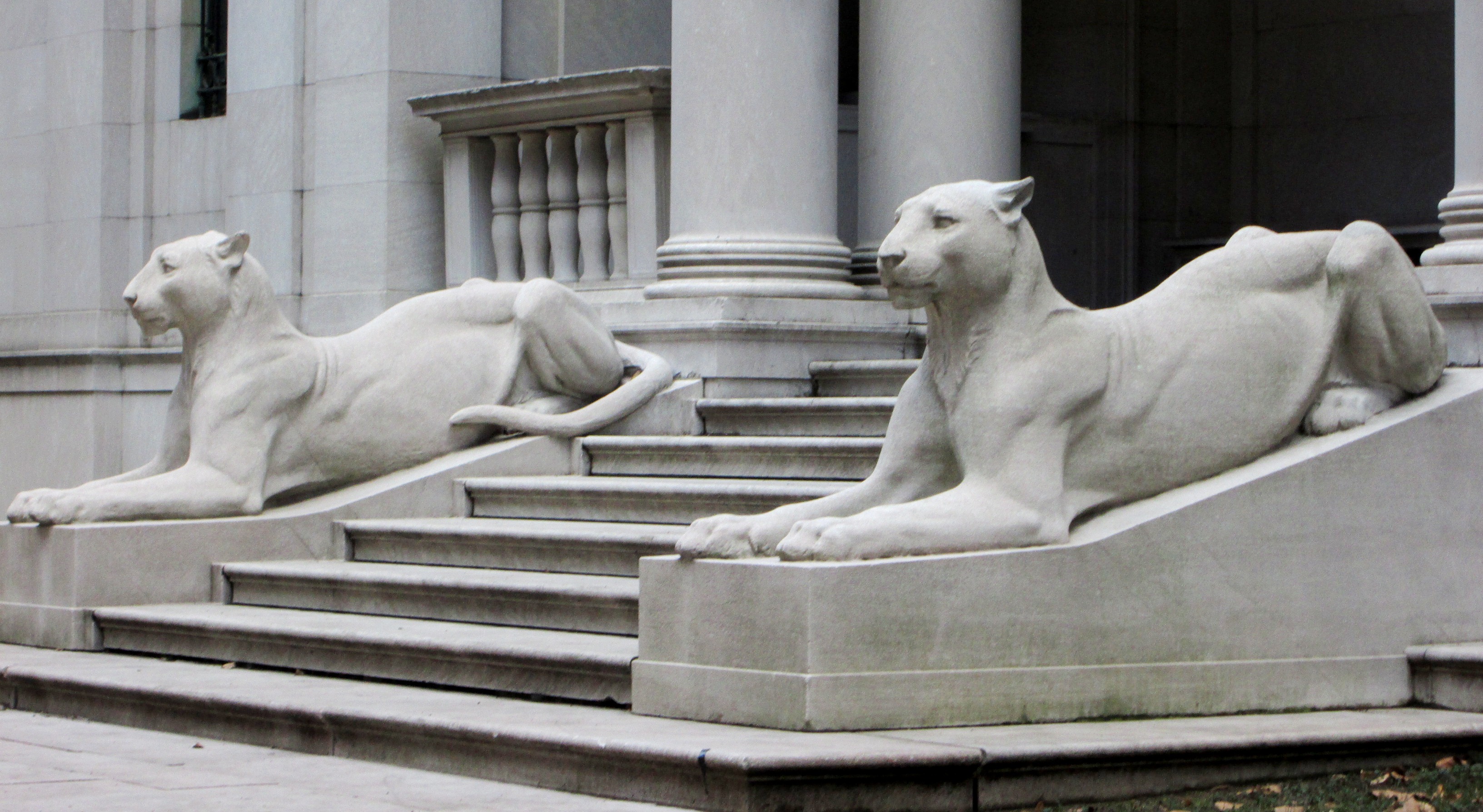
To house this growing hoard, Morgan purchased land adjacent to his residence and commissioned McKim to design a library. Construction began in April 1903. The exterior walls are dry masonry marble -- blocks set so precisely that no mortar was needed, with tinfoil sheeting placed between them to prevent moisture buildup. The entrance is flanked by two stone lionesses sculpted by Edward Clark Potter, who would later create the famous lions guarding the New York Public Library. Inside, the East Room features floor-to-ceiling bookshelves in three tiers, lunettes painted by Harry Siddons Mowbray in the style of Pinturicchio, and a fifteenth-century fireplace. Morgan's West Study, with its red damask walls and secret compartments behind movable bookcases, served as his working office. During the Panic of 1907, the presidents of New York's banks were locked in this room overnight until they agreed on a plan to halt the financial crisis.
Belle da Costa Greene's Domain
Around the time the library neared completion in late 1905, Morgan hired Belle da Costa Greene as his personal librarian. She was 26 years old. For the next four decades, Greene managed, expanded, and fiercely guarded the collection, becoming one of the most respected figures in the rare books world. She searched for volumes in back alleys and auction houses, though she initially avoided spending more than $10,000 without permission. Morgan sometimes acquired art on impulse -- in one case, buying a Vermeer minutes after learning about the artist. Greene stayed on after Morgan's death in 1913 and after his son Jack converted the library into a public institution in 1924, continuing to build the collection until her retirement in 1948.
Treasures Behind Glass
The scope of the collection is staggering. Three Gutenberg Bibles sit alongside one of six original copies of the first Italian Bible and one of three known copies of the Constance Missal. The manuscript collection spans authors from the ancient world to Bob Dylan, whose handwritten lyrics for "Blowin' in the Wind" and "It Ain't Me Babe" are preserved on scraps of paper. Beethoven's Violin Sonata in G major was the only significant music manuscript Morgan bought in his lifetime, but subsequent acquisitions expanded the musical holdings to include Schubert, Chopin, and Gilbert and Sullivan manuscripts. In 2024, the museum announced the discovery of a previously unknown waltz by Chopin dating from the 1830s, identified after a curator found the manuscript while cataloguing a bequest. The drawing collection holds 12,000 works spanning six centuries, including watercolors by William Blake, etchings by Rembrandt, and concept drawings for Saint-Exupery's The Little Prince.
A Library That Keeps Growing
The Morgan has never stopped expanding. Benjamin Wistar Morris designed an annex in the 1920s. A glass conservatory by Voorsanger and Mills connected the buildings in 1991. Most dramatically, Renzo Piano redesigned the complex in a $106 million expansion completed in 2006, building much of the new space underground and adding a glass entrance pavilion. The library was renamed the Morgan Library and Museum upon reopening. It celebrated its centennial as a public institution in 2024, launching a $50 million fundraising campaign. Through all these transformations, Morgan's original rooms remain essentially as he left them -- the red damask, the secret compartments, the dry masonry walls that have stood without mortar for more than a century, still holding the weight of everything he gathered.
From the Air
Located at 40.7488N, 73.9816W on Madison Avenue between 36th and 37th Streets in Manhattan's Murray Hill neighborhood. From the air, the Morgan complex occupies much of the block east of Madison Avenue. Nearby landmarks include the Empire State Building (6 blocks north) and Grand Central Terminal (6 blocks northeast). Nearest airports: KJFK (14 nm SE), KLGA (7 nm NE), KEWR (10 nm W). Best viewed at 1,500-2,000 ft AGL.