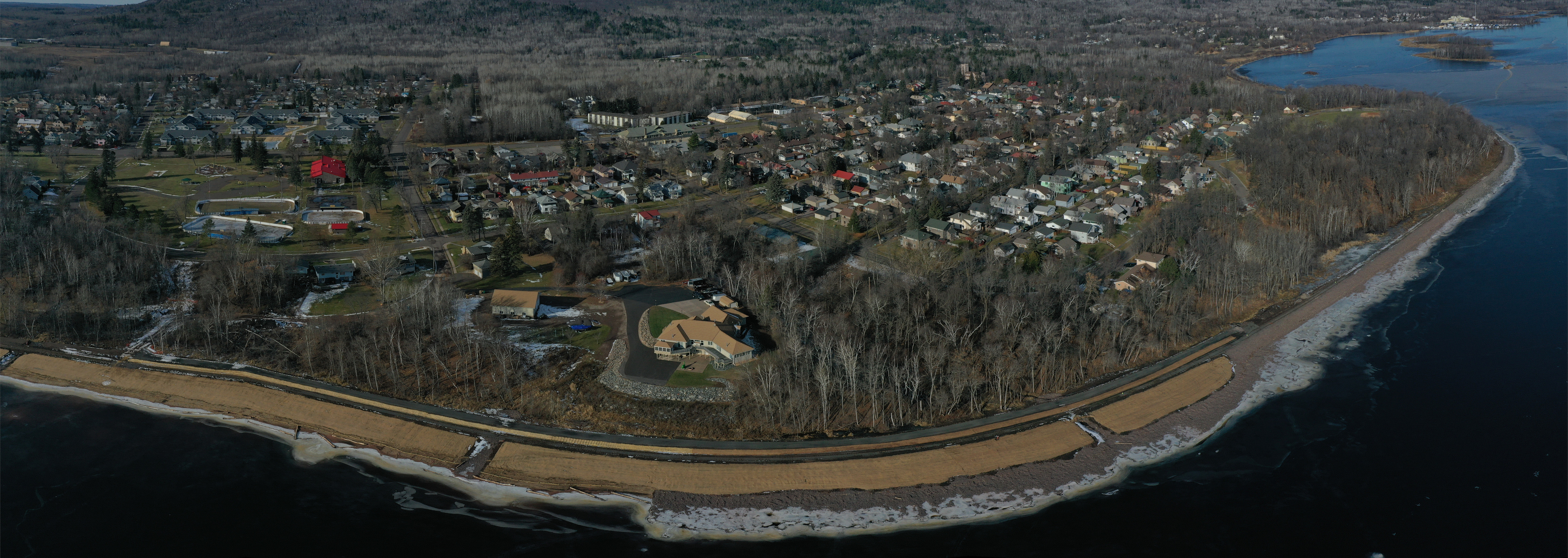
Morgan Park, Duluth, Minnesota
Look for the missing fourth barb. That was the marketing slogan for nails made at the Duluth Works, the U.S. Steel plant that gave Morgan Park its reason for existing. The nail department deliberately left out the fourth barb -- the one used to hold the wire before striking the head -- creating a visible omission that told consumers this nail was made in Duluth. It was a small act of pride from a workforce that, at its peak, operated the largest integrated steel works west of Chicago. The nails went everywhere. The town that made them sat isolated on the Saint Louis River in western Duluth, a planned community so completely controlled by its corporate parent that if you failed to mow your lawn, the company would do it for you and dock your paycheck.
Model City, Corporate Kingdom
Morgan Park began as "Model City" in 1913, a company town designed and built by U.S. Steel to house workers at its new Duluth Works plant. In June 1914, the developers renamed it in honor of J.P. Morgan, the financier whose consolidation of Andrew Carnegie's steel empire had created U.S. Steel itself. Until the 1930s, only employees of U.S. Steel and its subsidiaries were permitted to live there. The Morgan Park Company, a subsidiary of the Minnesota Steel Company, functioned as a private government -- managing trash pickup, lawn care, police and fire protection, healthcare through its hospital, and snow removal. The community boasted recreational facilities, community clubs, a K-12 school, and the Lake View Store, billed as America's first indoor mall. Connected to Duluth by east and west road links, Morgan Park remained a self-contained world within a larger city until 1933, when U.S. Steel deeded all properties to the City of Duluth.
Steel Born from a Tax Fight
The Duluth Works existed because of a political bargain. In the early 1900s, the Minnesota Legislature considered imposing a heavy ore tax on every ton of iron shipped from the Mesabi Range. U.S. Steel, which would have been hit hardest, agreed to build a manufacturing complex in Duluth and produce finished materials within the state that supplied its ore. The Minnesota Steel Company, incorporated by U.S. Steel in 1907, began construction in 1910 and poured its first ingot of steel on December 11, 1915. Speculators predicted Duluth would become a manufacturing center rivaling Pittsburgh or Chicago, but those ambitions never materialized. The plant remained the largest employer in Duluth throughout its existence and the fourth-largest industrial facility in Minnesota, but its market area was sparsely populated. Eighty percent of its semi-finished steel was shipped to mills in Joliet, Chicago, and Gary for final processing.
Wire, Barbs, and Missile Silos
Duluth Works was primarily a wire product manufacturer, converting iron ore and coke into steel for blooms, bars, billets, and rods. Its merchant and wire mills produced nails, wire, barbed wire, fencing, fence posts, highway mesh, and sign posts. From the late 1930s until closing, the plant was the sole producer of fence posts, steel wool, and barbed wire within the entire U.S. Steel empire. The wire mesh product developed in 1954, along with output from U.S. Steel's Universal Atlas Cement plant on the same grounds, proved instrumental in constructing the ICBM missile silos of the Midwest for the Strategic Air Command. Wire and cement from this isolated Minnesota town helped build the infrastructure of Cold War nuclear deterrence.
The Long Shuttering
The end came in stages. In June 1970, the Minnesota Pollution Control Agency gave U.S. Steel three years to study its harmful emissions and two years to implement corrective actions. Instead, in November 1971, U.S. Steel closed the "hot side" -- all blast furnaces, pig iron casters, and open hearths went silent, and 1,600 steelworkers lost their jobs. The cold side continued using imported steel until October 1973. The cement plant closed in 1976. The coke plant, the last survivor, shut down in 1979 when the MPCA clamped down on its emissions, ending U.S. Steel's association with Duluth after nearly seventy years. By then, only 200 employees remained as residents of Morgan Park. The Duluth Works joined a long roll call of shuttered steel towns -- Youngstown, Homestead, Duquesne, McKeesport -- casualties of foreign steel dumping and the industry's failure to modernize from open hearth to basic oxygen furnace technology.
Brownfield and Beyond
In 1983, the EPA placed the former plant site on the Superfund list. Buildings were inspected and hazardous materials removed. In 1988, U.S. Steel contracted for demolition of the massive complex; the last structure came down in 1997. Today the land sits largely vacant, a brownfield awaiting redevelopment. The cement plant site has been deemed clean, though areas of the former steel plant remain contaminated, and the MPCA, EPA, and U.S. Steel continue monitoring. Morgan Park itself endures as a residential neighborhood, its historic character still visible in the planned street grid and worker housing that U.S. Steel laid out over a century ago. The missing fourth barb on its nails was a mark of identity, a small defiance stamped into metal. The neighborhood carries a similar mark -- shaped by forces larger than itself, bearing the scars, still standing.
From the Air
Located at 46.688°N, 92.210°W along the Saint Louis River in western Duluth, Minnesota. The former Duluth Works steel plant site is visible as a large cleared brownfield area along the river, adjacent to the Morgan Park residential neighborhood. Duluth Sky Harbor Airport (KDYT) is east along the waterfront; Duluth International Airport (KDLH) is northwest. The neighborhood sits between Smithville to the west and Gary-New Duluth to the south. The adjacent Spirit Lake Marina (former McDougall Duluth Shipbuilding site) provides another visual reference. Best viewed from 3,000-5,000 feet approaching from the south over the St. Louis River Estuary.