Morne Trois Pitons National Park
The name means "mountain of three peaks," but the number undersells what is happening here. Morne Trois Pitons is not a single mountain so much as an entire volcanic landscape caught in the act of creation. Mud boils. Streams run yellow with sulfur. A lake 200 feet across churns at temperatures that would kill you in seconds. When UNESCO designated this park a World Heritage Site in 1997, the citation praised its "volcanically active" terrain, which is a polite way of saying the earth beneath your feet has not finished deciding what it wants to be.
Where the Island Breathes
Established in July 1975 as Dominica's first legally protected national park, Morne Trois Pitons covers roughly 7,000 hectares of the island's mountainous interior. The landscape is defined by volcanic cones, glacis slopes, and soufriere deposits, the sulfurous vents that give several Caribbean features their names. Steep-sided hills plunge into deep canyons, and every major waterway in the southern half of Dominica originates here. The park's centerpiece features read like a geologist's wish list: the Boiling Lake, a water-filled fumarole reaching 180 degrees Fahrenheit at its edges; the Valley of Desolation, where mud ponds bubble and small geysers hiss; Titou Gorge, a narrow slot canyon fed by warm springs; and the Emerald Pool, where a waterfall drops into a basin so green it looks artificially lit.
Scarred but Standing
Dominica sits in the hurricane corridor, and the park bears the evidence. Hurricane David in 1979 and Hurricane Allen in 1980 struck back-to-back, snapping old-growth trees and reshaping the canopy. The forest recovered, as tropical forests do, filling gaps with pioneer species before the slower-growing hardwoods reclaimed their space. No human settlements exist within the park boundaries, though not for lack of trying on the island's part. A proposal to build a cable car over the canopy was defeated, a rare instance of restraint in a region where tourism revenue is existential. A small quarry and limited farming persist at the park's southern edge, and the government's electric utility holds rights for hydropower and geothermal extraction. The tension between preservation and economic need is real, but so far the wilderness has held its ground.
Feathers in the Fog
The park's steep terrain and dense canopy make its wildlife easier to hear than to see. Four species of hummingbird patrol the understory. The rufous-throated solitaire fills the forest with a song that sounds like someone tuning a flute. Two parrots found nowhere else on Earth nest in these mountains: the imperial amazon, Dominica's national bird, with its deep purple plumage, and the smaller red-necked amazon. BirdLife International has designated the park an Important Bird Area for its populations of restricted-range species. On the ground, the Dominican anole, Anolis oculatus, skitters across rocks and branches, while tree frogs add their chorus after rain. Agoutis forage on the forest floor, and bats navigate the twilight beneath the canopy.
The Second-Tallest Peak on a Small Island
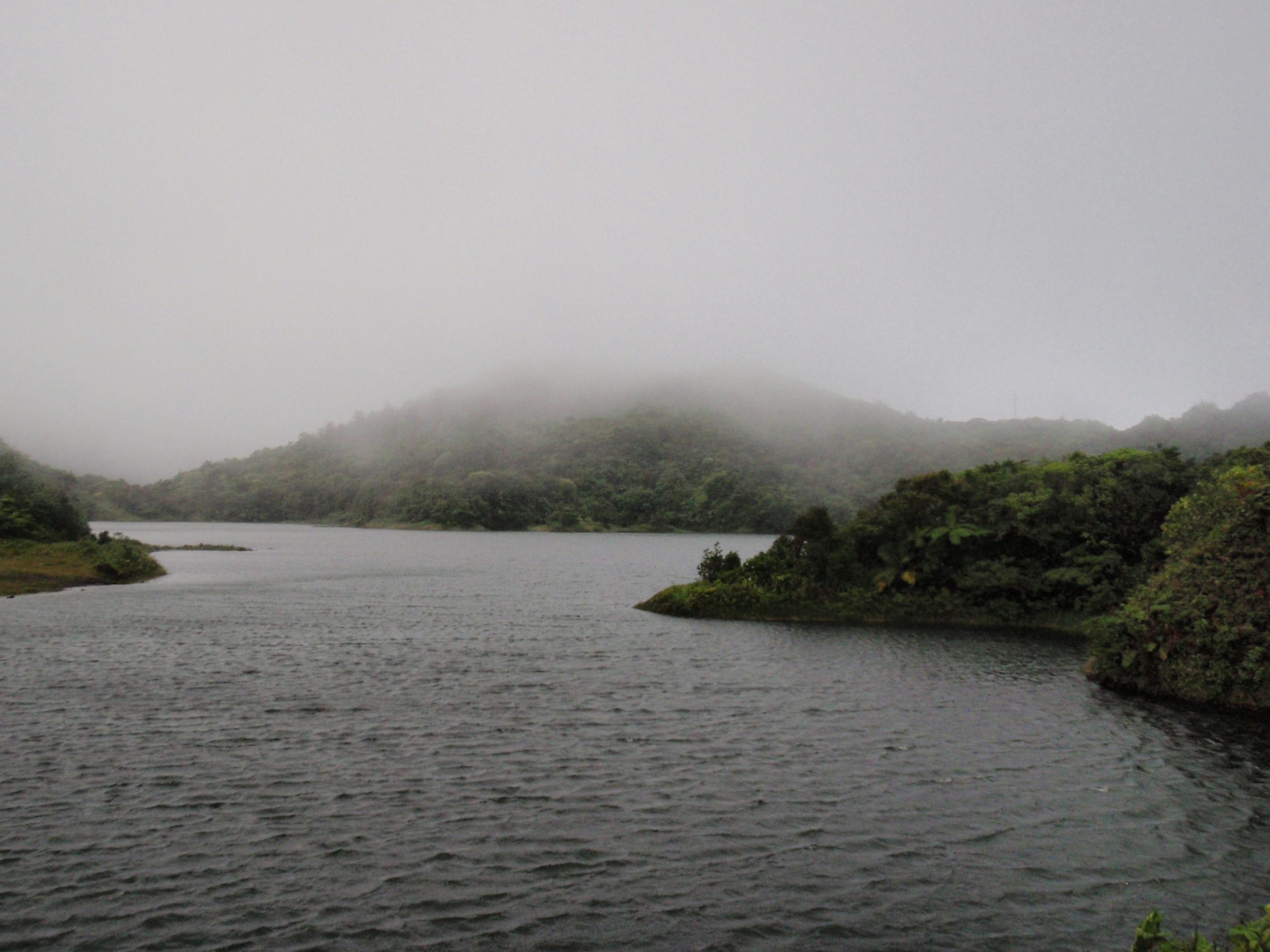
Morne Trois Pitons itself rises to 1,342 meters, making it Dominica's second-highest summit after Morne Diablotins at 1,447 meters. The difference of roughly 100 meters matters less than the character of the terrain. Where Diablotins is a long, ridged ascent through cloud forest, Trois Pitons is steeper and more volcanic, with fumaroles steaming along the approach and the Valley of Desolation spread below like a warning. The trails that wind through the park are among the most dramatic in the Caribbean, connecting waterfalls, hot springs, and viewpoints that reveal just how much geological energy is compressed into this small island. Middleham Falls, accessible via a muddy but manageable trail, drops through the forest canopy. Freshwater Lake, Dominica's largest, sits in a volcanic basin at elevation, its surface mirror-still on calm days.
From the Air
Centered at 15.27N, 61.28W in Dominica's mountainous interior. The park occupies the southern volcanic massif of the island. Douglas-Charles Airport (TDPD) is on the northeast coast, about 20 nm away. Canefield Airport (TDCF), closer but smaller, sits on the west coast near Roseau. From 5,000 feet, the three peaks of Morne Trois Pitons are identifiable by their clustered volcanic profile. The Boiling Lake may be visible as a steam plume rising from the eastern slopes. The Valley of Desolation appears as a pale, barren patch amid otherwise dense green forest.