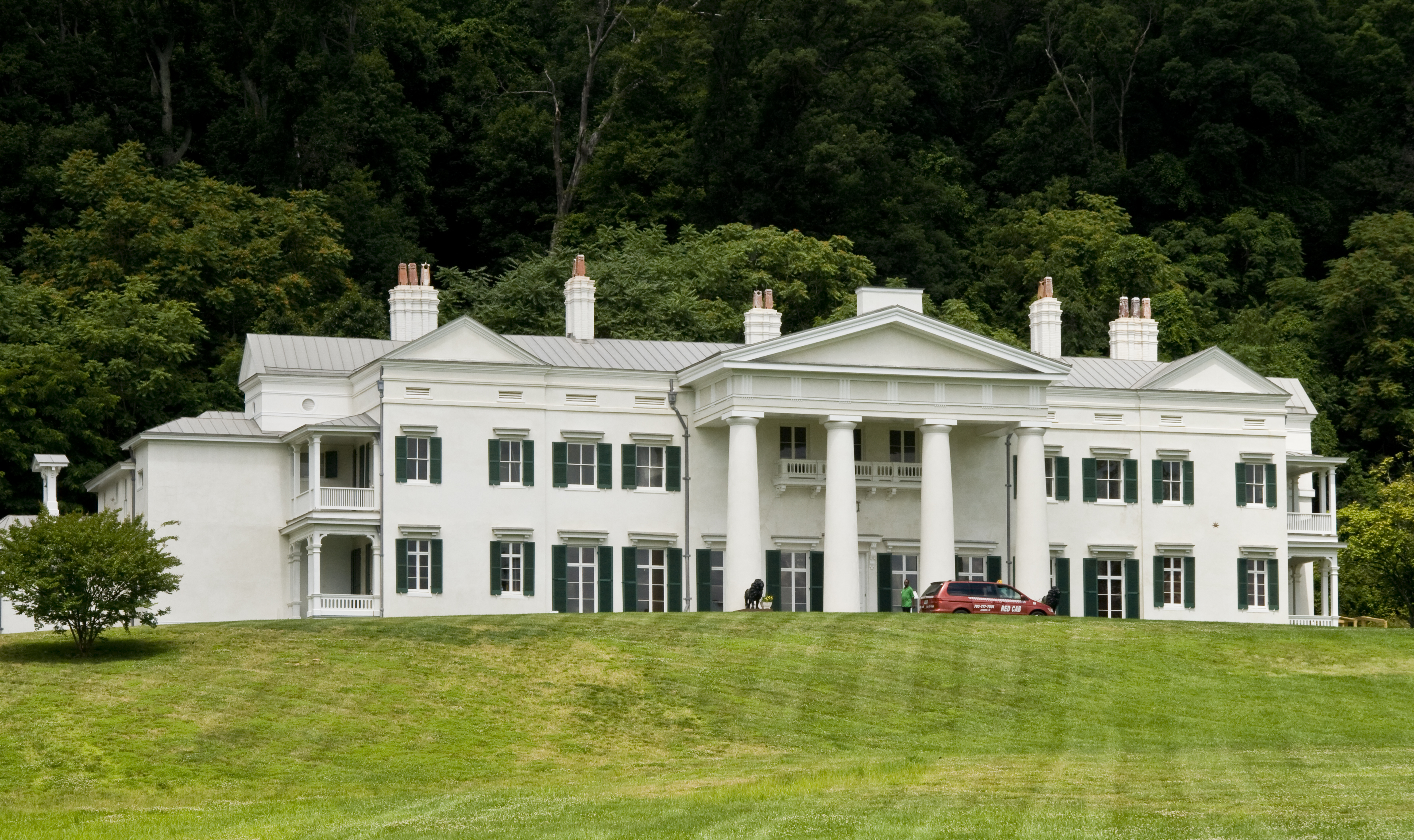
Morven Park
Two governors, four architectural reinventions, and a century of foxhounds running across rolling green hills - Morven Park in Leesburg, Virginia, has lived more lives than most American estates. What began as a fieldstone house around 1780 became a Greek Revival showpiece, then an Italianate palazzo with towers tall enough to rival Queen Victoria's seaside retreat, and finally the beating heart of Virginia's equestrian world. Today the 1,000-acre property draws over 200,000 visitors a year to what locals call the "Central Park" of Loudoun County, the wealthiest county in the United States. But the real story of Morven Park is about the people who kept reinventing it, each owner reshaping the land and the mansion to match a different vision of what Virginia could be.
The Governor's Mansion That Kept Changing Its Mind
Wilson Cary Seldon built the original fieldstone house on this hillside around 1780, when Leesburg was still a frontier crossroads. Judge Thomas Swann acquired the property around 1800 and, by 1830, had constructed the center two-story portion with a commanding Greek Revival portico - four columns announcing ambition in the language of classical architecture. But it was Swann's son, Thomas Jr., who truly transformed the place. Around 1850 he hired the Baltimore firm of E.G. Lind and William T. Murdock to convert the Palladian home into something audaciously Italianate: four towers rose above the Virginia countryside, the tallest reaching five stories, drawing comparisons to Queen Victoria's Osborne House on the Isle of Wight. Swann Jr. went on to serve as governor of Maryland after the Civil War, making Morven Park the seat of political power. His daughter and her husband, Dr. Shirley Carter, later removed the towers and reworked the interior, but the bones of each era survive beneath the stucco, layered like geological strata.
A New York Lawyer's Virginia Dream
Westmoreland Davis arrived from New York in 1903 with deep Virginia roots and a passion for horses. He and his wife, Marguerite Inman Davis, threw themselves into the fox hunting community with the fervor of converts who had always belonged. Davis became a founding member of the Loudoun Hunt and served as Master of Foxhounds, riding out across the same fields where Seldon's fieldstone walls still anchored the north wing. While Davis turned the estate into an agricultural showpiece, Marguerite cultivated formal boxwood gardens near the mansion - living sculptures that still frame the approach today. Davis served as Virginia's governor from 1918 to 1922, making Morven Park the rare estate to house the governors of two different states. The Davises were the last private owners. When their stewardship ended, so did the era of personal transformation. The estate passed into the hands of a nonprofit foundation, its future tied to public support rather than private ambition.
Where Olympic Riders Learned Their Craft
From 1967 to 1991, Morven Park housed what many considered the most prestigious riding school in the United States. The Morven Park International Equestrian Institute trained instructors in advanced dressage, three-day eventing, and show jumping under the direction of Major John Lynch, a man whose credentials read like a tour of the English-speaking world's finest military academies. Lynch had taught at the Army School of Equitation at Weedon and at both Sandhurst and Woolwich. He had coached British, Irish, and American Olympic teams. Under his guidance, riders who arrived as talented amateurs left as competitors capable of representing their countries on the world stage. The institute closed in 1991, but the equestrian tradition endures. The Morven Park International Equestrian Center hosts Olympic-level riders in horse trials, dressage, and carriage driving events. From 1980 to 2010, the Morven Park Steeplechase Races drew crowds as one of the most popular meets in the country.
Foxhounds, Carriages, and the Sport of Kings
Tucked within the estate grounds, the Museum of Hounds and Hunting of North America preserves the art, artifacts, and memorabilia of foxhunting - a sport that has shaped Loudoun County's identity for over two centuries. Nearby, the Winmill Carriage Museum displays the collection assembled by Viola Townsend Winmill, showcasing an era when horsepower was literal and a well-appointed carriage signaled status as clearly as any mansion. Together these collections tell a story about Virginia's horse country that extends far beyond sport. The relationship between land, horse, and rider defined how the Piedmont was settled, how its economy functioned, and how its social hierarchies were maintained. In 2017, the equestrian center launched a multimillion-dollar renovation and introduced Polo in the Park, adding another chapter to a tradition that stretches back to the Davises' first foxhunt across these rolling acres.
The Central Park of Horse Country
Morven Park today is a place of contradictions held in productive tension. It is a historic estate that functions as a public park, a center of elite equestrian sport surrounded by hiking trails and athletic fields open to anyone. The mansion sits on the National Register of Historic Places as a Virginia Historic Landmark, its stuccoed walls concealing the fieldstone, brick, and ambition of two and a half centuries. Miles of trails wind through 1,000 acres of rolling Piedmont landscape - the same land where governors once strategized and Olympic riders once trained. The Center for Civic Impact, housed on the grounds, teaches students from kindergarten through twelfth grade the skills of engaged citizenship, partnering with Loudoun County Public Schools to connect classroom learning to the world beyond the gates. Morven Park endures because each generation found something new in it - a home, a showpiece, a school, a public trust.
From the Air
Located at 39.14°N, 77.57°W in Leesburg, Virginia, in the heart of Loudoun County's horse country. The 1,000-acre estate is visible as a large green expanse northwest of Leesburg's town center. Look for the mansion and its formal gardens, the equestrian center's rings and courses, and the rolling Piedmont terrain. Leesburg Executive Airport (KJYO) lies approximately 3nm southeast. Dulles International (KIAD) is about 15nm to the east. The Blue Ridge Mountains form the western horizon. Best viewed at 2,000-3,000 feet AGL on a clear day when the estate's layout and surrounding horse farms are most distinct.