Mosque-Cathedral of Cordoba
You enter through the Courtyard of the Oranges, where citrus trees stand in rows that have been replanted for a thousand years, and then you step inside and the world changes. Eight hundred and fifty-six columns stretch in every direction, holding up a canopy of red-and-white horseshoe arches that seem to multiply as your eyes adjust to the dimness. This is the Great Mosque of Cordoba -- except that at its center, almost violently, a Renaissance cathedral rises through the roof, its vaulted nave punching upward through the Islamic geometry like a ship crashing through ice. The Mosque-Cathedral of Cordoba is not a building at peace with itself, and that tension is precisely what makes it one of the most extraordinary structures on earth.
A Mosque Built in Layers
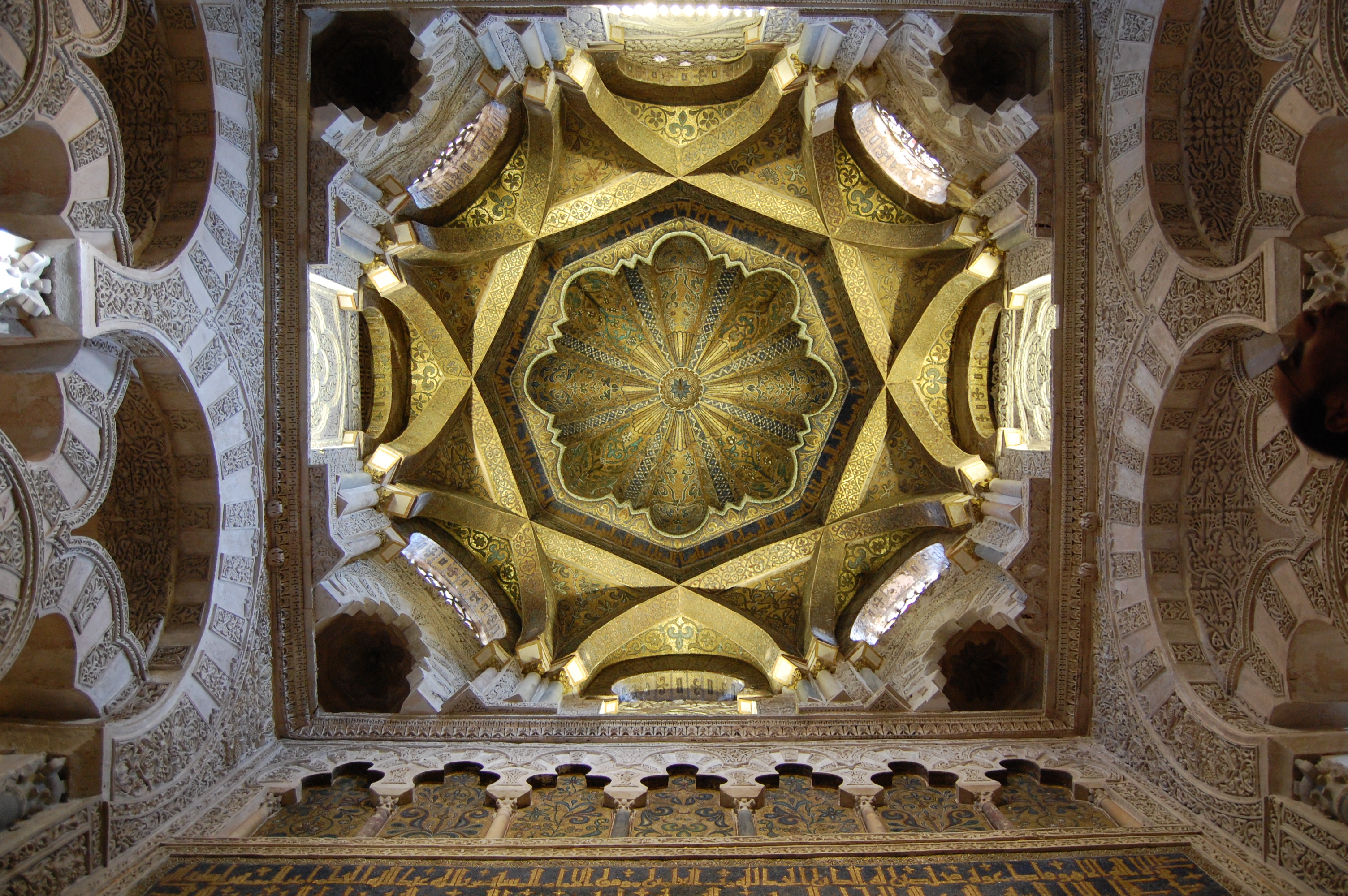
Abd ar-Rahman I founded the mosque in 786, reportedly purchasing half of a Visigothic church site to build it. What began as a relatively modest prayer hall grew through four major expansions over two centuries. Abd ar-Rahman II extended it southward in the 9th century. Al-Hakam II pushed it further south in the 960s, adding the spectacular mihrab -- the prayer niche oriented toward Mecca -- whose golden mosaics were created by artisans sent from the Byzantine emperor in Constantinople. The final expansion came under the vizier al-Mansur in 987, who widened the mosque dramatically to the east. By the time the last stones were laid, the mosque was one of the largest in the Islamic world, its forest of columns creating a deliberately disorienting effect: no single vantage point could take in the whole space, and the worshipper was meant to feel surrounded by an infinite pattern, a physical metaphor for the infinite nature of God.
The Cathedral That Split the Sky
When Ferdinand III conquered Cordoba in 1236, the mosque was consecrated as a Christian cathedral. For nearly three centuries, the Christians worshipped inside the Islamic structure with relatively minor alterations -- a few chapels inserted between columns, a coat of whitewash here and there. Then in 1523, the cathedral chapter received permission from Charles V to build a full Renaissance cathedral in the mosque's interior. Charles reportedly approved the plan without seeing the building. When he finally visited Cordoba and saw what his permission had wrought, he is said to have told the builders: "You have destroyed something unique in the world to build something you can find in any city." Whether the quote is apocryphal or not, it captures the architectural reality. The cathedral is handsome on its own terms -- Hernan Ruiz I designed its initial phase, and Hernan Ruiz II completed the dome -- but it sits inside the mosque like a foreign body, its vertical Christian ambition at odds with the mosque's horizontal Islamic infinity.
Architecture as Power Struggle
The building today is a physical record of who ruled Cordoba and what they believed. The Umayyad caliphs expressed their authority through the mosque's expansions, each ruler leaving his architectural signature. Al-Hakam II's mihrab, with its Byzantine mosaics, asserted Cordoba's claim to rival Damascus and Baghdad as a center of Islamic civilization. The Christian additions -- chapels, choir stalls carved from mahogany, Baroque altarpieces -- wrote a new narrative over the old one without erasing it. The ownership of the building remains contested to this day. The Catholic Church formally registered it in 2006, but critics argue that the mosque-cathedral never ceased to be state property, originally belonging to the Crown of Castile. Muslim groups have periodically requested permission to pray in the building; Spanish church authorities and the Vatican have opposed the requests, though there have been token concessions, including Saddam Hussein's prayer at the mihrab in December 1974.
Where Two Infinities Meet
Visit the Mosque-Cathedral and you experience something available nowhere else: the collision of two complete architectural visions in a single building. The mosque's double arches -- striped red and white in alternating voussoirs of brick and stone -- create a rhythm that pulls the eye sideways, endlessly. Step into the cathedral nave and the eye is pulled upward, toward the dome, toward heaven in the vertical Christian sense. The South Asian philosopher and poet Muhammad Iqbal visited in 1931 and was so moved that he composed a poem calling the mosque a timeless monument to the human capacity for devotion. The building has inspired that kind of response for twelve centuries. It is not harmonious. It is not meant to be. It is a place where two civilizations built their highest expressions of faith in the same footprint, and neither could bring itself to demolish what the other had made.
From the Air
Located at 37.879N, 4.779W in the historic center of Cordoba, on the north bank of the Guadalquivir River. The mosque-cathedral's large rectangular footprint and distinctive bell tower (the converted minaret) are clearly visible from the air. The Roman Bridge extends south from just below the building to the Calahorra Tower. Nearest airport is Cordoba (LEBA). Seville San Pablo (LEZL) is the nearest major international airport. The Courtyard of the Oranges on the north side of the building is also visible from above.