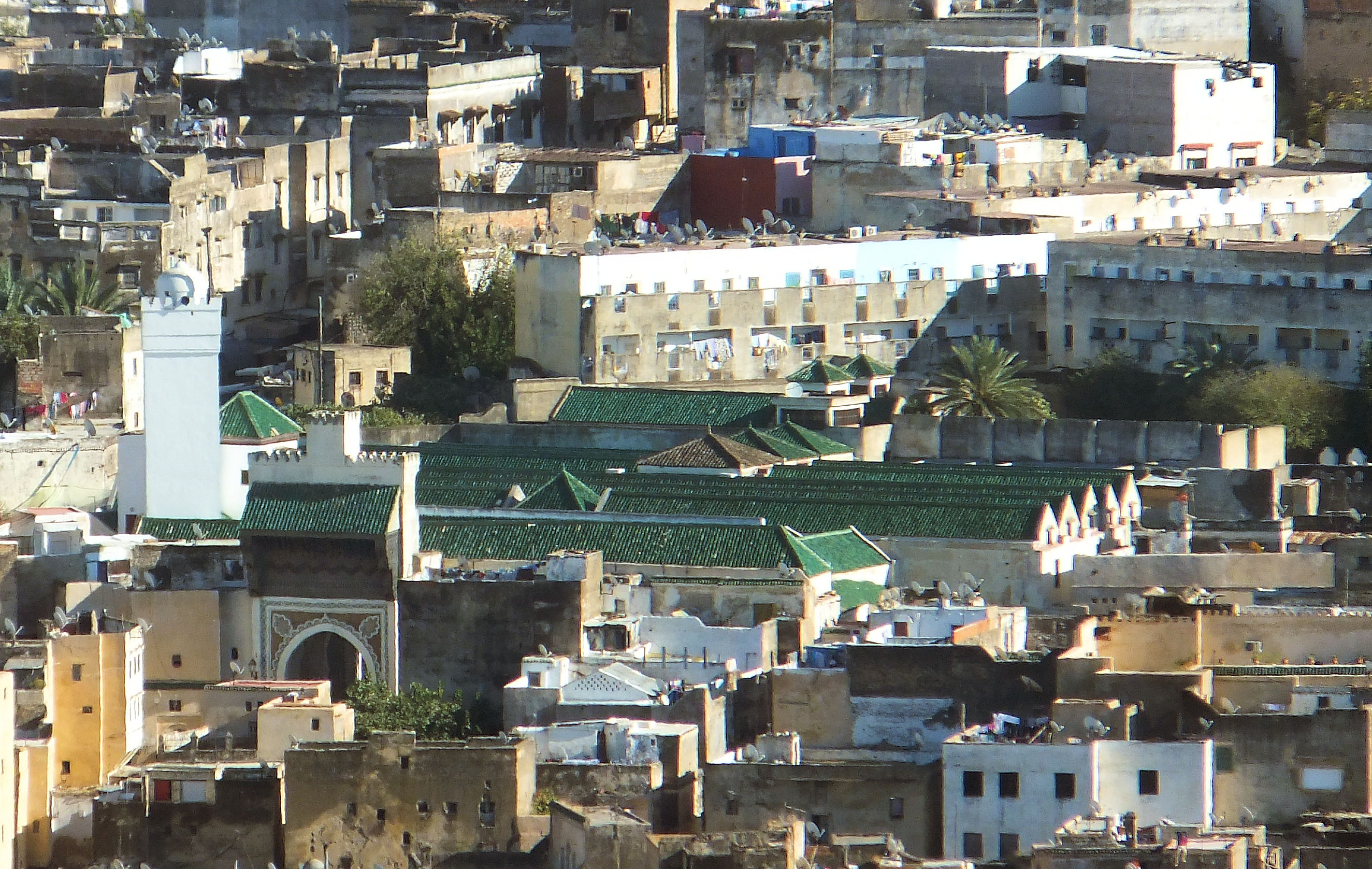
Mosque of the Andalusians
In 818, a failed uprising against the Umayyad emir al-Hakam I in Cordoba ended in severe repression. Thousands of Andalusian families fled across the Mediterranean, and a community of these refugees settled in Fez, on the east bank of the Oued Fes. They built a mosque around 860, naming it for the homeland they had lost. Twelve centuries later, the Mosque of the Andalusians still stands on the same site -- its minaret, its monumental gate, and its prayer hall visible from across the medina skyline. What makes the building remarkable is not any single era's contribution but the way successive dynasties treated it: each one restored, expanded, and embellished the mosque while choosing, almost without exception, to preserve what earlier hands had made.
A Modest Beginning
The original construction was simple. According to the 12th-century Andalusian geographer Al-Bakri, the mosque consisted of a hypostyle hall with six or seven aisles formed by parallel rows of horseshoe arches supported on stone columns. A small courtyard contained a walnut tree and several other plantings. Unusually for Moroccan mosques, the rows of arches ran east-to-west, parallel to the southern qibla wall rather than perpendicular to it -- a layout that may reflect Andalusian rather than Moroccan architectural conventions. The mosque drew water from an artificial channel called the Oued Masmuda. Whether the Umayyad caliph Abd ar-Rahman III contributed funds to later improvements, as some sources suggest, or simply lent his name to work carried out by others, remains uncertain.
Layers of Restoration
The mosque was not significantly modified until the early 13th century, during the Almohad period, when Caliph al-Nasir undertook a reconstruction that gave the building much of its current form. Rather than replacing the old minbar wholesale, the Almohads opted to restore and reuse it. Most of its surfaces were covered with new wooden panels decorated in the Moorish style of the period, strongly influenced by Andalusi craftsmanship. But the upper back panel, which bore inscriptions from the 10th-century Umayyad restoration, was deliberately preserved in place -- perhaps indicating a certain respect the Almohads held for the former Caliphate of Cordoba. This layering of eras on a single object captures the mosque's character in miniature.
Dynasties Come and Go
The Marinids added a fountain to the courtyard, which the Alawi sultan Moulay Isma'il later renovated -- his name is still visible on it. The mihrab's carved stucco decoration was remade at some point and is no older than the 18th century. The monumental gate, whose height makes it visible from far across the city, likely dates from a restoration during the Alawi period as well. French scholar Henri Terrasse conducted a comprehensive study of the mosque and its minbar during the protectorate period, publishing his findings in 1942. Each intervention added something new while leaving the fundamental structure intact. The mosque accumulated history the way a living tree accumulates rings -- each layer visible, none erased.
Exile's Enduring Monument
The refugees who built this mosque in 860 could not return to Cordoba. Their exile became permanent, and the community they founded on the east bank of the Oued Fes grew into one of the two great neighborhoods of the early city, counterpart to the Qarawiyyin quarter on the west bank. The mosque they built outlasted the Umayyad emirate that expelled them, the caliphate that replaced it, and every subsequent dynasty that ruled Morocco. Seen from above, its minaret and the tall silhouette of its gate rise from the eastern side of the medina, markers of a community that turned displacement into permanence. The horseshoe arches inside still echo the architectural forms of Al-Andalus -- the land the founders carried in memory, built into stone, and handed down through twelve centuries of continuous worship.
From the Air
Coordinates: 34.063N, 4.968W. The mosque sits on the eastern side of Fes el Bali, across the Oued Fes from the Qarawiyyin Mosque quarter. Its prominent minaret and tall monumental gate are visible from the air among the medina rooftops. Nearest airport: Fes-Saiss (GMFF), approximately 15 km south. The mosque lies in the Andalusian quarter of the old city, distinguishable from the denser Qarawiyyin quarter to the west.