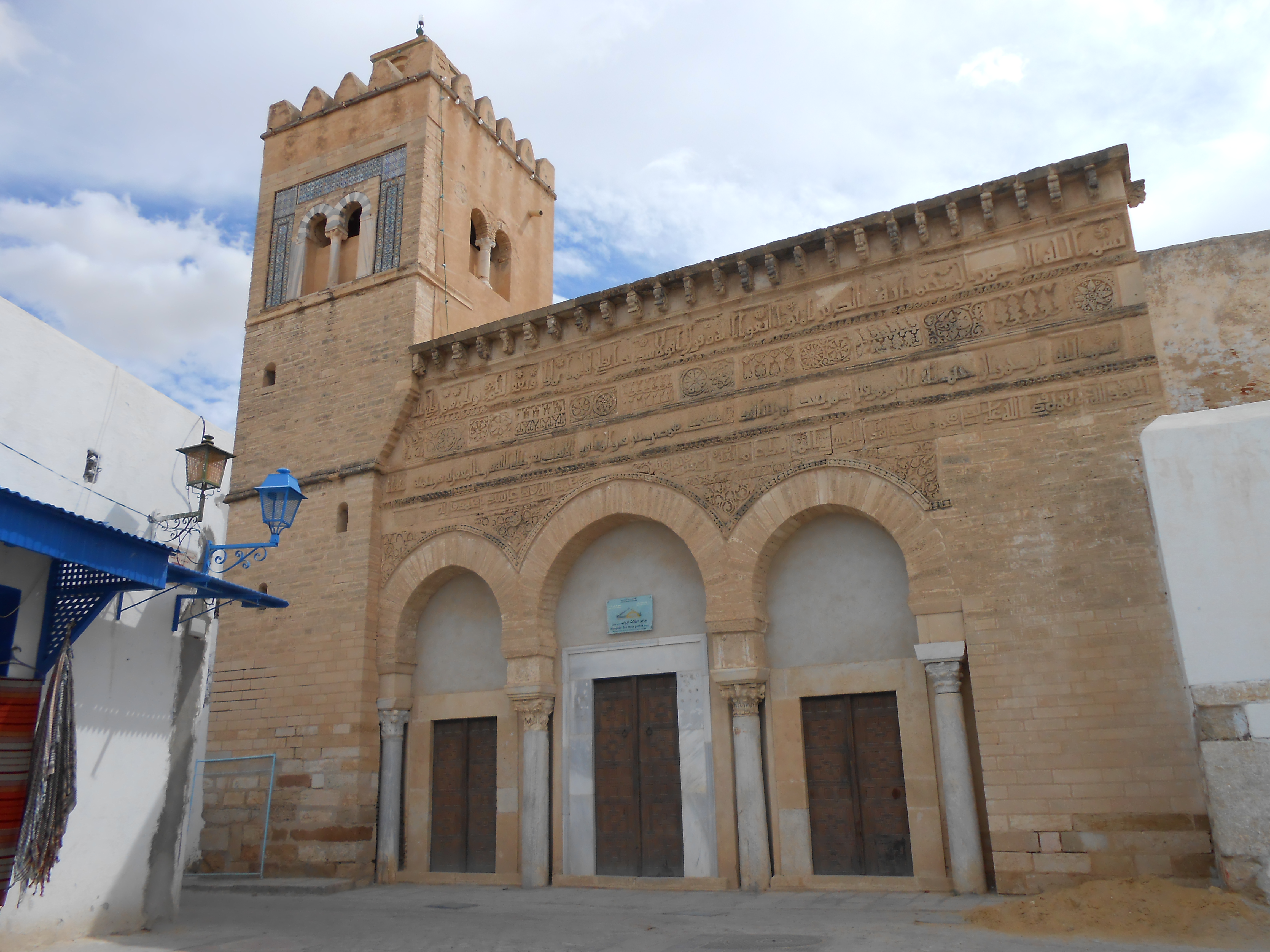
Mosque of the Three Doors
Three horseshoe arches frame three doorways, and above them, bands of carved Kufic script spell out verses from the Quran. The facade of the Mosque of the Three Doors in Kairouan is not large, but it changed the course of Islamic architecture. Built in 866 during the Aghlabid era, it is one of the earliest known examples of a richly decorated exterior facade on a mosque, a practice that would eventually become standard across the Islamic world.
A Patron from the West
The foundation inscription on the facade records the name of the man who paid for it all: Muhammad ibn Khayrun al-Ma'firi al-Andalusi. His name tells a story. The nisbas suggest he was originally from al-Andalus, Islamic Spain, and that he was most likely a former slave who had earned or purchased his freedom. Some scholars believe he was a merchant. Whatever his origins, he chose to invest his wealth in a building that would carry his name across the centuries. Only the front facade survives from his original construction, but it remains the mosque's defining feature, the element that scholars travel to Kairouan to study.
Arches and Ancestors
The three horseshoe arches that give the mosque its name rest on ancient columns that were salvaged from older buildings and set into the wall. This practice of reusing classical columns, known as spolia, was common across the Aghlabid territories and created a visual conversation between the Islamic present and the Roman and Byzantine past. Inside, the prayer hall is nearly square, divided by four columns into three naves covered by nine vaults. The architectural design blends inherited local traditions with the metropolitan styles of the Abbasid heartland in Baghdad, producing something distinctly North African in character.
Words Carved in Stone
The upper bands of the facade carry two Quranic excerpts, from Surah 33 and Surah 30, followed by the foundation inscription itself. These inscriptions were partially rearranged in the fifteenth century when the Hafsid dynasty added a minaret in 1440 and inserted a new inscription recording their restoration along the lower band. The French scholar Georges Marcais later reconstructed what the original Aghlabid-era arrangement would have looked like, separating the ninth-century text from the fifteenth-century additions. Reading the facade today is an exercise in archaeological layering: one dynasty's devotion inscribed over another's, each generation leaving its mark on the same wall.
Small Building, Long Shadow
The Mosque of the Three Doors is not a grand monument. It has no courtyard, no monumental minaret from its founding period, no sprawling complex. It is a neighborhood mosque, built by a private citizen for a local community. Yet its influence on Islamic architectural history is disproportionate to its size. The decision to lavish artistic attention on an exterior facade, to make the public face of the building a work of decorative art, anticipated a tradition that would define mosques from Morocco to Central Asia. In Kairouan, a city that also holds the Great Mosque of Uqba, one of the most celebrated mosques in the world, this smaller building quietly stakes its own claim to significance.
From the Air
Located at 35.677N, 10.103E in Kairouan, central Tunisia. The mosque sits within the dense urban fabric of Kairouan's medina, south of the Great Mosque. Nearest airport is Monastir Habib Bourguiba International (DTMB), approximately 60 km east. From the air, Kairouan appears as a compact walled city surrounded by semi-arid terrain. Recommended viewing altitude: 2,000-3,000 feet AGL.