Mostar
Don't let anyone tell you Bosnian coffee is the same as Turkish coffee. At Cafe de Alma in Mostar, near the foot of the rebuilt Stari Most bridge, the staff will insist on the distinction -- the grind, the preparation, the way you sip it from the traditional set with a Turkish delight to cut the bitterness. It costs two convertible marks, about one euro. This small ritual of local pride captures something essential about Mostar: a city that has been flattened, divided, and rebuilt, and that still fiercely maintains its identity. The most heavily bombed city in Bosnia and Herzegovina during the 1990s wars, Mostar has put itself back together with remarkable determination, though the seams remain visible to anyone willing to look beyond the postcard views of the old town.
Where the Neretva Divides and Connects
Mostar sits in the valley of the Neretva River, in the heart of Herzegovina, surrounded by the raw karst landscape of the Dinaric Alps. The city exists because of the river crossing -- its very name derives from the mostari, the bridge keepers who guarded the Ottoman-era Stari Most. That bridge, a single limestone arch 24 meters above the turquoise Neretva, was the symbolic and literal center of the city for over four centuries. Before the bridge, there was a wooden suspension structure that hung on chains and terrified anyone who crossed it. After 1566, there was Mimar Hayruddin's masterwork, and a city grew around it. The old town that clusters at the bridge's approaches -- the bazaar quarter of Kujundziluk, the stone Ottoman houses cascading down the riverbanks -- remains one of the most atmospheric medieval quarters in the Balkans.
The City That Was Most Diverse
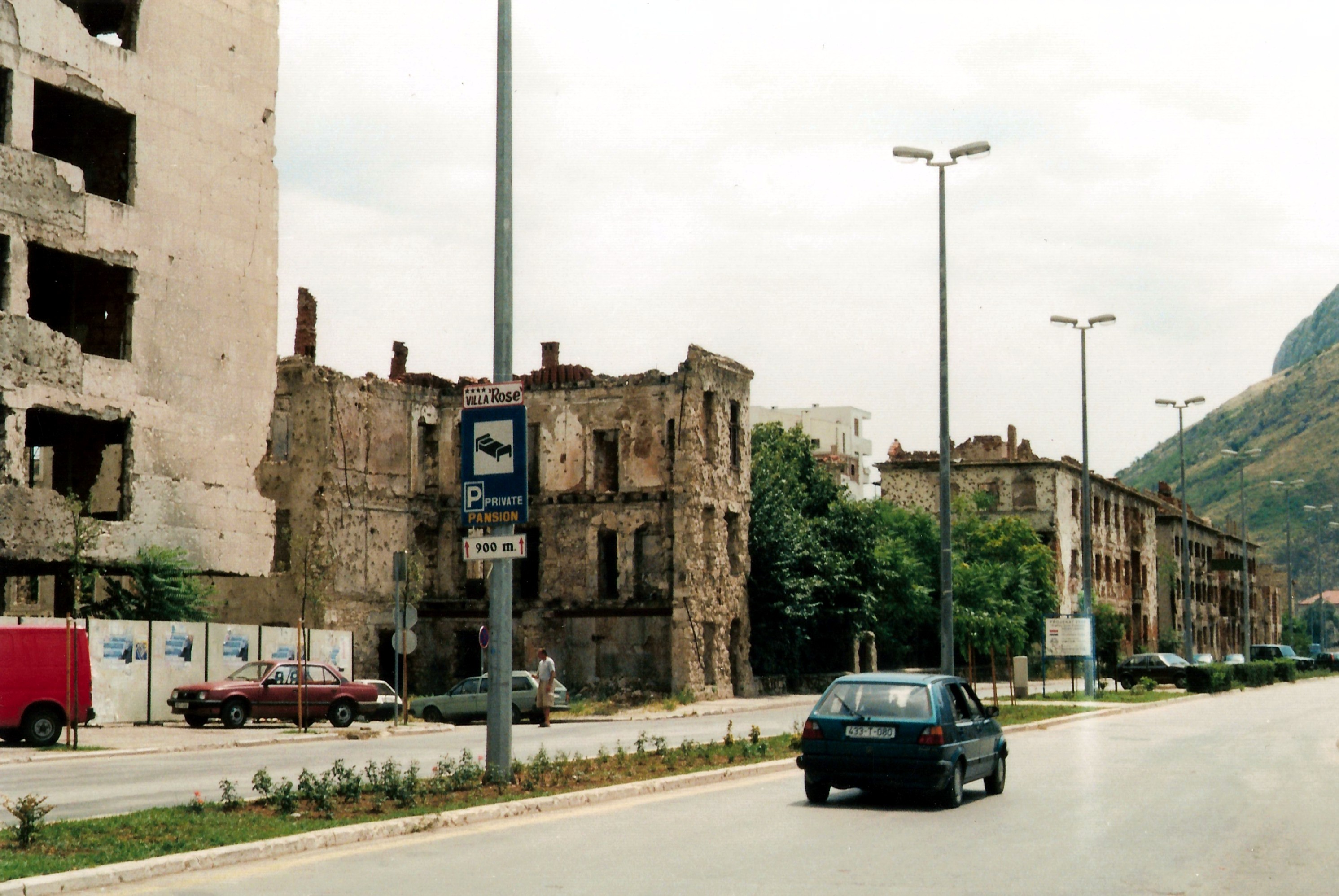
Before the war, Mostar was one of the most ethnically mixed cities in Yugoslavia. Its municipality of roughly 126,000 people included Bosniaks, Croats, Serbs, and people who identified simply as Yugoslavs, in roughly comparable numbers. Mosques, churches, and a synagogue shared the skyline. That diversity did not survive the 1990s intact. The city endured two successive sieges: first by the Yugoslav People's Army in 1992, which damaged or destroyed most of its bridges and cultural institutions, and then the Croat-Bosniak conflict of 1993-1994, which bisected Mostar along ethnic lines. Approximately 90,000 of the city's 120,000 residents fled during the fighting. Today, the city remains effectively divided, with the western part predominantly Croat and the eastern part predominantly Bosniak. The narrow pre-war Bosniak plurality has become, as the International Crisis Group observed, a substantial Croat majority.
Ruins and Rebuilding
The visible signs of Mostar's wars are everywhere, if you look. Bullet holes pock the facades of apartment blocks along the former front lines. Empty buildings stand with vegetation growing through shattered windows. The Stari Most itself was destroyed in November 1993 and rebuilt with international support, reopening in 2004 using some original stones recovered from the Neretva by Hungarian army divers. Twelve of the city's fourteen mosques were damaged or destroyed during the fighting, along with the Catholic Cathedral, the Franciscan Church and Monastery, and a Bishop's Palace whose library held over 50,000 books. The Serbian Orthodox Zitomislic Monastery was demolished by Croatian forces. The rebuilding has been extensive, and the old town in particular has been restored to something approaching its former beauty, but Mostar wears its history openly.
The Everyday Pleasures
For all its complicated past, Mostar is a lively and genuinely beautiful place. The old town bazaar of Kujundziluk sells handicrafts, carpets, and jewelry from narrow stone-front shops. Young men dive from the rebuilt Stari Most into the Neretva 24 meters below -- a tradition that predates the war and has since become a stop on the Red Bull Cliff Diving World Series. The surrounding region offers remarkable day trips: Blagaj, twelve kilometers southeast, where a karst river emerges from a cliff face beside a historic Dervish tekke; Pocitelj, a medieval walled town dating to 1383 with views over the Neretva valley; and the pilgrimage town of Medjugorje, twenty-five kilometers away. The 157-kilometer Ciro Trail, a cycling route from Dubrovnik following a decommissioned Austro-Hungarian narrow-gauge railway through 19th-century tunnels, ends in Mostar.
A City Still Becoming
Mostar is not a place that has finished processing its history. The ethnic division remains a fact of daily life -- two school systems, two bus companies, lingering tensions that outsiders may not immediately perceive beneath the warm hospitality. But the city is more than its wounds. Cafe de Alma still roasts its own coffee. The Neretva still runs improbably turquoise through the gorge. The bridge still arches overhead, rebuilt but recognizably the same shape that Hayruddin engineered five centuries ago. Visitors come expecting a war museum and find instead a living city with Ottoman courtyards, excellent food, Bosnian coffee that is emphatically not Turkish coffee, and a complicated, ongoing conversation about what it means to share a beautiful place with people who were once your neighbors, then your enemies, and are now your neighbors again.
From the Air
Located at 43.34N, 17.81E in the Neretva river valley of Herzegovina. The city occupies both banks of the Neretva gorge, with the distinctive white arch of Stari Most visible at low altitude. Mostar Airport (LQMO) is approximately 7 km south. The Neretva valley runs roughly north-south, flanked by the Hum and Velez mountains. From cruising altitude, the river's turquoise color contrasts sharply with the surrounding limestone terrain. Sarajevo is a 2-hour drive to the north through the river valley; Dubrovnik (LDDU) lies to the south along the coast.