Mottisfont Abbey
The spring still rises in the grounds, just as it did when the first settlers gathered here. Mottisfont takes its name from the font, a natural spring around which the local community held its moots, or meetings. An Augustinian priory grew up around this reliable water source in 1201, founded by William Briwere, a courtier who served four Plantagenet kings and knew how to make a public show of wealth and piety. Eight centuries later, the water still flows, the estate still draws visitors, and the layers of history are so densely packed that a single walk through the grounds passes from medieval monastic ruins to a room painted by one of the twentieth century's most gifted artists.
Pilgrims and a Holy Finger
Briwere chose his location well. The Test Valley offered fertile land and abundant water, and the priory sat on the pilgrim route to Winchester Cathedral. The canons welcomed travelers who came to venerate Mottisfont's prize relic, said to be the finger of St John the Baptist. The priory prospered until the Black Death struck in the mid-fourteenth century, devastating the community along with much of England. It never fully recovered, and when Henry VIII dissolved the monasteries in 1536, he gave Mottisfont to Sir William Sandys. The priory buildings were converted into a country house, a transformation common across England but one that preserved more of the medieval fabric than outright demolition would have allowed.
The Whistler Room
Mottisfont's most celebrated interior dates from the 1930s, when Maud and Gilbert Russell made the estate the center of a fashionable artistic and political circle. Maud was a wealthy patron who entertained writers and artists including Ben Nicholson and Ian Fleming. She commissioned Rex Whistler to decorate her salon, and the result is one of the finest pieces of trompe-l'oeil painting in England. Whistler created the illusion of Gothic architecture on flat walls, columns and arches and tracery that recall the priory's medieval past without replicating it. The room is a conversation between centuries, a twentieth-century artist's homage to thirteenth-century builders. Boris Anrep contributed mosaics throughout the house, including one angel bearing Maud's face, a testament to their long love affair.
Roses and the River Test
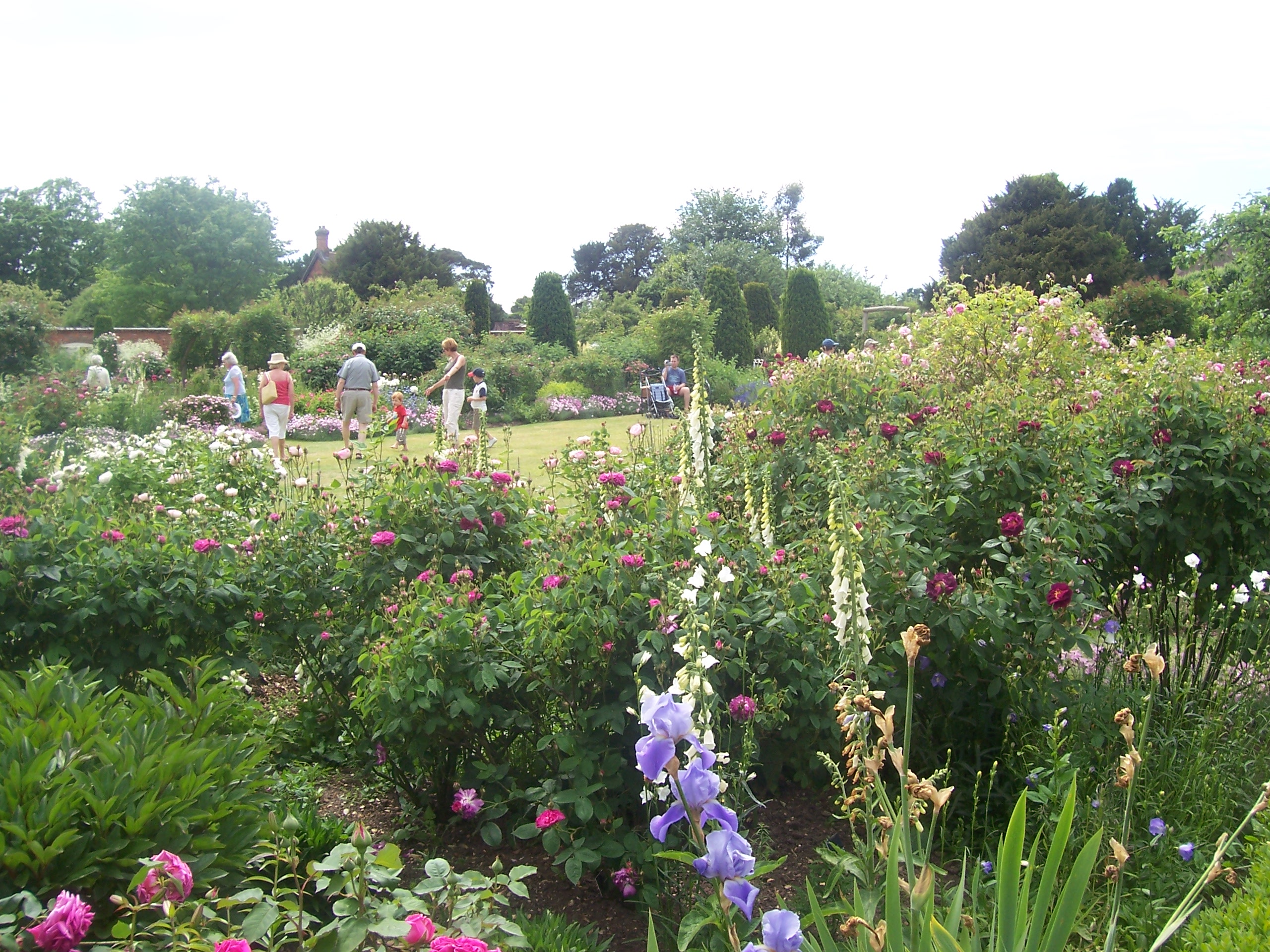
Mottisfont's walled rose garden holds the National Plant Collection of pre-1900 shrub roses, ancestral species and nineteenth-century cultivars whose scent on a June evening is reason enough to visit. The collection preserves varieties that have largely vanished from commerce, roses bred for fragrance and form rather than modern disease resistance. Beyond the rose garden, the grounds include the largest London plane tree in Britain, walks along the River Test, one of England's finest chalk streams, and enough lawn space that games and picnics are encouraged. The estate attracted nearly 400,000 visitors in 2019, making it one of the National Trust's most popular Hampshire properties.
Art, War, and Memory
During World War II, Mottisfont was commandeered as a hospital with eighty beds, one of countless country houses pressed into military service. After the war, the painter Derek Hill, who had been a regular visitor, donated his substantial collection of early twentieth-century art to the National Trust to be displayed at Mottisfont in memory of his friendship with Maud Russell. Today, the house hosts a changing program of temporary exhibitions alongside Hill's permanent collection. The combination is distinctly Mottisfont: a medieval priory, a Tudor conversion, a twentieth-century artistic salon, and a contemporary gallery, all sustained by the same spring that first attracted settlers to this valley beside the Test. The water still flows; the place still draws people in.
From the Air
Located at 51.041N, 1.535W in the Test Valley, Hampshire. The estate sits along the River Test with mature grounds and the abbey buildings visible amid parkland. Nearest airports: EGHI (Southampton, 12 nm southeast), EGLS (Old Sarum, 15 nm west). The River Test provides a clear navigation reference running north-south through the valley. Recommended viewing altitude 2,000-3,000 ft.