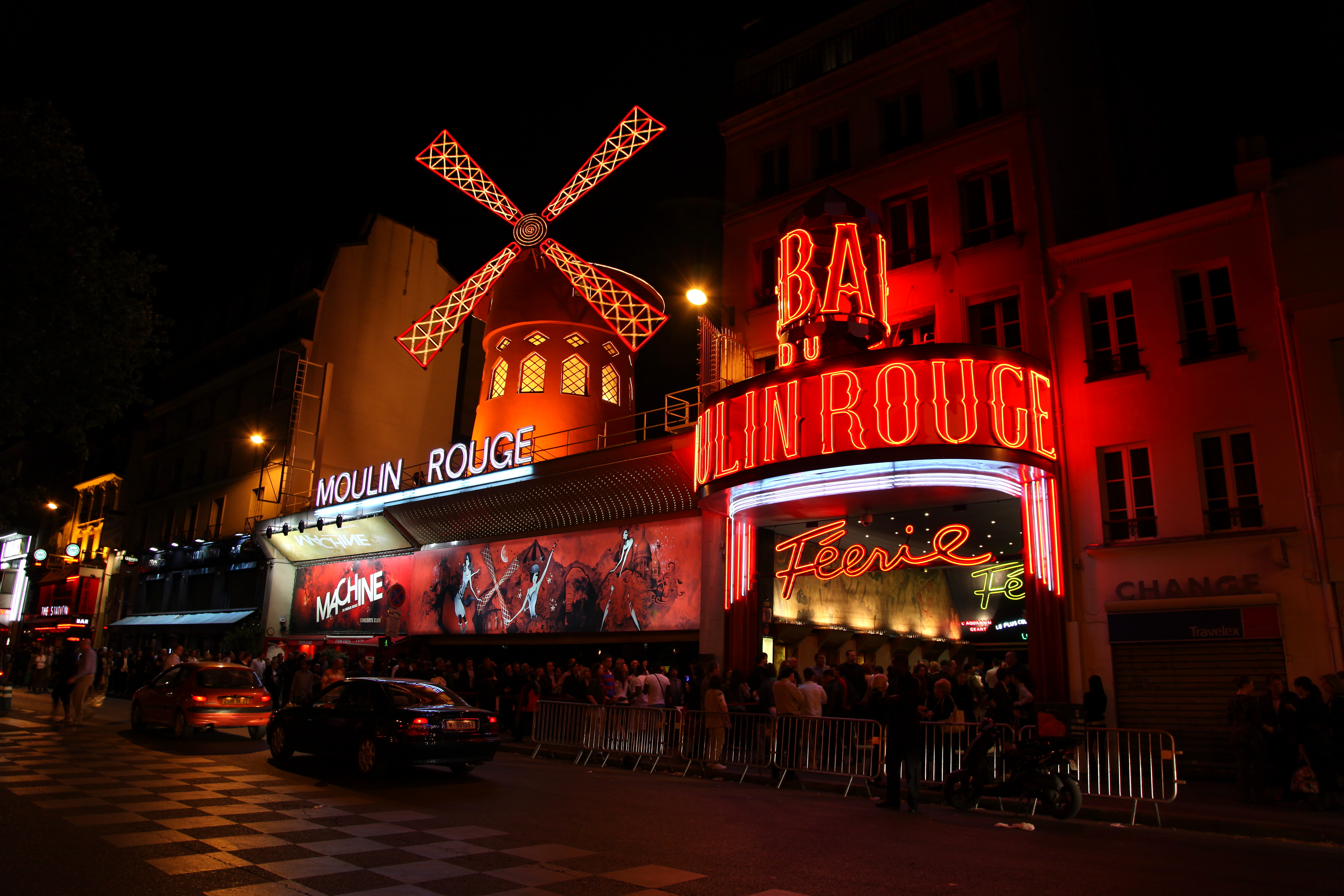
Moulin Rouge: The Red Windmill That Invented Parisian Nightlife
"Hey, Wales, the champagne's on you!" In October 1890, the dancer known as La Goulue shouted this across the floor of the Moulin Rouge to the Prince of Wales, the future Edward VII, who had reserved a table to watch the quadrille. That a working-class dancer could heckle the heir to the British Empire -- and that the crowd loved it -- captures exactly what the Moulin Rouge was from the beginning: a place where social hierarchies dissolved in music, movement, and the calculated illusion of democratic pleasure.
The Business of Bohemia
Joseph Oller and Charles Zidler opened the Moulin Rouge on October 6, 1889, at the foot of the Montmartre hill. They were not artists or dreamers but shrewd businessmen who understood that wealthy Parisians would pay handsomely for the thrill of slumming. The garden featured a large ornamental elephant. The red windmill on the roof became the most recognizable landmark in Pigalle. Oller and Zidler called it "The First Palace of Women" and created a setting where workers and aristocrats, artists and bourgeoisie, tourists and locals could mingle -- or at least watch each other. The courtesans who danced the can-can were the original attraction, but the dance quickly evolved from seduction into spectacle. Within a year, the Moulin Rouge had spawned imitators across Europe. Within two, Toulouse-Lautrec had painted his first poster for the venue, immortalizing La Goulue in an image that became synonymous with Paris itself.
Scandals and Stars
The early years were a cavalcade of provocation. Le Petomane -- a performer whose act involved controlled flatulence -- became one of the most popular attractions. The 1893 Bal des Quat'z'Arts scandalized the city with a procession featuring a nude Cleopatra surrounded by naked young women. In 1907, during a performance of Le Reve d'Egypte, the novelist Colette exchanged scandalous kisses on stage that revealed her relationship with the Marquise de Morny, and the show was promptly banned. That same year, Mistinguett made her debut. Born into poverty, she rose through sharp wit and relentless determination to become the Moulin Rouge's greatest star, touring Europe and America and producing enduring songs like "Ca c'est Paris." When Zidler died in 1897, the singer Yvette Guilbert eulogized him as a man who had "the knack of creating popular pleasure, in the finest sense of the word."
Fire, War, and Reinvention
On February 27, 1915, the Moulin Rouge burned during construction work. It remained shuttered for nine years. After World War I, the cabaret rebuilt under new management, with Jacques-Charles as impresario and Mistinguett as headliner. The 1920s brought American jazz: in 1929, Adelaide Hall and a hundred Black performers arrived with Lew Leslie's Blackbirds revue, becoming the hit of the season. In 1937, New York's Cotton Club staged performances on the Moulin Rouge stage. Then came the occupation. The German army's leisure guides listed the Moulin Rouge as a must-visit attraction. Stage shows continued for occupation troops, and the venue appeared in the memoirs of German officers stationed in Paris. The Germans promoted a motto for their soldiers' recreational visits: "Jeder einmal in Paris" -- everyone once in Paris.
The F Dynasty
After the Liberation, Edith Piaf returned to the Moulin Rouge stage accompanied by a young Yves Montand. In 1951, Jo France acquired the venue and undertook extensive renovations, preserving the decor that exists largely intact today. In 1953, Bing Crosby made his European stage debut at a charity gala attended by the French president. The Clerico brothers took over in 1955, installing a giant aquarium and introducing the first aquatic ballet. Beginning in 1963, owner Jacki Clerico established a tradition of naming every revue with a title beginning with F: Frou-Frou, Frisson, Fascination, Fantastic, Festival, Follement, Frenesie, Femmes femmes femmes, Formidable. Since 1999, the current revue has been Feerie. Through all these productions, the French cancan has remained the signature act -- high kicks, petticoats, and precisely choreographed chaos, performed nightly.
The Windmill Keeps Turning
The Moulin Rouge has hosted Queen Elizabeth II, Liza Minnelli, Frank Sinatra, Dean Martin, and Mikhail Baryshnikov, who premiered a Maurice Bejart ballet there in 1986. Baz Luhrmann's 2001 film and the subsequent Broadway musical extended the brand into the twenty-first century. But the venue's most dramatic recent moment was accidental: on April 25, 2024, the iconic windmill blades collapsed onto the street. No one was injured. The blades were restored by July 5, in time for the Olympic torch relay that passed through the neighborhood ten days later. The windmill that has defined the Pigalle skyline since 1889 had briefly lost its sails -- and Paris, characteristically, fixed the problem before the world arrived to look.
From the Air
The Moulin Rouge (48.884N, 2.332E) is located on the Boulevard de Clichy at the Place Blanche, at the foot of the Montmartre hill in the 18th arrondissement of Paris. The red windmill on its roof is a recognizable landmark. Montmartre's Sacre-Coeur basilica is 800 meters to the northeast and higher on the hill. Paris Charles de Gaulle (LFPG) is 23km northeast; Paris Orly (LFPO) is 15km south. The Pigalle entertainment district clusters around the boulevard.