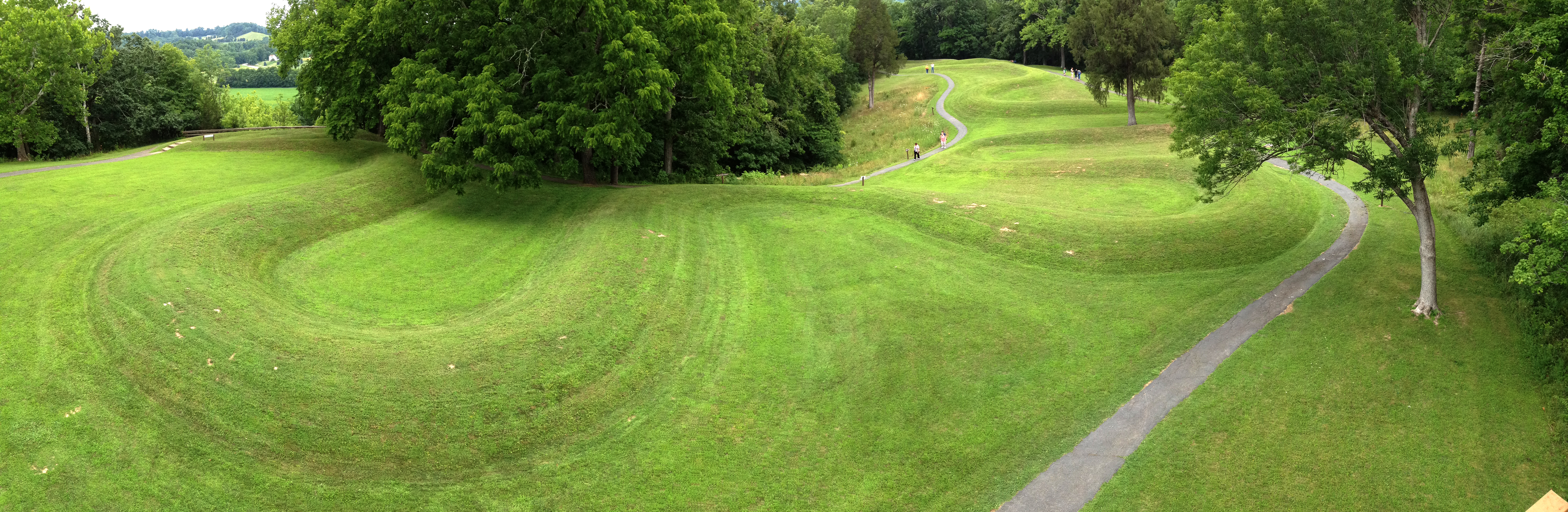
Serpent Mound
In the rolling hills of Adams County, Ohio, a quarter-mile-long serpent writhes across the landscape. Serpent Mound is the largest surviving effigy mound in the world - a raised earth sculpture depicting an uncoiling snake with an oval shape in its open jaws. The serpent measures 1,348 feet from head to tail, averaging about 3 feet in height. It was built by Indigenous peoples around 300 BCE, possibly by the Adena culture, though some researchers attribute it to later Fort Ancient people. The mound's purpose remains debated - ceremonial, astronomical, territorial? The snake's head aligns with the summer solstice sunset. Whatever its original meaning, Serpent Mound is a monument to the engineering skill and cosmological thinking of ancient North American peoples, visible today almost exactly as they built it over 2,000 years ago.
The Effigy
Serpent Mound depicts a snake with an uncoiling body and open jaws. The jaws hold (or are about to swallow) an oval shape - variously interpreted as an egg, the sun, a frog, or the moon. Seven coils form the body, and the tail spirals inward. The entire effigy was created by piling soil and clay over a low stone foundation, then shaping the material into the serpent form. No burials have been found within the mound itself, unlike many other mounds in the region. This suggests Serpent Mound served a different purpose - ceremonial, astronomical, or symbolic - rather than mortuary. The mound sits on a plateau overlooking Brush Creek, on the edge of a ancient meteor impact crater.
The Builders
Who built Serpent Mound is debated. For decades, archaeologists attributed it to the Adena culture (800 BCE - 100 CE), who built many burial mounds in the Ohio Valley. However, recent radiocarbon dating of charcoal within the mound suggests construction around 1070 CE, which would place it in the Fort Ancient period (1000-1650 CE). The dating is controversial - the samples may have come from later repairs rather than original construction. The Adena attribution remains popular. What's certain is that Indigenous peoples built Serpent Mound using sophisticated engineering and astronomical knowledge, creating a monument that has endured for millennia.
The Alignments
Serpent Mound's head points toward the summer solstice sunset - when the setting sun appears directly in line with the serpent's open jaws. This alignment suggests astronomical purpose, though whether the mound was an observatory, a ceremonial marker, or both is unknown. Other alignments have been proposed: the coils may mark other solar events, or lunar positions. The mound sits on the edge of a cryptoexplosion structure (possibly an ancient meteor impact crater), which may have influenced the site's selection. The combination of celestial alignment and unusual geology suggests Serpent Mound's builders chose this location deliberately, though their reasons remain their own.
The Preservation
Serpent Mound narrowly escaped destruction multiple times. In the late 19th century, Frederick Putnam of Harvard's Peabody Museum raised funds to purchase and protect the site - an early American preservation effort. The site became a state park in 1900 and is now managed by the Arc of Appalachia Preserve System. A viewing tower allows visitors to see the entire serpent's shape, impossible to comprehend from ground level. The site is on the National Register of Historic Places and has been nominated for UNESCO World Heritage status. Preservation challenges continue - erosion, visitor impact, and the effects of time on earthen structures require ongoing attention.
Visiting Serpent Mound
Serpent Mound is located at 3850 State Route 73 in Peebles, Ohio. The site is open daily during daylight hours; admission is charged. A viewing tower and walking paths allow close observation of the effigy. The museum provides context about mound-building cultures and archaeological research. Summer solstice events draw visitors who watch the sunset align with the serpent's head. The site is in rural Adams County - Cincinnati is 80 miles southwest, Columbus is 100 miles northeast. The nearest significant services are in Peebles or West Union. Driving is essentially required. Allow 1-2 hours for the site itself; combine with exploration of Ohio's scenic hill country. The mound is best appreciated from the tower, where the serpent's form becomes clear.
From the Air
Located at 39.03°N, 83.43°W in Adams County, Ohio. From altitude, Serpent Mound is visible as a serpentine earthwork on a plateau above Brush Creek - the distinctive coiling shape is clearer from above than from ground level. The surrounding terrain is hilly Appalachian forest and farmland. The Ohio River is 25 miles south. Cincinnati is 80 miles southwest. Columbus is 100 miles northeast. The mound sits on the edge of a circular geological feature - the Serpent Mound cryptoexplosion structure, possibly an ancient impact crater. The rural isolation is apparent - scattered farms, winding roads, few settlements.