Moundville Archaeological Site
Somewhere around the year 1200, workers began hauling baskets of earth to the edge of a bluff above the Black Warrior River. They did not stop until they had raised twenty-nine flat-topped pyramids, enclosed a plaza the length of several football fields, and erected a mile-long wooden palisade around the perimeter. This was Moundville, the political and ceremonial capital of the Province of Pafalaya, a Mississippian culture chiefdom that dominated west-central Alabama from the 11th through the 16th century. At its peak it was the second-largest settlement of the Mississippian era in what is now the United States, surpassed only by Cahokia in Illinois. Today, 326 acres of the site survive as an archaeological park administered by the University of Alabama, a place where the scale of pre-Columbian civilization remains visible in the contours of the land itself.
City on the Bluff
The Moundville people chose their location with care. The site sits on a bluff overlooking the Black Warrior River in Hale County, just south of present-day Tuscaloosa. Below the fall line, the valley widens into rolling hills cut by intermittent streams, a transition zone between Piedmont and Coastal Plain that offered extraordinary ecological diversity: oak-hickory forests, maritime magnolia, and pine. The roughly 300-acre residential and political center was protected on three sides by a bastioned wooden palisade. Inside, groups of 10 to 20 houses clustered around the rectangular plaza. The flat-topped earthen mounds were built in stages, each layer added over decades, and the buildings atop them served both ritual and residential purposes. Remote sensing and excavation have revealed that the plaza itself was not empty space but contained the remains of hundreds of buildings.
Power Written in Earth and Shell
In the 1960s, archaeologist Christopher Peebles examined hundreds of human burials excavated at Moundville during the 1930s. What he found reshaped understanding of Mississippian social structure. People buried within the mounds were accompanied by finely crafted ornaments of stone, shell, and copper. Those buried elsewhere had none. Because some children bore the same elite grave goods, Peebles concluded that the highest social status at Moundville was inherited, not earned. Among the site's most celebrated artifacts is a finely carved diorite bowl depicting a crested wood duck, discovered by Clarence Bloomfield Moore during his 1906 excavation. Moore, a Philadelphia lawyer turned archaeologist, donated this piece and more than 500 other artifacts to the Smithsonian Institution. Trade goods, including distinctive negative-painted pottery found only at the site, confirm that Moundville's elites maintained exchange networks extending well beyond the Black Warrior Valley.
Rediscovery and Rescue
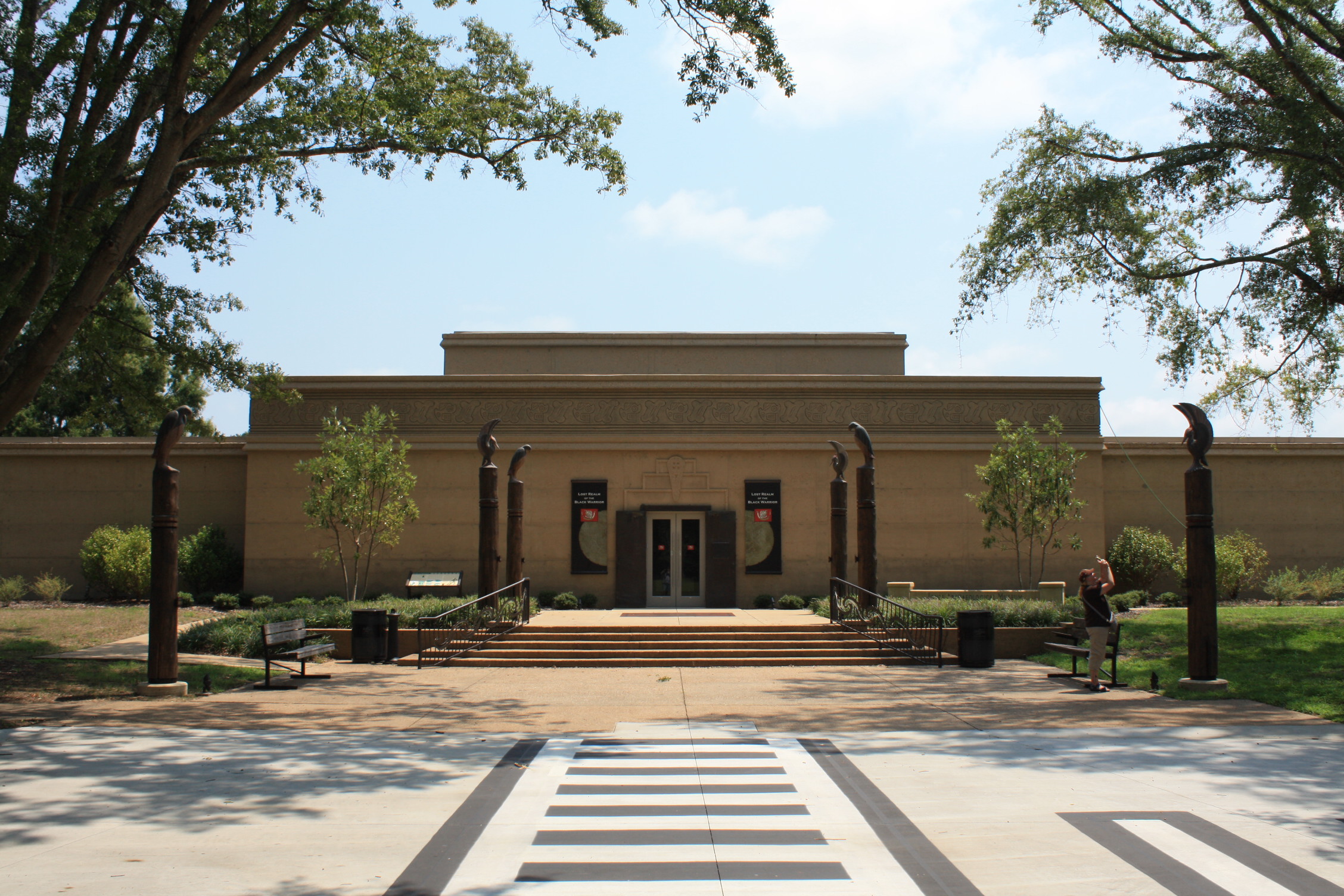
The site first entered the written record in 1848, when E. G. Squier and Edwin Hamilton Davis documented it in their Smithsonian survey, Ancient Monuments of the Mississippi Valley. For decades after, the mounds drew more looters than scholars, and many artifacts were carried off, stratigraphy destroyed. The turning point came in the mid-1920s, when concerned citizens led by geologist Walter B. Jones organized an effort to save what remained. With help from the Alabama Museum of Natural History, they purchased the land containing the mounds. During the 1930s, workers from the Civilian Conservation Corps helped excavate and stabilize the site. In 1991, the park was officially renamed Moundville Archaeological Park. The museum on the grounds, named for Jones, houses artifacts that span the site's four-century occupation.
Ancestors Coming Home
Moundville's story does not end with archaeology. In November 2021, the Native American Graves Protection and Repatriation Review Committee determined that the site was culturally linked to seven Muskogean-speaking tribes. Archaeological evidence traces Moundville's descendants to the Tombigbee and Alabama River regions, connecting the ancient city to the modern Muscogee Nation, Choctaw Nation, and Chickasaw Nation, among others. In 2024, the University of Alabama repatriated human remains and many associated artifacts to the descendant tribes. The population had begun leaving Moundville in the 14th century, dispersing across the Southeast long before European contact, but the connection endured. The mounds still rise above the river, and the people whose ancestors built them are, at last, reclaiming what was taken.
From the Air
Moundville Archaeological Site is located at 33.005N, 87.631W on a bluff above the Black Warrior River in Hale County, Alabama. The nearest airport is Tuscaloosa National Airport (KTCL), approximately 15 nm to the north-northeast. The site's 29 earthen mounds and central plaza are visible from moderate altitude (2,000-4,000 feet AGL) as a distinct geometric pattern of raised platforms in a cleared area along the river's west bank. Approach from the east following the Black Warrior River south from Tuscaloosa for the best perspective on the site's relationship to the river bluff.