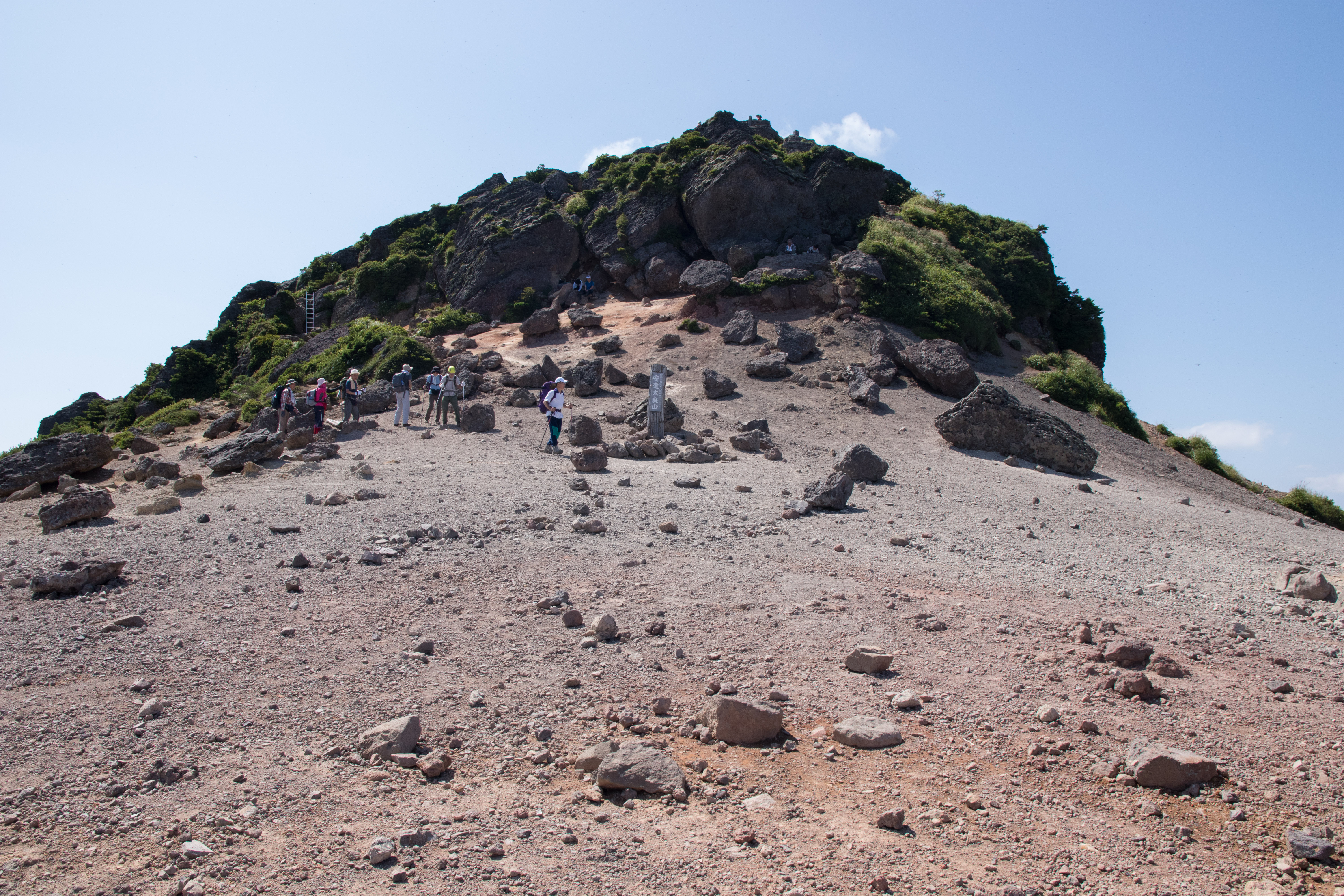
Mount Adatara
Chieko kept saying it: the sky over Tokyo was not the real sky. The real sky, she insisted, was the one you could see above Mount Adatara, back in her home country of Fukushima. Her husband, the sculptor and poet Kotaro Takamura, published those words in his 1941 collection "Chieko-sho" -- poems mourning the wife he had lost to tuberculosis in 1938, after years of watching her mind slip into schizophrenia. The line became one of the most famous in Japanese literature, and it turned this 1,728-meter stratovolcano into something more than geology. Every autumn, when hikers ride the ten-minute ropeway up to the ridgeline and look out over the Adatara range, many of them are searching for Chieko's sky.
The Poet's Mountain
Chieko Takamura was born in the town of Adachi, in what is now the city of Nihonmatsu, at the foot of Mount Adatara. She grew up under that sky before moving to Tokyo, where she became a painter and married Kotaro Takamura, one of Japan's foremost modern sculptors and poets. Their relationship was a partnership of equals -- radical for early twentieth-century Japan. But in 1931, Chieko began showing signs of schizophrenia, and by 1935 Kotaro was forced to commit her. She died of tuberculosis three years later. The poems he wrote in her memory, collected as "Chieko-sho" (Chieko's Sky), are suffused with grief and tenderness. The most famous, "A Portrait of Chieko," contains her declaration that Tokyo's sky was not real -- that the true sky could only be found above Mount Adatara. The poem made the mountain a symbol of purity, longing, and home.
Fire Beneath the Summit
Mount Adatara is no gentle backdrop. It is an active stratovolcano, the highest peak in a range that stretches nine kilometers north to south through central Fukushima Prefecture, roughly fifteen kilometers southwest of the city of Fukushima and east of neighboring Mount Bandai. The summit crater, called Numanotaira, is a stark lunar landscape ringed by fumaroles that hiss sulfurous steam into the mountain air. In the nineteenth century, miners extracted sulfur from that crater. On a July day in 1900, the volcano reminded them who was in charge: an eruption within the crater killed 72 mine workers, injured 10 more, and obliterated the sulfur mine entirely. The crater left behind by that blast still looks otherworldly -- hikers who reach it along the narrow ridgeline called Ushi-no-se, the "cow's back," describe the sensation of standing on the edge of the moon.
A Mountain for Everyone
Despite its volcanic temperament -- the most recent eruption was in 1996 -- Mount Adatara is one of the most accessible peaks in Fukushima. It was selected by mountaineer and author Kyuya Fukada as one of Japan's Hyakumeizan, the 100 Famous Mountains, for its grace, history, and individuality. The Adatara Ropeway at the Adatara Kogen Ski Resort lifts hikers to roughly 1,350 meters in ten minutes, with panoramic views of the Adatara range, distant Azuma Kofuji, and the Zao mountains beyond. From the upper station, even beginners can reach the 1,728-meter summit in about ninety minutes. But the mountain saves its finest spectacle for late September and October, when Japanese oak, beech, and other deciduous trees set the entire mountainside ablaze in yellow, red, and orange. The autumn color, spreading in waves below the ropeway, draws thousands for momiji-gari -- the traditional art of autumn leaf viewing.
Still Watching the Sky
The hot springs that ring the mountain's base have drawn visitors for centuries, and the ski resort keeps the slopes busy through winter. But it is Chieko's sky that lingers. On clear days, standing on the summit with the Tohoku landscape unfolding in every direction, the sky overhead does feel different from the one that hangs over Tokyo -- wider, deeper, a more saturated blue. Whether that is poetry or meteorology or simple altitude, each visitor decides for themselves. Kotaro Takamura spent his final years in a small hut in Iwate Prefecture, still writing, still grieving. He died in 1956. His wife's words outlived them both, fixed forever to this mountain. The sky above Mount Adatara has become one of Japan's most poetic landmarks -- not for anything you can see on the ground, but for what you see when you look up.
From the Air
Located at 37.644N, 140.286E in central Fukushima Prefecture, Japan. Mount Adatara rises to 1,728 meters (5,669 feet) and is the highest peak in the north-south Adatara volcanic range. The summit crater (Numanotaira) with active fumaroles is visible from altitude. The mountain sits roughly 15 km southwest of Fukushima city and east of Mount Bandai. Nearest airport: Fukushima Airport (RJSF), approximately 40 km to the south. The Adatara Kogen Ski Resort and ropeway are visible on the eastern slopes. Caution: active volcanic area with potential sulfurous emissions. Mountain weather can change rapidly; expect clouds forming around the summit.