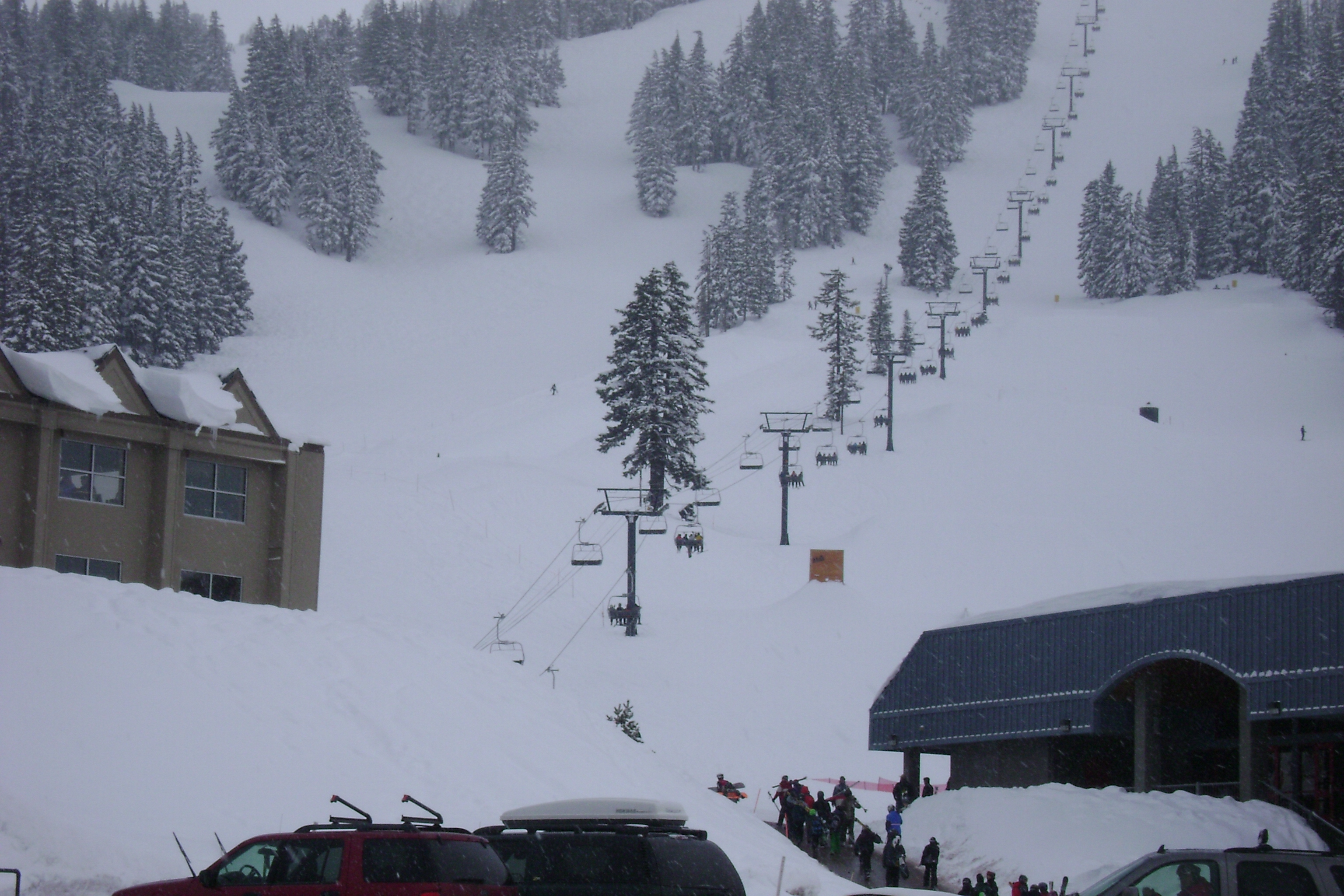
Mount Bachelor Ski Area
In 1983, the Summit Express became only the second high-speed detachable chairlift installed anywhere in the world, and in 1986, the Pine Marten Express followed as the world's first height-adjustable detachable quad. These engineering innovations capture something essential about Mount Bachelor: this is a ski resort that has always pushed boundaries, built on the flanks of an actual volcano in central Oregon's Cascade Range. The mountain earned its current name only in 1983 when the Bend Chamber of Commerce convinced officials to retire the old moniker 'Bachelor Butte' for something more evocative. But the skiing here has been extraordinary since the first black chair started running in 1961, when legendary broadcaster Lowell Thomas flew in from Sun Valley to see what all the fuss was about.
Born from Fire and Snow
Mount Bachelor rises as a stratovolcano in the Cascade Range, its symmetrical cone dominating the landscape west of Bend. The resort wraps around this volcanic peak in a way few ski areas can match: on clear days, skiers can descend in any direction from the summit, a full 360-degree experience made possible by the mountain's isolated position. The volcano's height creates its own weather, pulling moisture from the Pacific Ocean and dumping over 400 inches of snow in typical winters. That maritime influence means the snow often arrives wet and heavy, though Bachelor holds some of the driest conditions relative to other Cascade resorts thanks to its elevation and aspect variety.
The Outback and Beyond
Before the Outback Express existed, adventurous skiers in the early 1970s paid a dollar in advance for the 'Outback Trail Tour,' skiing the northwestern slopes and catching a snowcat ride back to the lodge. The terrain was worth the primitive logistics. In 1975, a proper trail was cut, and by 1976 the Outback double chairlift went in at a cost of $700,000. The investment paid off spectacularly. In 1987, that chair was replaced by a high-speed quad capable of moving 2,800 skiers per hour, and the resort's reputation for serious terrain grew. The 1996 addition of the Northwest Express further expanded the skiable vertical, lowering the minimum lift-served elevation and opening massive new terrain to the west.
Olympic Proving Ground
Mount Bachelor has shaped generations of American ski racing talent. Kiki Cutter trained here before earning five World Cup victories and competing in the 1968 Olympics. Mike Lafferty followed, finishing third in World Cup downhill standings in 1972. The tradition continues: Tommy Ford developed his skills on these slopes before earning eight U.S. Alpine titles and competing in the 2010 Olympics. The resort's challenging terrain parks and consistent snow make it the official training home for numerous Winter Olympic athletes and a regular host for USSA competitions. In 2006, Bachelor's superpipe hosted the Olympic Qualifier event.
A Mountain That Tests You
The 1976 drought nearly broke the resort. Mount Bachelor opened January 2, closed February 14 for lack of snow, reopened briefly February 26, then struggled through to April 30. The estimated $4 million loss took four years to recover. But that crisis sparked innovation: the Nordic program expanded, the main lodge grew, and in 1983 the Summit Express became just the second high-speed detachable chairlift installed anywhere in the world. Today, twelve chairlifts serve terrain that Transworld Snowboarding readers ranked fourth-best in North America in 2003. The mountain also boasts the longest groomed Nordic season on the continent, stretching from late November into June when conditions cooperate.
Where the Cone Calls
Dedicated skiers speak of 'the cone,' a bulge on the mountain's north side accessible only by hiking before the lifts start or after they close. This bootpack culture reflects Bachelor's soul: despite the modern infrastructure, the mountain rewards those willing to earn their turns. The summit chair sits just below the volcano's actual crater rim, close enough that high winds frequently put it on standby. But when the stars align and the chair runs to the top, skiers stand on the edge of a geological feature still classified as potentially active, then drop into runs that flow down every face of this remarkable volcanic cone.
From the Air
Located at 44.003N, 121.677W in the Oregon Cascades. The volcanic cone is highly visible from altitude, appearing as a symmetrical peak west of Bend. Best viewed from 8,000-12,000 feet. Roberts Field (KRDM) in Redmond lies 25nm northeast. The mountain creates its own weather systems; expect turbulence and rapid visibility changes near the summit. Winter operations benefit from approaching from the east where the Deschutes Plateau provides smoother air.