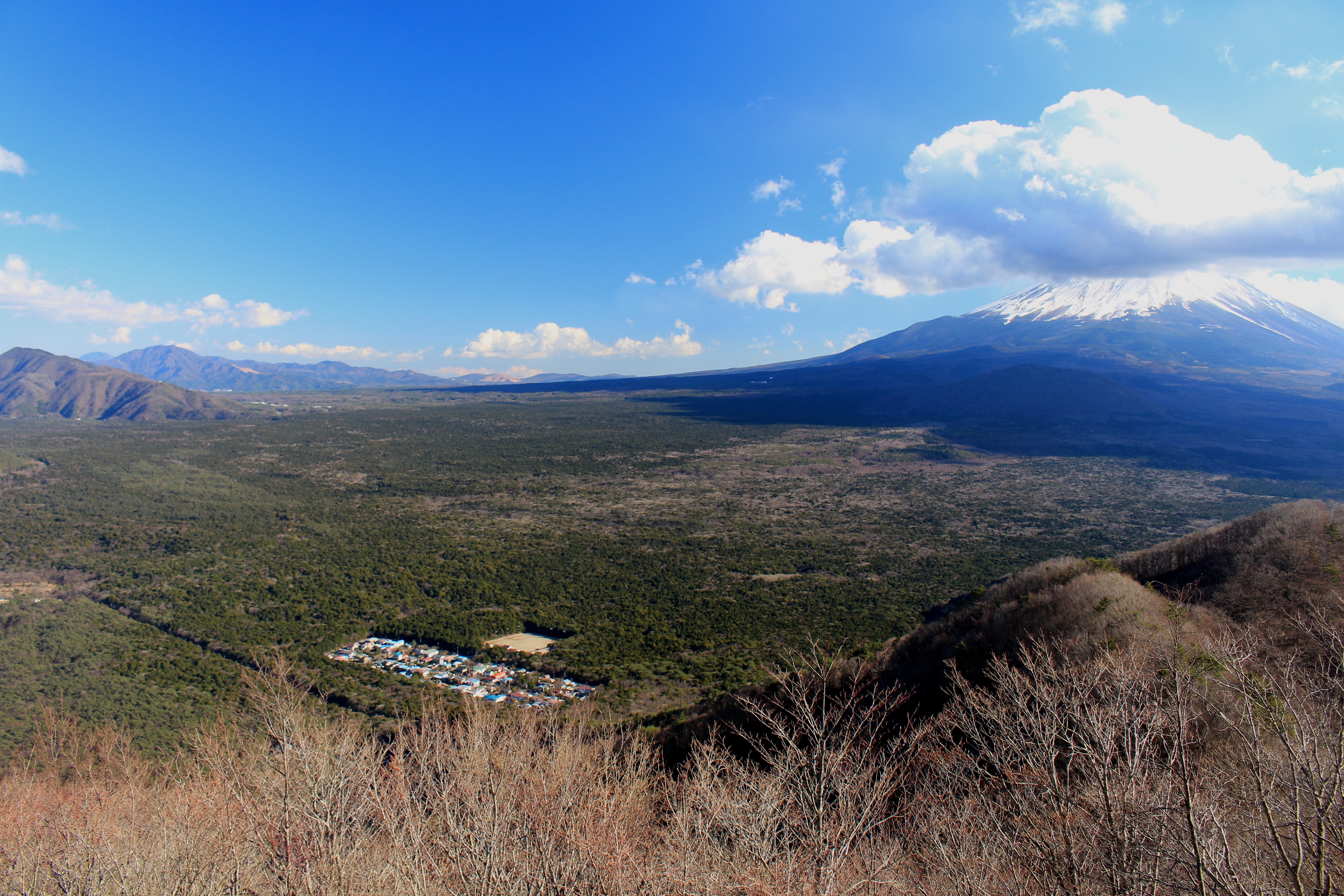
Mount Fuji
A Japanese proverb holds that a wise person climbs Mount Fuji once, but only a fool climbs it twice. Every summer, more than 200,000 people prove themselves wise or foolish on the slopes of this 3,776-meter stratovolcano, many of them ascending through the night to witness goraikou -- the "arrival of light" -- as sunrise gilds the summit crater. The mountain has held this magnetic pull for centuries. Hokusai painted it thirty-six times. Shinto devotees built shrines at its base to appease the volcano's fire goddess. Samurai trained on its flanks. And a woman named Tatsu Takayama defied the ancient ban on female climbers to reach the summit in 1832, four decades before the government formally lifted the prohibition.
Where Three Plates Collide
Mount Fuji sits at one of Earth's most geologically restless intersections, where the Eurasian, North American, and Philippine Sea plates grind together. This triple junction has been building volcanoes here for hundreds of thousands of years. The mountain visible today is actually the youngest of three stacked cones. The oldest, Pre-Komitake, began erupting in the Middle Pleistocene. Komitake formed on top of it, then fell silent around 100,000 years ago. Ko-Fuji -- "Old Fuji" -- rose next, only to be largely buried by Shin-Fuji, the "New Fuji" that began forming 17,000 years ago. The last flank eruption occurred in 1707, sending ash falling on Edo, present-day Tokyo. More than 100 parasitic cinder cones stud the flanks, and over 70 lava tunnels honeycomb the interior. Mount Fuji remains classified as active, and after the devastating 2011 Tohoku earthquake, scientists calculated that magma chamber pressure may have increased -- though direct measurement remains impossible.
Sacred Symmetry
The near-perfect conical silhouette is not just aesthetically striking -- it became theologically significant. In Shinto tradition, Konohanasakuya-hime, goddess of flowering trees and wife of the deity Ninigi, presides over the mountain. Fujisan Hongu Sengen Taisha, the grand shrine at the base, has been dedicated to her for centuries. During the Heian period (794-1185), as volcanic activity subsided, the mountain became a center for Shugendo, a syncretic practice blending mountain worship with Buddhism. By the early 12th century, the monk Matsudai Shonin had established a temple at the very summit. The Edo period brought Fuji-ko, a devotional cult founded by the ascetic Hasegawa Kakugyo, whose followers believed climbing the mountain would purify and rebirth them. The kanji characters chosen for the mountain's name -- meaning "wealth" and "man of status" -- were applied by sound rather than meaning, and the true etymology of "Fuji" remains debated to this day.
The Four Roads Up
Four major routes lead to the summit, each with numbered stations that serve as waypoints and rest stops. The Yoshida route on the north side is the most popular, with extensive mountain huts and the largest parking area at its fifth station. Fujinomiya, on the south side, boasts the highest starting elevation. Subashiri passes through forested lower slopes, and Gotemba offers the longest but most gradual ascent. Most climbers begin at the fifth stations, reachable by bus, and the ascent from there takes five to seven hours. The descent is quicker -- three to four hours. Sir Rutherford Alcock, the first foreigner to summit, managed eight hours up and three hours down in September 1860, then published the first widely read Western account in his book The Capital of the Tycoon. Overtourism has become a serious concern: in 2024, Yamanashi Prefecture imposed a climbing fee (2,000 yen that season, raised to 4,000 yen for 2025) and a daily cap of 4,000 hikers on the Yoshida trail, with gates closing between 4 p.m. and 3 a.m.
Turbulence and Tragedy
Mount Fuji's beauty conceals lethal forces. On March 5, 1966, BOAC Flight 911, a Boeing 707 carrying 124 people, broke apart in clear-air turbulence generated by lee waves downwind of the mountain shortly after departing Tokyo. Everyone aboard perished. A memorial near Gotemba New Fifth Station marks the crash site. The mountain's weather can turn deadly for climbers too -- climbing between October and May is officially discouraged after multiple fatalities in cold conditions. At the summit, temperatures have plunged as low as -38 degrees Celsius, recorded in February 1981. The tundra climate means snow blankets the cone for months; the seasonal snowcap typically appears around October 2, though in 2024 it arrived on November 6, the latest since record-keeping began in 1894. A staffed weather station operated at the summit for 72 years until its closure in September 2004, replaced by automated instruments that continue to monitor the mountain's moods.
Icon in Every Medium
After Edo became Japan's capital around 1600, travelers on the Tokaido road saw the mountain daily, and it saturated Japanese art. Hokusai's Thirty-six Views of Mount Fuji, including the famous Great Wave, made the cone recognizable worldwide. The mountain appears in Japan's oldest surviving narrative, the 9th-century Tale of the Bamboo Cutter, and in countless poems across the centuries. Historian H. Byron Earhart noted that by medieval times, the Japanese considered it "the number one mountain of the known world." Its influence extends far beyond Japan: Mount St. Helens was once called "The Fuji of America" before its 1980 eruption destroyed the symmetry, and New Zealand's Mount Taranaki has doubled for Fuji in film and television. The silhouette inspired the Infiniti automobile logo. Even in radiology, a distinctive brain scan pattern carries the name "Mount Fuji sign." Visible from Tokyo, Yokohama, and on clear days even Chiba and Saitama, the mountain remains inescapable -- a presence that defines Japan's horizon and identity.
From the Air
Mount Fuji (35.3608N, 138.7275E) rises to 3,776 meters (12,389 feet), making it the dominant terrain feature in central Honshu. The summit is visible from well over 100 km in clear conditions. The nearest airport with international service is Mt. Fuji Shizuoka Airport (RJNS), roughly 80 km to the south. Tokyo Haneda (RJTT) is approximately 130 km to the northeast. Pilots should be aware of severe mountain wave turbulence and rotor on the lee side -- the crash of BOAC Flight 911 in 1966 was attributed to clear-air turbulence from lee waves. Recommended viewing altitude is 5,000-8,000 feet AGL when orbiting at a safe distance. The Fuji Five Lakes region to the north provides excellent landmarks for orientation.
Sources
- UNESCO World Heritage - Fujisan, sacred place and source of artistic inspiration
- Mount Fuji Climbing Regulations 2025 - Yoshida Trail
- BOAC Flight 911 - Wikipedia
- Last staff exit Fuji weather station - The Japan Times
- National Geographic - How the first woman defied a ban to climb Mount Fuji
- Snow caps Japan's Mount Fuji to end record delay - Al Jazeera