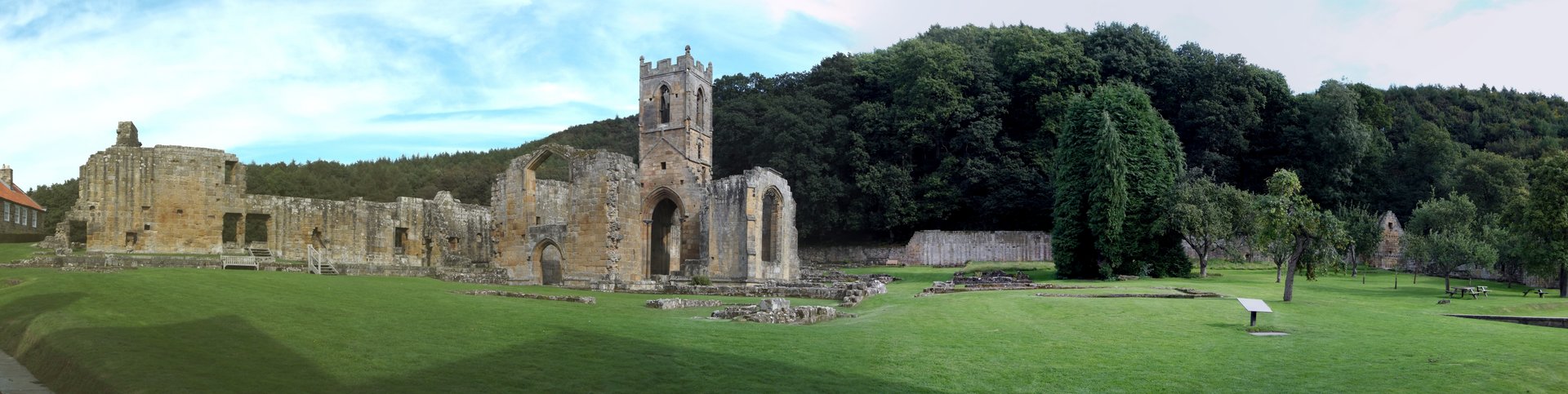
Mount Grace Priory
Most medieval monasteries were communal places: shared dormitories, shared meals, shared worship. Mount Grace Priory was designed for solitude. Founded in 1398 in the woodlands below the Cleveland Hills in North Yorkshire, it was a Carthusian charterhouse, and the Carthusian rule demanded something radical in an age of monastic community: each monk lived essentially alone.
A Cell of One's Own
The Carthusian Order, founded in 1084 in the French Alps, was the strictest of the monastic orders. Its members lived in individual cells, each a small two-story house arranged around a cloister. At Mount Grace, the Great Cloister to the north of the church contained seventeen cells for choir monks, while a smaller Lesser Cloister to the south held six cells for lay brothers. Each cell had its own garden, enclosed by high walls. Food was delivered through an L-shaped hatch in the wall, designed so that the monk could not see the person delivering it and the server could not see the monk. The monks ate alone. They prayed alone. They worked alone in their gardens. They gathered in the church for certain offices, but the rest of their hours were spent in silence and isolation. It was a monastic life stripped to its essentials: prayer, contemplation, and the deliberate absence of human company.
Political Foundations
Mount Grace was founded by Thomas Holland, 1st Duke of Surrey, a nephew of King Richard II. The founding charter, created between February and April 1398 and now held in the collection at Ripley Castle, dedicated the priory to the Blessed Virgin and Saint Nicholas and called for prayers for the king and members of Holland's family. The priory's early years were shaped by the turbulent politics of the late fourteenth and early fifteenth centuries. Nicholas Love, who became prior, forged a connection with the Lancastrian administration by submitting his work The Mirror of the Blessed Life of Jesus Christ to Thomas Arundel, Archbishop of Canterbury and Henry IV's chancellor, in support of the archbishop's campaign against the Wycliffite heresy. In return, Arundel granted the priory confraternity, linking it to the broader network of spiritual and material patronage. In 1410, the house was formally incorporated into the Carthusian order. By the early sixteenth century, the priory held lands in Yorkshire, Lincolnshire, and beyond, generating a gross income of over 382 pounds.
Resistance and Surrender
When Henry VIII demanded the oath of supremacy in 1534, acknowledging the king rather than the pope as head of the English church, some of the Mount Grace monks attempted to refuse. They were imprisoned. Resistance proved impossible to sustain, and the last prior, John Wilson, eventually handed the keys to Henry's representatives. The priory was closed in 1539. In December of that year, the brothers were awarded pensions totaling 195 pounds: sixty pounds plus the use of the house and chapel for the prior, seven pounds each for eight priests, and smaller sums for the remaining eighteen members. It was a more generous settlement than many dissolved houses received, though generosity is a relative term when applied to the confiscation of everything a community had built over 140 years.
Silence Preserved
What makes Mount Grace exceptional is not its history but its survival. Of the nine Carthusian charterhouses that existed in medieval England, Mount Grace is the best preserved and most accessible. The layout of the entire monastery is visible: the church, both cloisters, and the individual cells with their gardens and high walls. One cell has been fully reconstructed, complete with its latrine and the distinctive L-shaped food hatch. Visitors can walk the cloister and understand, physically, what a life of deliberate isolation looked like. The monks were remarkably conscious of sanitation. The reconstructed cell includes a latrine, and the drainage ditches that served as the monastery's sewage system can still be traced. After the Dissolution, the ruins of the guest-house were incorporated into a seventeenth-century manor built by Thomas Lascelles during the Commonwealth period, later converted into an example of the Arts and Crafts movement. The site is now jointly managed by English Heritage and the National Trust, set in the woodlands of the North York Moors National Park. English Heritage lets the Prior's Lodge as a holiday cottage. There is an irony in that: a building designed for the most austere form of monastic isolation is now available for weekend breaks. But the silence of the place endures. The high-walled gardens are still enclosed. The food hatches are still angled to prevent eye contact. Eight centuries after the Carthusians devised their rule, the architecture of solitude remains legible.
From the Air
Located at 54.38N, 1.31W in the North York Moors National Park, set in woodlands below the Cleveland Hills near East Harlsey. The priory layout with its individual cells and cloisters is visible from lower altitudes. The A19 road runs nearby. Nearest airports: EGNV (Teesside International) approximately 15 miles north; EGNM (Leeds Bradford) approximately 35 miles southwest. The surrounding terrain transitions from lowland vale to the escarpment of the Cleveland Hills.