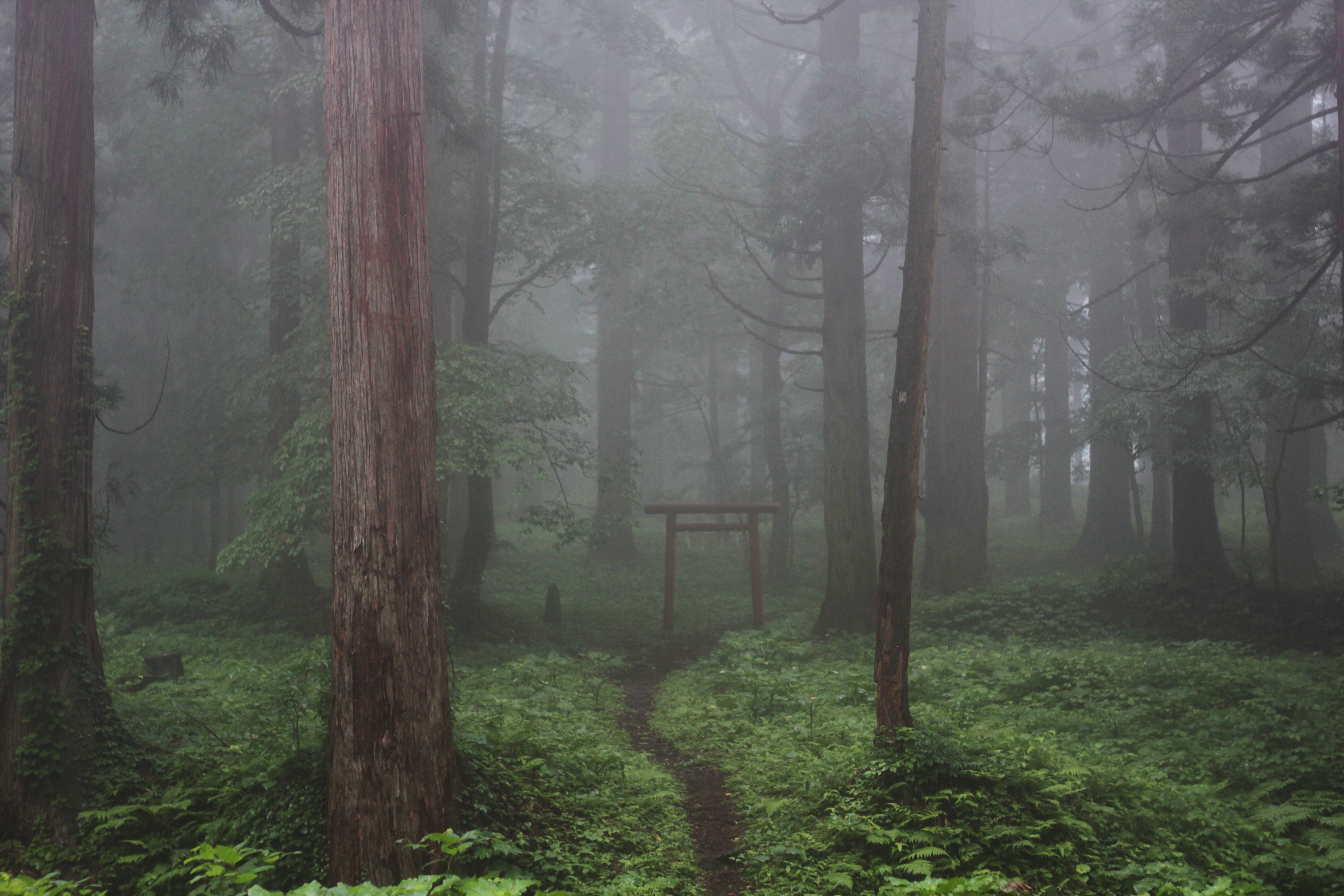
Mount Haguro
During the Edo period, 336 temple lodgings lined the slopes of Mount Haguro. Three hundred and thirty-six places to sleep, pray, and prepare for the climb -- on a mountain that barely crests 414 meters. That extraordinary density of spiritual infrastructure tells you everything about what this place meant, and still means, to Japan. Mount Haguro is the gateway to the Dewa Sanzan, the Three Mountains of Dewa, and the only one of the trio that remains open through the brutal Yamagata winters when deep snow buries the higher peaks of Gassan and Yudono. For over 1,400 years, this has been where the pilgrimage begins.
The Pagoda in the Forest
The approach to Mount Haguro starts in dense forest at the mountain's base, and the first landmark stops most visitors in their tracks. The Goju-no-to -- a five-story wooden pagoda -- rises from the cedar shadows with the quiet authority of something that has stood for roughly six centuries. Designated a National Treasure of Japan, it is the kind of structure that photographs cannot adequately convey: the proportions, the way forest light filters through surrounding trees onto weathered timber, the silence. Beyond the pagoda, the famous stone stairway begins. There are exactly 2,446 steps, laid out in a path that winds upward through Japanese cedar so old and tall they form a canopy that blocks much of the sky. The climb is not steep in any single stretch, but its relentlessness wears on the legs. A teahouse at the halfway mark provides rest, refreshments, and -- for those who want it -- a certificate of having ascended the hard way.
Where Basho Paused to Write
In 1689, the haiku master Matsuo Basho traveled through this region on the journey he immortalized as Oku no Hosomichi -- The Narrow Road to the Deep North. He climbed Mount Haguro and paused along the stone steps to compose poetry. A commemorative stone near the trail marks the spot. Basho's account of Dewa Sanzan helped cement these mountains in Japanese literary culture, but the tradition of pilgrimage here predates him by a thousand years. The mountain was first opened as a religious site in 593 by Prince Hachiko, the eldest son of Emperor Sushun. Fleeing political assassination by the Soga clan, the prince found spiritual purpose in these peaks and established the worship that would draw pilgrims across centuries. The path Basho walked had already been worn smooth by generations of feet.
One Shrine for Three Mountains
The summit of Mount Haguro does not announce itself with a dramatic peak. The trail simply levels out, and after passing through a torii gate, pilgrims find themselves on the grounds of Dewa Shrine. The main hall here, the Sanzan Gosaiden, is unique among the Dewa Sanzan sites: it venerates the deities of all three sacred mountains -- Haguro, Gassan, and Yudono -- under one roof. This makes it possible for pilgrims who cannot reach the snow-locked higher peaks to pay their respects to all three in a single visit. The shrine's status has shifted with Japan's religious history. During the Meiji era, when the government separated Shinto and Buddhism, Hagurosan Shrine was designated a kokuhei shosha, a government-supported shrine. Today it holds equal status as a Beppyo shrine alongside its two companion shrines on Gassan and Yudono.
Gateway for the Yamabushi
Mount Haguro's significance extends beyond tourism or even conventional worship. It serves as the ritual entry point for yamabushi -- mountain ascetic practitioners of Shugendo -- who undertake the full pilgrimage across all three peaks each summer. These practitioners, dressed in white robes and blowing conch shells to announce their passage, follow a discipline that stretches back to the founding centuries of the shrine. The mountain's year-round accessibility makes it the natural starting point: from Haguro, yamabushi proceed to the higher and more challenging Gassan and Yudono. The town of Haguro-machi at the mountain's base still hosts over 30 shukubo -- temple lodgings where pilgrims stay, eat vegetarian cuisine, and observe monastic rhythms. Though the number has dwindled from the Edo period's 336, the tradition of offering shelter to those on spiritual journeys has never ceased. The Saikan temple lodging on the mountain itself continues to welcome travelers who wish to experience the mountain beyond a day hike.
From the Air
Located at 38.70N, 139.98E in western Yamagata Prefecture, northern Honshu. Mount Haguro is the lowest (414m) of the Three Mountains of Dewa and is heavily forested, making it appear as a modest wooded hill from the air amid the larger peaks of Gassan (1,984m) to the southeast. The Shonai Plain stretches to the west toward the Sea of Japan coast. Nearest airport: Shonai Airport (RJSY) approximately 12nm west-northwest. Yamagata Airport (RJSC) lies approximately 50nm to the southeast. The area frequently experiences low cloud and mist, especially during summer and autumn. The town of Tsuruoka sits at the mountain's western base and is the main access point.