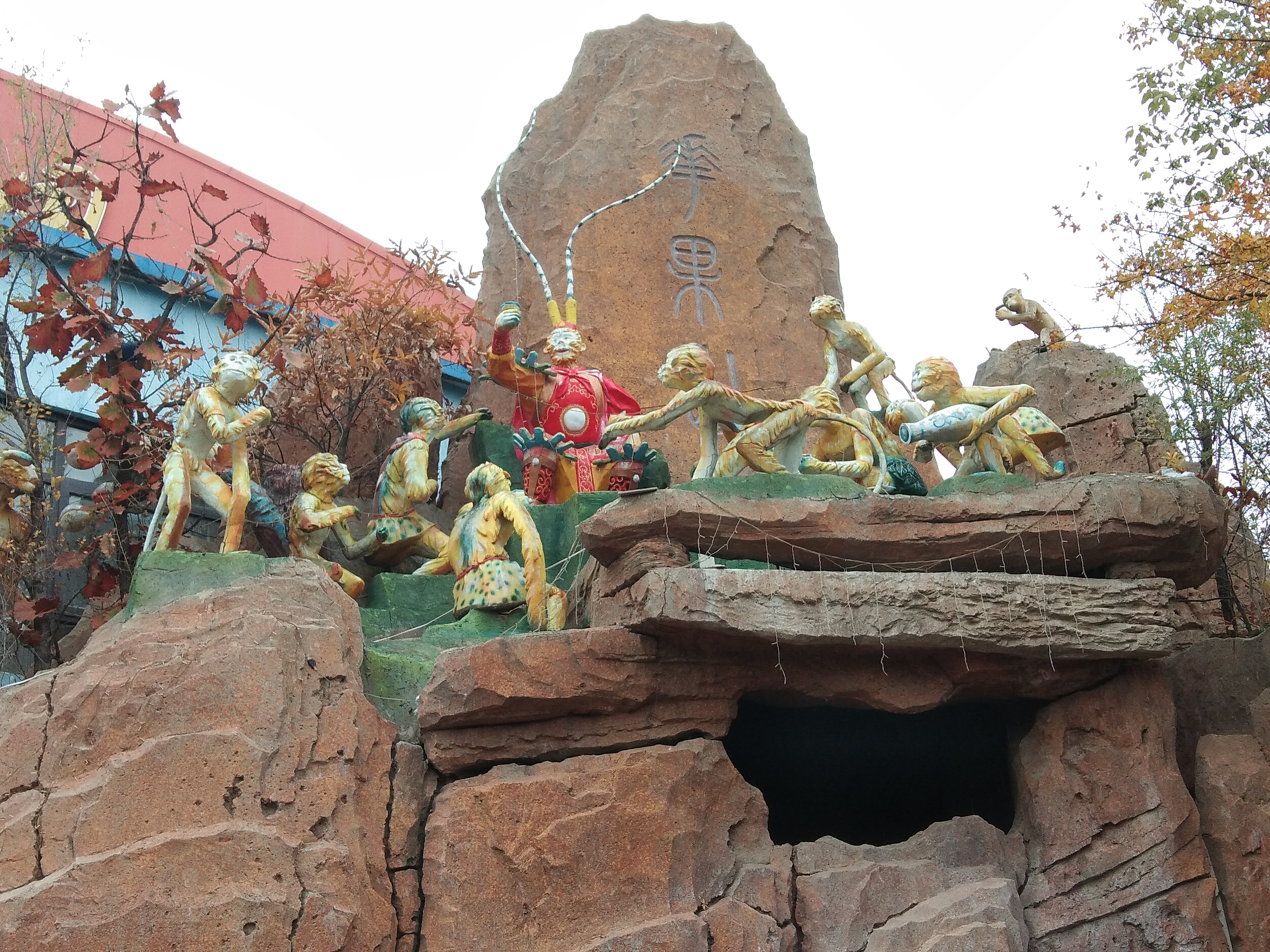
Mount Huaguo
Every Chinese child knows the story: a stone on a magical mountain absorbs the essence of sun and moon until, one day, it cracks open and a monkey leaps out. This is the birth of Sun Wukong, the Monkey King, protagonist of Journey to the West and one of the most beloved characters in world literature. His home is Mount Huaguo -- Flower and Fruit Mountain -- and while the 16th-century novel places it in a mythical Eastern Continent, at least seven real mountains across China have claimed the honor of being its inspiration. The most widely accepted candidate rises near Lianyungang in Jiangsu Province, where folklore, landscape, and literary geography converge.
Where Myth Meets Mountain
In the novel, Mount Huaguo stands in the country of Aolai, a place of waterfalls, hidden caves, and demon populations. Its centerpiece is the Shuilian Cave -- the Water Curtain Cave -- which Sun Wukong discovers by plunging through a thundering waterfall, earning the loyalty of every monkey on the mountain and the title "Handsome Monkey King." The real Mount Huaguo near Lianyungang trades jungle for temperate forest, but it has its own waterfalls, its own caves, and a landscape dramatic enough to feel like the setting the author Wu Cheng'en -- himself from nearby Huai'an -- might have had in mind. A statue of Sun Wukong marks his legendary homeland at the mountain's summit, and tourists flock here to walk through recreated scenes from the novel.
Seven Mountains, One Monkey
The contest for Mount Huaguo's true identity has engaged scholars for decades. In Loufan, Shanxi, researchers found temples dedicated to the Monkey King predating the novel itself. In Shunchang, Fujian, a curator discovered a joint tomb of Sun Wukong and his brothers from the late Yuan or early Ming dynasty. Scholar Du Guichen argued in 2006 that Mount Tai in Shandong was the prototype, pointing to landmarks like Aolai Peak and the Sun-drying Sutra Stone. In Yiyang, Henan, experts noted that the name "Huaguoshan" first appeared in the Northern Song dynasty's Taiping Huanyu Ji, centuries before the novel was written, and that the site's proximity to the hometown of the real monk Xuanzang strengthened the connection. Even Siming Mountain in Ningbo has been proposed, based on its geographical resemblance to the novel's descriptions.
The Origin Stories
Chinese folklore offers multiple accounts of Sun Wukong's supernatural birth. In one version, the bodhisattva Guanyin paused on Flower and Fruit Mountain to meditate on a large rock, and her divine essence caused the stone to give birth to the Monkey King. In another, the mother goddess Nuwa sacrificed herself to repair the sky, transforming into thousands of colorful crystals. One fell onto the mountain, where it spent ages absorbing celestial energy until it produced a stone monkey. These origin stories belong to oral tradition rather than the novel itself, but they reflect how deeply the mountain and its most famous resident are embedded in Chinese cultural imagination -- not just as literary creations but as figures who feel almost historical.
A Mountain That Belongs to Everyone
What makes the Mount Huaguo debate endlessly renewable is that Journey to the West belongs to all of China. Written in the 16th century but drawing on Tang dynasty legends, folk tales, and Buddhist scripture, the novel is a shared inheritance that every region wants to claim a piece of. The mountain near Lianyungang has the strongest traditional association, the most developed tourist infrastructure, and the advantage of being in the same province where Wu Cheng'en lived. But the competing claims from Shanxi, Fujian, Shandong, Henan, and Zhejiang are not frivolous -- each rests on genuine evidence, and each reflects a local tradition of Monkey King veneration that predates modern tourism. Sun Wukong, it seems, has as many homelands as he has admirers.
From the Air
Located at 34.65°N, 119.29°E near Lianyungang, Jiangsu Province. Mount Huaguo is visible as a prominent hill formation east of the city, with tourist infrastructure and the Sun Wukong statue visible at lower altitudes. Nearest airport: Lianyungang Huaguoshan International Airport (ZSLG/LYG) -- named after this mountain -- approximately 10 km to the southeast. At 3,000-5,000 feet AGL, the mountain's forested slopes and the surrounding coastal plain provide good visual contrast.