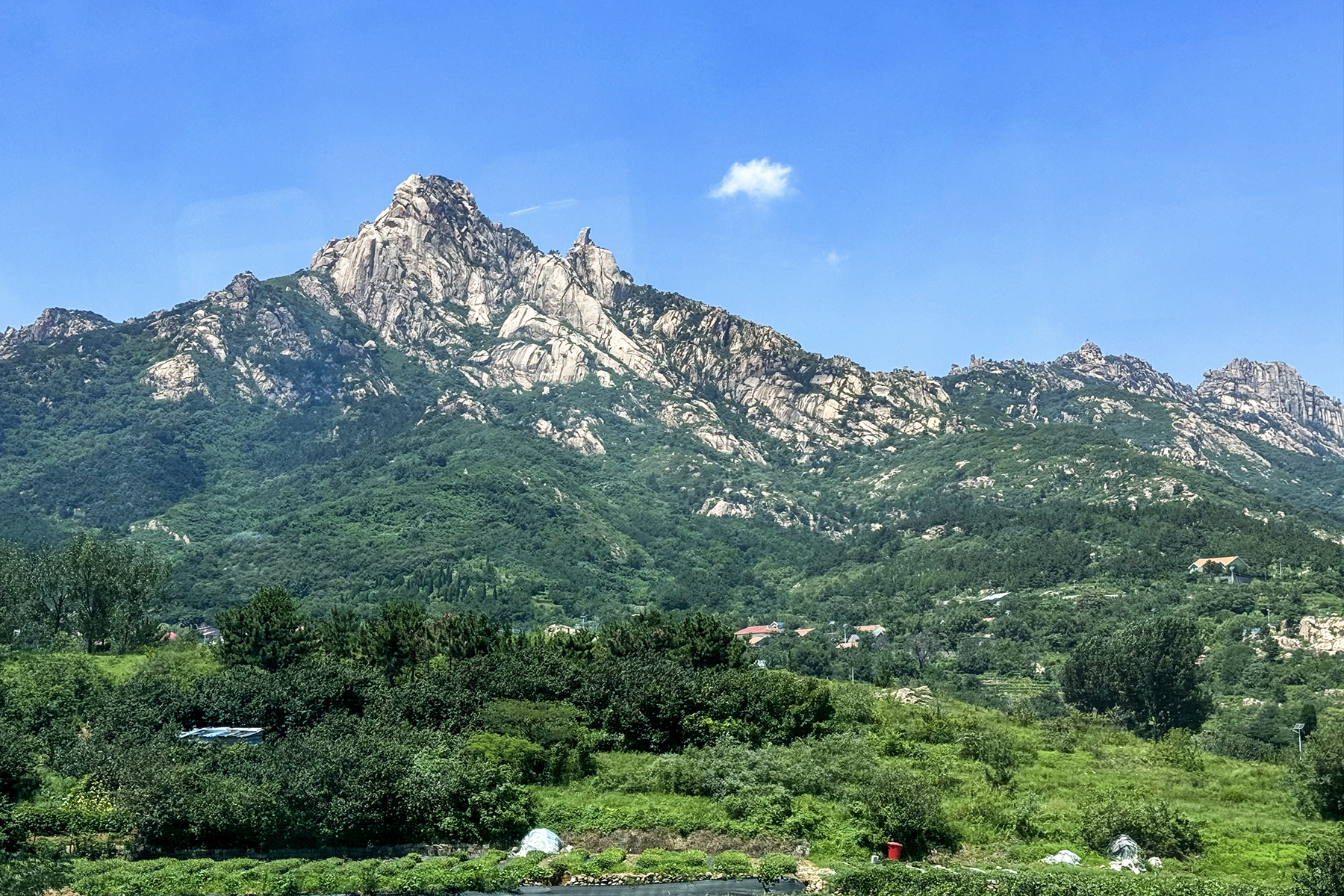
Mount Lao
Genghis Khan's decree is carved into the temple wall. On the grounds of the Temple of Supreme Purity, at the southeastern foot of Mount Lao, an imperial edict granting Taoism official protection has survived nearly eight centuries of dynastic collapse, revolution, and modernization. The mountain itself has endured far longer. Rising 1,132.7 meters from the coast of Shandong Province -- the highest peak that meets the sea anywhere in China -- Mount Lao has been a center of Taoist worship for over a thousand years, home to as many as 1,000 monks and nuns at its peak, and the birthplace of the Complete Perfection School of Taoism.
Where Granite Meets the Sea
The mountain is granite, shaped by Pleistocene glaciers and the meltwater that followed. Its landforms are the work of ice -- jagged peaks, smooth-walled valleys, polished rock faces that catch the light differently as the sun moves across the sky. Thirty kilometers northeast of downtown Qingdao, Mount Lao occupies a national park covering 446 square kilometers, large enough to contain six designated scenic areas. The Chinese have traditionally recognized twelve canonical sceneries on the mountain, each with a poetic name: Taiqing Suiyue, bright moon reflected in temple spring water; Jufeng Xuzhao, the rising sun illuminating the highest peak; Longtan Penyu, water cascading from the dragon pool. These are not just descriptions but invitations -- ways of seeing that have been cultivated for centuries.
The Temples of Purity
The Temple of Supreme Purity is the largest temple complex on Mount Lao, first built during the Northern Song dynasty and rebuilt during the reign of the Wanli Emperor in the Ming dynasty. Its main structure, the Hall of the Three Pure Ones, houses statues of the Taoist Trinity. Two ancient cypress trees in the courtyard are said to have been planted during the Han dynasty. A natural spring called Shenshui -- Immortal Water -- feeds from the mountain's underground reservoirs. The Qing dynasty writer Pu Songling is said to have resided here in his later years, and his stories from Strange Stories from a Chinese Studio are set on the mountain, specifically referencing the peonies and camellias that grow in the temple grounds. Higher up the slope, the Temple of Great Purity dates to the Yuan dynasty, rebuilt between 1297 and 1307, making it one of the oldest surviving structures on the mountain.
Emperors, Martial Artists, and Gamblers
Mount Lao collects legends the way its granite collects mist. The emperor Qin Shi Huang is said to have visited, hoping to meet immortals and gain immortality. Emperor Wu of Han came with the same ambition. The Taoist Master Changchun -- Qiu Chuji, who served as Genghis Khan's top religious affairs official -- knew the mountain well enough to call it by an older name, Mount Ao. In a different register entirely, the martial arts style of Northern Praying Mantis is attributed to Wang Lang, who is said to have developed it while living on the mountain. A stone statue of Wang Lang stands there today. And in a tradition that bridges the sacred and the profane, gamblers visit a famous tree on Mount Lao, believing that three pats on its trunk will bring luck with money.
Water, Tea, and Beer
Mount Lao's underground springs do not only feed ancient temples. The spring water from these granite aquifers is used to brew Tsingtao beer, making Mount Lao indirectly responsible for one of China's most recognized exports. The mountain is also famous for its green tea -- Laoshan green tea, grown in the mineral-rich soil at elevations where coastal fog and mountain air create ideal growing conditions. During the 2012 Golden Week holiday, approximately 176,000 visitors came to hike the trails and visit the temples. The mountain carries a 5A government tourism rating, the highest available, recognition that what draws people here is not just scenery or history but the accumulated weight of both -- a landscape where every waterfall has a name, every temple has a spring, and the water itself flows from mountain to teacup to beer bottle.
From the Air
Mount Lao rises to 1,132.7 meters at approximately 36.19N, 120.59E on the southeastern coast of the Shandong Peninsula, about 30 km northeast of downtown Qingdao. The mountain is a prominent terrain feature visible from significant altitude, with its granite peaks meeting the East China Sea. Maintain safe altitude for terrain clearance. Nearest airport: ZSQD (Qingdao Jiaodong International Airport).