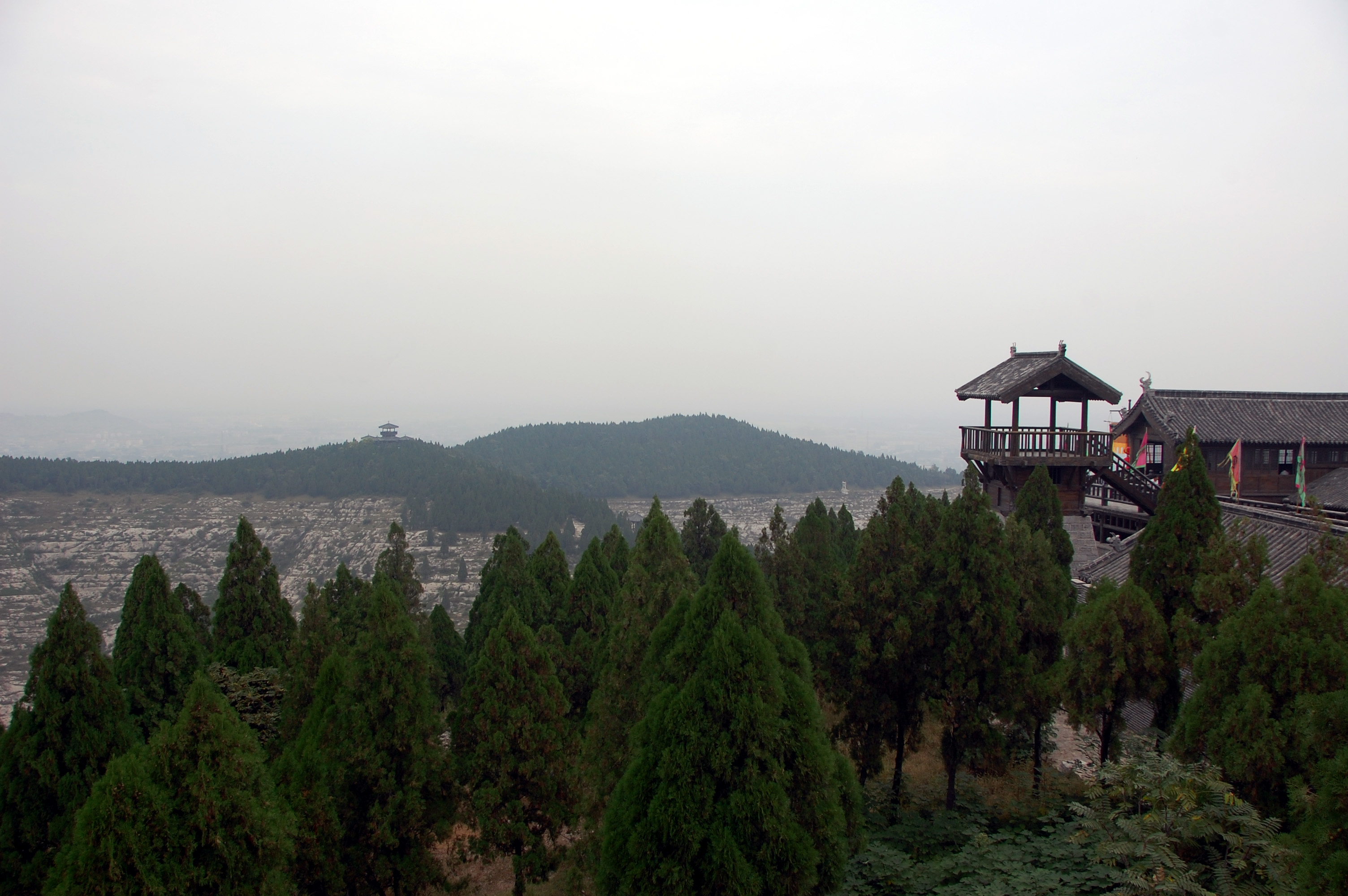
Mount Liang
"In 36 feasting towers, there is enough food for a million soldiers and their mounts." So a Yuan dynasty play describes Mount Liang, imagining it as an impregnable fortress ringed by 72 deep rivers and garrisoned with hundreds of warships. The reality is more modest: a hill in Liangshan County, Shandong, rising just 197.9 meters above sea level. But from this unprepossessing summit, one of the greatest works of Chinese literature took its name and its soul. Water Margin, the classic novel of righteous outlaws, placed its 108 heroes here, and the legends that inspired that novel grew from real bandits who once roamed the vast marshes that surrounded this mountain.
A Prince's Tomb, a Bandit's Fortress
The mountain takes its name from the Prince of Liang, a son of Emperor Wen of the Han dynasty, who was buried here after his death. But the prince's association with the mountain has been thoroughly overshadowed by the outlaws who came centuries later. From prehistoric times, the area around Mount Liang was surrounded by the largest marshland in North China, known as the Daye Marsh and later the Liangshan Marsh. During the Song dynasty, when the Yellow River flowed through this region, the mountain stood at the northern edge of what became known as the "eight hundred li moorage of Mount Liang," a vast expanse of water, reeds, and mud where government control was nearly nonexistent.
Righteous Bandits
Because the marshes straddled the frontiers of several administrative units, no single authority took responsibility for policing them. Outlaws and bandits thrived in this jurisdictional void during the Song dynasty. Some preyed selectively on the wealthy, earning the designation "righteous bandits" and the admiration of peasants who saw them as champions against corrupt officials. Interestingly, the historical Song Jiang, who appears as a major character in Water Margin, was not actually associated with Mount Liang. The novel's author, Shi Nai'an, grafted Song Jiang's story onto the mountain's existing bandit legends, creating a composite narrative that drew from multiple real locations and historical figures. The result was a fictional Mount Liang far grander than the real one: a plateau ringed by high mountains and protected by six passes and eight fortresses.
When the Marshes Disappeared
The landscape that made Mount Liang a credible outlaw refuge began to change in 1289, when the Yellow River shifted course and the surrounding marshes started to shrink. By the Ming dynasty, the great marsh had fragmented into five smaller wetlands. After the Yellow River shifted back to its northern course in 1853, sediment carried downstream gradually filled in what remained. Human land reclamation finished the job. Today, Dongping Lake is all that survives of the marshes that once defined this landscape. The transformation is disorienting: the mountain that Water Margin describes as unreachable by imperial armies now sits in dry farmland, a few kilometers from the modern county seat and 80 kilometers west of the Beijing-Shanghai railway.
Literature Made Landscape
In recent years, considerable effort has gone into developing Mount Liang as a tourist destination, with new buildings erected to match descriptions from Water Margin. It is an unusual project: constructing physical reality to match fiction, rather than the other way around. The Shuipo Liangshan scenic area invites visitors to walk through a landscape that never existed as described, experiencing a literary creation as if it were historical preservation. Banditry continued on the real Mount Liang until the mid-17th century, when the Qing dynasty established a military garrison in what is now Liangshan County, finally bringing the area under consistent government control. But by then, the legends had already escaped the mountain. Water Margin had traveled further than any bandit ever could.
From the Air
Located at 35.787N, 116.093E in Liangshan County, Shandong Province. Mount Liang rises modestly to 197.9 meters in otherwise flat terrain, with Dongping Lake visible to the east as a remnant of the historic marshlands. The mountain is 80 km west of the Beijing-Shanghai railway corridor. Nearest airports include Jining Da'an Airport (ZSJG) approximately 60 km east and Heze Mudan Airport to the southwest.