Mount Lowe Railway
Three million candlepower swept across the Los Angeles basin from Echo Mountain in 1894. The searchlight, purchased from the Chicago World's Fair, was so powerful that publicist George Wharton James claimed he could read a newspaper by its beam on Catalina Island, twenty-six miles away. Residents announcing birthdays could arrange to have the light shine on their homes. The beam also stirred up horses, interrupted revival meetings, and invaded lovers' privacy until the 1930s, when authorities finally declared it a public nuisance. The searchlight was merely one attraction of the Mount Lowe Railway, a Victorian engineering marvel that carried tourists from the floor of the San Gabriel Valley to the crest of the mountains on a combination of electric trolley and cable-driven incline.
Thaddeus Lowe's Electric Mountain
Thaddeus S.C. Lowe had already made his name generating hydrogen gas for Union Army observation balloons during the Civil War when he turned his attention to the San Gabriel Mountains. With civil engineer David Macpherson, a Cornell graduate, Lowe built what would become one of only two scenic mountain electric traction railways in the United States. The railway opened on July 4, 1893, climbing from Mountain Junction in Altadena through the Poppyfields district to Rubio Canyon. There, at the Rubio Pavilion - a platform spanning the canyon with an integrated twelve-room hotel - visitors could view eleven named waterfalls before boarding the Great Incline. The incline's grade changed three times, from a steep 62 percent at the base to a gentler 48 percent at the summit, with cars designed to adjust smoothly to each transition.
White City in the Sky
Echo Mountain became a self-contained resort complex. The 40-room Echo Chalet opened on the railway's first day; by November 1894, the 80-room Victorian Echo Mountain House rose as a luxury facility meant to rival the Hotel Del Coronado in San Diego. Lowe installed a telescope and observatory, hoping to establish Mount Lowe as the astronomical center of the San Gabriels. He recruited astronomer Lewis Swift, whose reputation for discovering comets preceded him. Given the absence of light pollution, Swift discovered 95 new nebulae from the Echo Mountain vantage point. A menagerie housed lynxes, raccoons, snakes, and a black bear. Lowe piped hydrogen gas from his Pasadena plant some three miles uphill to fuel the heating and lighting systems before electricity made the technology obsolete.
The Alpine Division's Vertiginous Views
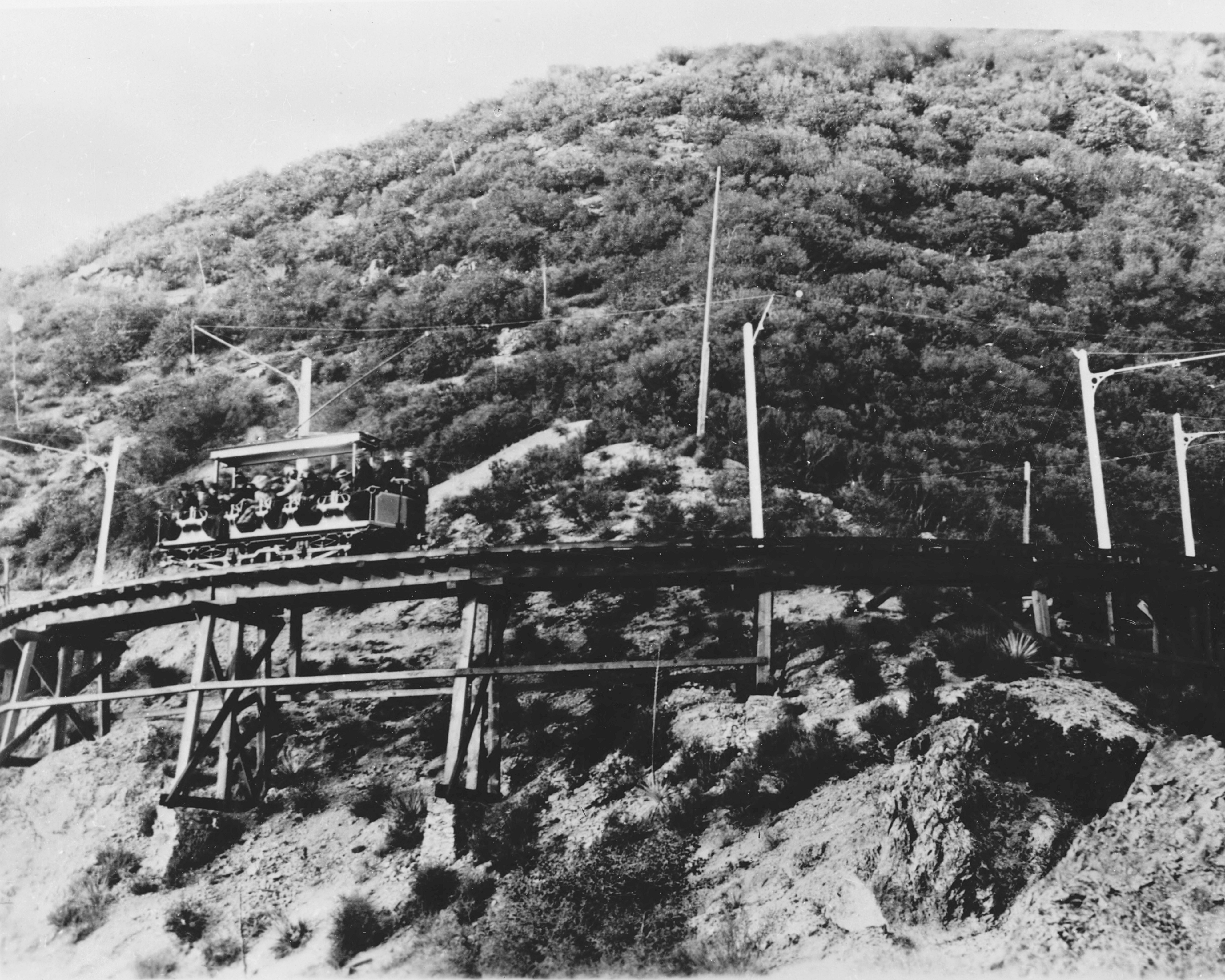
Beyond Echo Mountain, the Alpine Division carried passengers across three canyons on narrow-gauge track to the foot of Mount Lowe. Limited electrical power meant only one trolley could operate at a time. The route featured a point called Cape of Good Hope, cut around a bluff, and the ironically named longest straight track - just 225 feet. At Circular Bridge, passengers looked down at a 340-degree turn negotiating a switchback over what resembled a section of roller coaster, with a view almost straight down from the side of the car. The line ended at Crystal Springs, where Ye Alpine Tavern offered tennis courts, mule rides, a silver fox farm, and a wading pool. Visitors could purchase souvenir photographs taken by official photographer Charles Lawrence from his scaffold at the incline's summit - everyone aboard the car included, of course.
Disasters and Decline
Lowe's railway was never profitable. By 1898 it fell into receivership, and Congress, realizing the entire operation sat on federal land in the San Gabriel Timberland Reserve, awarded control to Jared Sidney Torrance. The Echo Mountain House burned in 1900, grossly underinsured. In 1905, a fierce wind ripped the roof from a newly built casino, hurling it onto the power station and igniting a fire that razed everything except the observatory. A 1909 flash flood destroyed the Rubio Pavilion and buried a caretaker's child in mud; three siblings who knew how to operate the incline cars escaped to the summit. In 1928, Santa Ana winds collapsed the observatory; curator Charles Lawrence barely escaped alive but had wisely packed the expensive lenses beforehand. The instrument now resides at Santa Clara University.
Ruins on the Mountainside
The Mount Lowe Tavern, rebuilt with a brick annex in 1925, burned from an electrical fire in September 1936. Two years later, floods washed railway property off the mountainsides, and the line was officially abandoned. Over its 45 years, an estimated three million people had ridden the railway. Henry Ford visited in 1922 and returned with a Hollywood film crew to document the journey; that footage survives at the Library of Congress. Today, hikers can trace the old right-of-way past concrete foundations, rusting wheel assemblies, and the bull wheel salvaged from the Incline Powerhouse before its 1962 demolition. The railway was placed on the National Register of Historic Places in 1993, exactly a century after its opening day, with the listing expanded in 2015. Echo Mountain's ruins mark where birthday searchlights once swept across the basin and astronomers discovered nebulae in unpolluted darkness.
From the Air
Located at 34.21N, 118.12W in the San Gabriel Mountains above Altadena, California. The former railway route climbs from approximately 1,300 feet at Mountain Junction to 3,200 feet at Echo Mountain and 5,000 feet at the Alpine Tavern site. Ruins are visible on clear days as cleared areas and foundation remnants on the mountainside. Nearest airports are Bob Hope Burbank (KBUR) 12nm west and El Monte (KEMT) 8nm south. Mountain weather can produce rapid visibility changes; Santa Ana winds historically caused multiple disasters at this site.