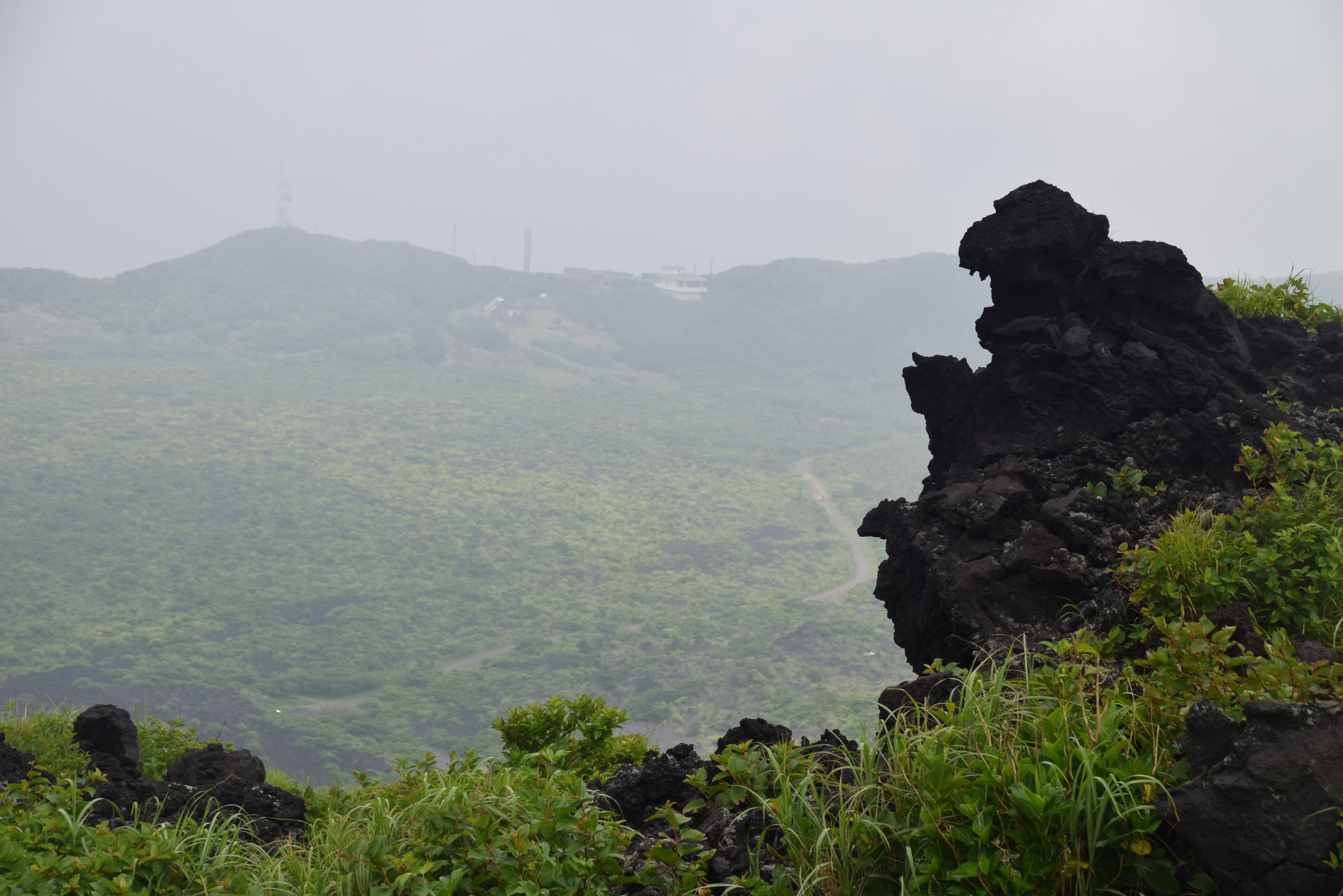
Mount Mihara
In 1933, nine hundred and forty-five people threw themselves into the same volcano. Mount Mihara, the 758-meter active cone at the heart of Izu Oshima island, had become something no one intended -- a magnet for despair, its open crater offering a terrible finality that drew crowds of the suicidal from mainland Japan. Authorities eventually erected fences and barriers, but the mountain's dark chapter had already burned itself into Japanese cultural memory. Today, Mount Mihara is better known for a different kind of drama: the spectacular 1986 eruption that lit the night sky with lava fountains taller than any skyscraper on Earth, and the Hollywood-scale fiction it has inspired.
Fire and Basalt
Mount Mihara is a predominantly basaltic stratovolcano that erupts at intervals of roughly 100 to 150 years for its major events, with smaller eruptions cycling every 30 to 40 years. The 1986 eruption was the defining modern event. Lava fountains shot 1.6 kilometers into the air -- nearly a mile high -- while a subplinian ash column climbed to 16 kilometers altitude. The eruption involved central vent activity, radial fissure eruptions, explosive blasts, flowing lava, and a churning lava lake. Its Volcanic Explosivity Index rating of 3 placed it in the same category as major historical eruptions worldwide. Every one of the island's 12,000 residents was evacuated by a fleet of dozens of military and civilian vessels. A previous major eruption in 1965 had also forced evacuation. The volcano last rumbled in 1990, and today its alert level sits at 1 -- active but quiet.
The Year of the Crater
The tragedy began on February 12, 1933, when twenty-one-year-old Matsumoto Kiyoko jumped into Mount Mihara's crater. She and her classmate Tomita Masako had traveled to the volcano together as part of a planned joint suicide -- a tradition known in Japanese as shinjuu. But at the rim, a guard stopped Tomita. Kiyoko went alone. The story that followed was explosive. Newspapers seized on the details: two young women, a forbidden relationship, a volcanic death. When it emerged that Tomita had purchased a round-trip ferry ticket and had previously accompanied another suicidal student to the crater, the press branded her a suicide guide. The sensationalized coverage triggered a horrifying wave of imitation. By the end of 1933, 945 people had leaped into Mount Mihara. Authorities built fences around the crater's edge and eventually made it a criminal offense to purchase a one-way ticket to the island.
Prison for Monsters
Mount Mihara's dramatic crater has proven irresistible to Japanese filmmakers. In the 1965 debut of the Gamera franchise, the military lures the giant turtle to Izu Oshima and traps it inside a rocket built on the island's slopes. Nearly two decades later, the 1984 film The Return of Godzilla used Mount Mihara as Godzilla's prison -- the King of the Monsters falls into the magma-filled crater after the Japan Self-Defense Forces detonate charges around the rim. In the 1989 sequel, Godzilla vs. Biollante, bombs planted on the mountain trigger an eruption that frees the creature. Koji Suzuki's horror novel Ring wove Mount Mihara into its mythology as well: the character Shizuko Yamamura predicts the volcano's eruption using psychic abilities, and later leaps into the crater in despair. The 1998 film adaptation carried these scenes to global audiences, embedding Mount Mihara in the nightmares of a generation.
Walking the Caldera Today
Modern visitors to Mount Mihara find a landscape transformed by centuries of eruption. The summit area features a broad caldera with stark lava fields, steaming fumaroles, and trails that wind along the crater rim offering views across the Pacific to the distant silhouette of Mount Fuji on clear days. The Izu Oshima Volcano Museum in Motomachi documents the mountain's geological history and the 1986 evacuation. The volcanic soil supports dense camellia forests on the lower slopes, and the island's famous Ura-Sabaku -- a barren stretch of volcanic rock and ash sometimes called Japan's only desert -- spreads across the eastern flanks. Hot springs heated by the magma chamber below draw visitors year-round. The mountain that has terrified and fascinated Japan for centuries now offers something rarer than spectacle: the chance to stand on an active volcano and feel the planet breathing beneath your feet.
From the Air
Mount Mihara sits at 34.72N, 139.39E on Izu Oshima island, approximately 100 km south-southwest of Tokyo. The volcanic cone rises to 758 meters (2,487 ft) and is clearly visible from altitude as the central peak of the roughly circular island. The summit caldera and dark lava fields provide strong visual contrast against the surrounding green forest. Oshima Airport (RJTO) lies on the island's northwest coast with a 1,800-meter runway. Nearest mainland airports: Tokyo Haneda (RJTT) approximately 100 km northeast, Chofu (RJTF). Expect orographic cloud buildup around the peak, especially in humid conditions. The Izu island chain extends south from here, providing a visual trail of volcanic islands.