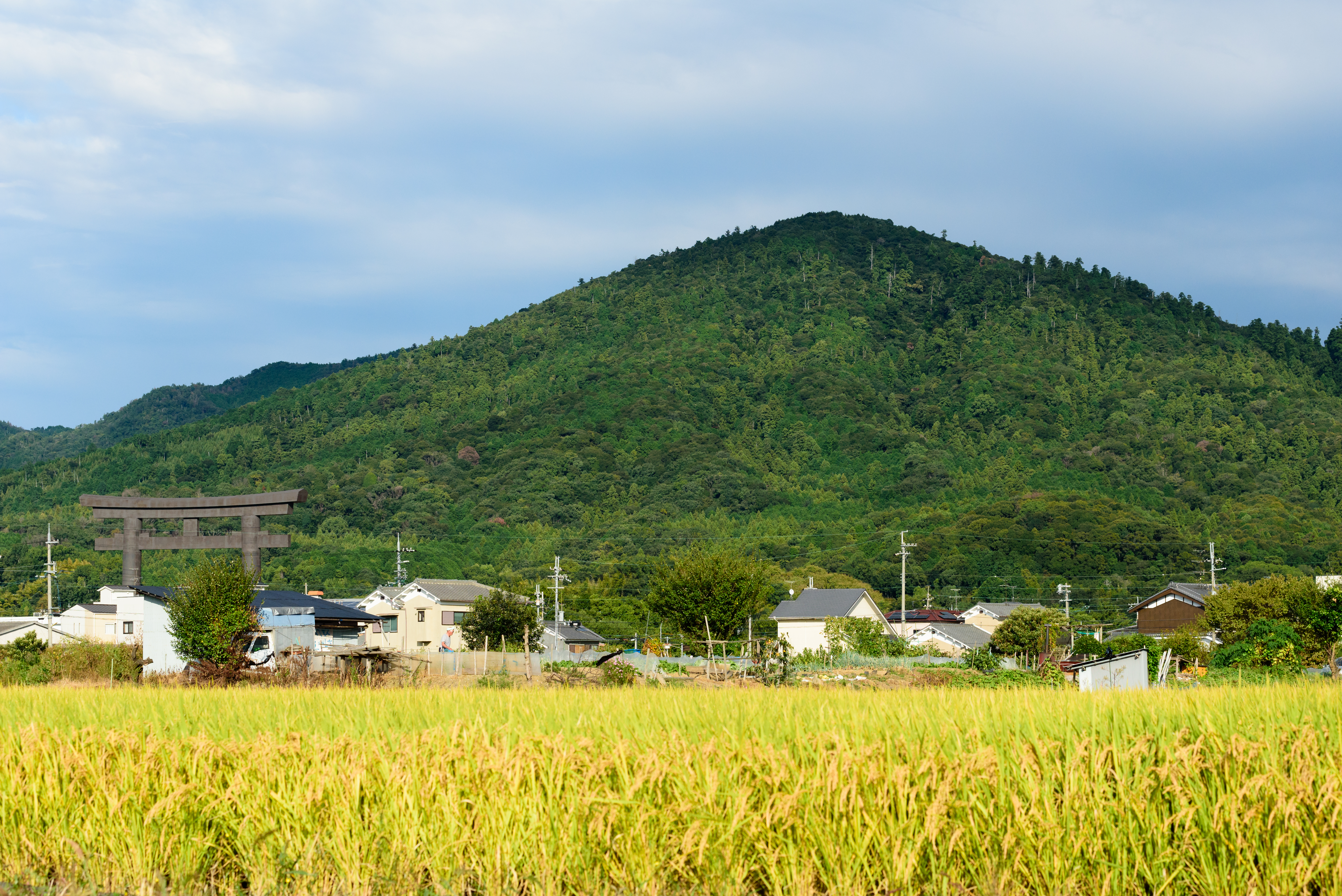
Mount Miwa: The Sacred Peak That Shaped a Kingdom
When Japan's oldest chronicles needed to explain how a plague ended, how a royal lineage began, and how a scattered people became a kingdom, they kept returning to the same place: a modest cedar-covered peak in what is now Nara Prefecture. Mount Miwa rises only 467 meters, barely a foothill by Japanese alpine standards, yet the Kojiki and Nihon Shoki -- the two foundational texts of Japanese history -- weave it into story after story, century after century. The mountain is the physical body of the kami Omononushi, a rain god linked to the powerful Okuninushi. No temple sits on its summit. No statue marks its peak. The entire mountain, from the cedar roots at its base to the rock at its crown, is the sacred object. When the Fujiwara clan -- the most powerful family in classical Japan -- needed to identify the mightiest kami in the land, they pointed here.
The God Who Demanded His Own Priest
The Nihon Shoki records that Emperor Sujin, the tenth emperor, faced a nation crippled by pestilence. He consulted the gods. The kami Omononushi spoke through the mouth of Princess Yamato-to-to-hi-momoso-hime, revealing himself as the deity of Mount Miwa. He promised to end the chaos if he were properly worshipped -- but not by just anyone. The kami demanded a specific man named Otataneko, described as his own half-divine child, to lead the rituals. The emperor found Otataneko, installed him as head priest, and the plague subsided. Crops recovered. This founding narrative established both the shrine's priesthood and the Miwa clan, Otataneko's descendants. Scholars read the story as evidence of a political marriage between the Yamato court and the established Miwa region -- an alliance sanctified by wrapping it in divine authority.
Three Loops of Thread
The myths of Mount Miwa are rich with serpent imagery and uncanny visitations. The Kojiki tells how a beautiful young woman named Ikutama-yori-hime was found to be pregnant, claiming a handsome stranger came to her only at night. Her parents devised a plan: sprinkle red earth by the bedside and thread a needle through the hem of the visitor's garment. In the morning, the hemp thread ran through the keyhole of the door, and when they followed it, the trail led to the shrine on the mountain. Only three loops of thread remained on the needle -- and those 'three rings' gave Mount Miwa its name, since 'miwa' can be written with the characters for 'three' and 'ring.' The serpent god had been visiting in human form. A later story tells of Princess Yamato-to-to-hi-momoso-hime, appointed consort to Omononushi, who begged to see her husband's true form. The kami warned her not to be shocked, then appeared as a magnificent snake inside her comb box. Her shriek of surprise drove the deity back to the mountain.
Tombs at the Mountain's Feet
Yamato leaders ruled from palaces near sacred mountains and chose to be buried in their shadows. Six keyhole-shaped tumuli have been found in the Shiki area at Mount Miwa's base, built between 250 and 350 AD during the Kofun period. All six are exceptionally large -- twice the size of comparable burial mounds found in Korea -- and contain extraordinary concentrations of bronze mirrors, weapons, ornaments, and finely crafted wood and bamboo coffins. The mounds share the same keyhole shape and stone chamber construction, suggesting a continuous ruling lineage. Archaeologists read these tombs as evidence of a centralizing Yamato state: the rulers buried here commanded enough resources and labor to construct monuments on a scale unprecedented in the region. Religious objects and pottery found on the mountain's slopes further confirm that Mount Miwa was not just a burial ground but an active ritual site across centuries.
Cedar, Poetry, and a Novelist's Sword
Japanese cedar -- cryptomeria -- blankets Mount Miwa and has been considered sacred here since antiquity. The trees are old enough that the mountain has its own micro-ecology, and the forest canopy filters the light into something hushed and green even at midday. Princess Nukata, one of the finest poets of the seventh century, composed a waka about Mount Miwa that was included in the Man'yoshu, Japan's oldest surviving anthology of poetry. More than a millennium later, Yukio Mishima set a kendo tournament on the mountain in his 1969 novel Runaway Horses, drawn to the site's layered associations with martial spirit and ancient divinity. Mount Miwa was first described in the Kojiki as Mount Mimoro; both names were in use until the reign of Emperor Yuryaku, after which the current name became standard. Even the name's meaning is debated -- 'miwa' may derive from 'august, beautiful hall,' though the kanji used today are purely phonetic.
From the Air
Located at 34.535N, 135.867E in the Yamato Basin of Nara Prefecture. Mount Miwa (467m) is a rounded, cedar-covered peak rising distinctly from the flat basin floor east of Sakurai city. From altitude, it stands out as an isolated green dome surrounded by rice paddies and low development. The six Kofun-period burial mounds at its base may appear as raised geometric earthworks from lower altitudes. Best viewed at 3,000-5,000 feet AGL from the west or north to appreciate the mountain's isolated profile against the Yamato hills. Nearest major airports: Osaka Itami (RJOO) approximately 30 NM west-northwest; Kansai International (RJBB) approximately 40 NM southwest. Be aware of the Nara Basin's occasional haze, especially in summer months.