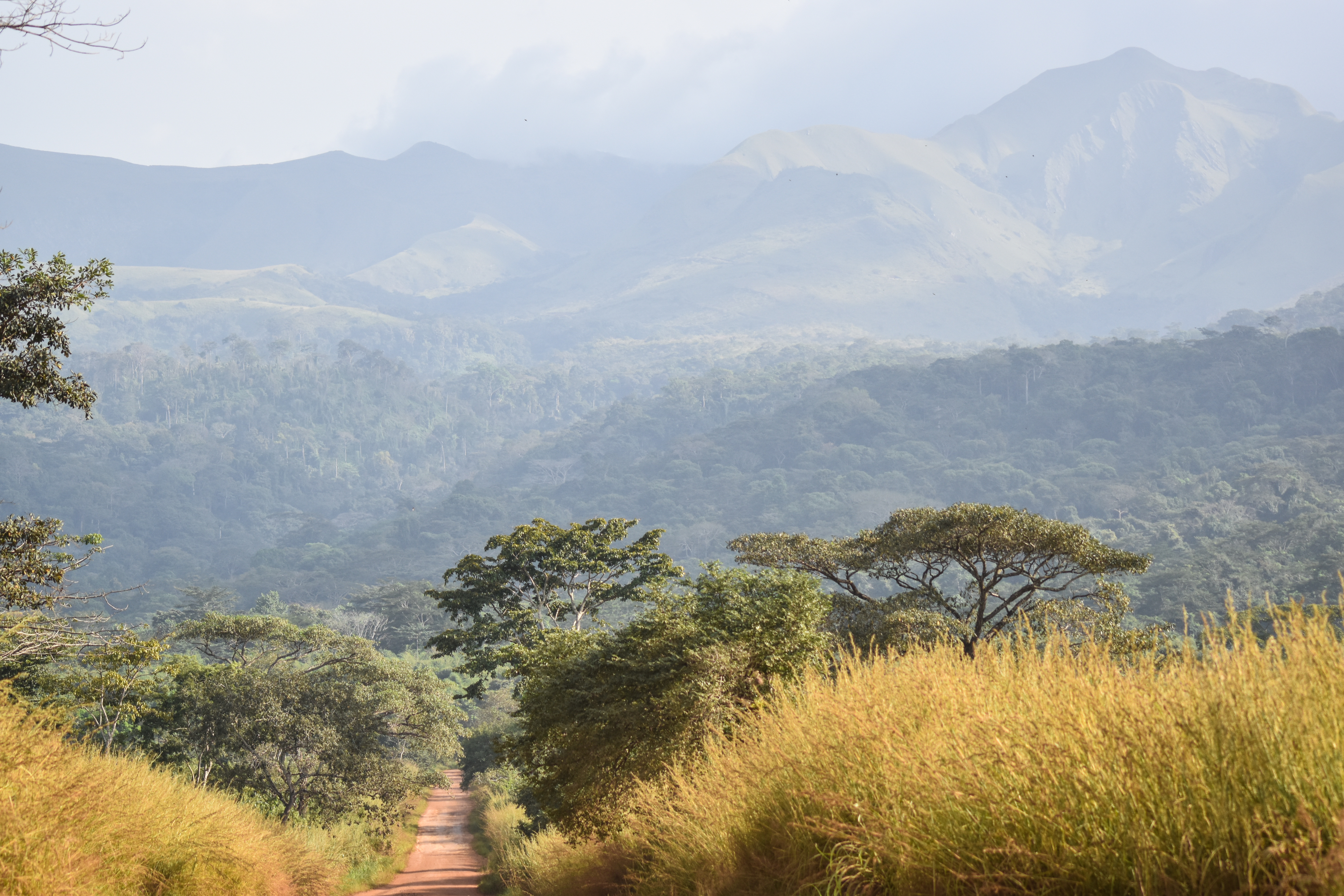
Mount Nimba Strict Nature Reserve: Where Toads Give Live Birth
Somewhere above 1,200 meters on the Nimba Range, in grasslands that catch the clouds before the forest below ever sees them, a small toad does something no other toad on Earth can do: it gives live birth. Nimbaphrynoides occidentalis skips the tadpole-in-water stage entirely, carrying its young internally and delivering fully formed toadlets directly onto the montane grass. This single species -- found nowhere else, reproducing in a way no other amphibian replicates -- captures what makes the Mount Nimba Strict Nature Reserve extraordinary. It is not simply a protected area. It is an evolutionary laboratory, isolated enough and old enough to have produced life forms that exist only here.
A Mountain That Builds Species
The Nimba Range rises as a narrow ridge along the tri-national border of Guinea, Ivory Coast, and Liberia, reaching 1,752 meters at its highest point. What makes it biologically remarkable is not height but isolation. The range stands apart from other highland "sky islands" of Forest Guinea, surrounded by lowland savanna that acts as a biological moat. Species that reached these slopes adapted to conditions found nowhere else -- the altitude, the persistent cloud cover above 900 meters, the seasonal rhythms of a mountain that generates its own weather. The result is staggering endemism. More than 317 vertebrate species inhabit the reserve, including 107 mammals. Over 2,500 invertebrate species have been catalogued, many found on Nimba and nowhere else. The viviparous toad gets the headlines, but it has company: the Nimba otter shrew, Lamotte's roundleaf bat -- recorded from a single mining site -- and endemic plants like Osbeckia porteresii and Blaeria nimbana.
Five Forests Stacked on a Slope
Climbing Nimba is like walking through a textbook on tropical ecology, each chapter written at a different altitude. The lowland foothills wear Western Guinean rainforest up to 600 meters -- semi-deciduous high forest with 40 to 70 tree species per hectare and up to 500 tree species recorded across the area. At 600 meters the montane zone begins, and the forest changes character. Semi-deciduous trees persist to about 900 meters, then give way to mossy cloud forests that stay wrapped in mist for most of the year. Three distinct types occupy this band: Parinari excelsa forests, summit forests, and tree fern forests that cluster in valleys where groundwater stays abundant. Above the tree line, Protea bushland transitions to the high-altitude grasslands that stretch from 1,200 meters to the peaks. Each zone supports its own community of specialists. The ecological compression -- five distinct habitats packed into roughly 1,100 vertical meters -- is what earned this place its UNESCO designation in 1981.
The Scar on the Liberian Side
The Nimba Range does not end at the Guinea-Ivory Coast border. It extends into Liberia, where the story turns from conservation triumph to cautionary tale. The Liberian-American-Swedish Mining Company, LAMCO, operated large-scale iron ore extraction from the Nimba range beginning in the 1960s, building the town of Yekepa into Liberia's third-largest settlement. For decades the mine was Liberia's biggest revenue earner. Civil wars in the 1990s disrupted operations, but the environmental damage was already done. Areas stripped by mining have not recovered, and pollution persists. The Guinean portion of the reserve, by contrast, has remained ecologically intact. UNESCO placed the site on its World Heritage in Danger list in 1992, and it remains there -- a recognition that the threats have not disappeared. New mining concessions in Guinea, including proposals for open-pit iron ore extraction near the reserve boundary, continue to alarm conservationists who argue that proximity alone endangers the resident chimpanzee populations and the irreplaceable endemic species.
Fortress and Frontier
Protection came early to Nimba. Ivory Coast established its strict nature reserve in 1943; Guinea followed by decree in 1944. The Guinean portion became a UNESCO biosphere reserve in 1980, and the combined site earned World Heritage status in 1981 and 1982. But designation alone does not secure a mountain. The reserve sits in one of the poorest regions of two of the world's poorest countries, far from capital cities and far from easy enforcement. Villagers on the Guinean side have resisted environmental restrictions that limit farming and resource extraction on land their communities have used for generations. The tension is familiar in conservation worldwide: a mountain rich in iron ore and biological gold, surrounded by people who need livelihoods. What makes Nimba's case distinctive is the irreplaceability of what it protects. The viviparous toad cannot relocate. Lamotte's roundleaf bat has been found at exactly one site. The cloud forests cannot regenerate once the water table shifts. Whatever is lost here is lost permanently.
From the Air
Located at 7.60N, 8.39W on the tri-national border of Guinea, Ivory Coast, and Liberia. The Nimba Range appears from altitude as a narrow elevated ridge running roughly northeast-southwest, with distinctly greener montane vegetation contrasting against the surrounding savanna lowlands. The peak reaches 1,752 meters (5,750 feet). Nearest airport is Nzerekore (GUNZ), approximately 100 km to the northwest. The Liberian mining town of Yekepa lies at the eastern base of the range. Cloud cover frequently obscures the upper slopes, especially during the wet season. Pilots should maintain safe altitude above the ridgeline and be aware of turbulence along the mountain flanks.