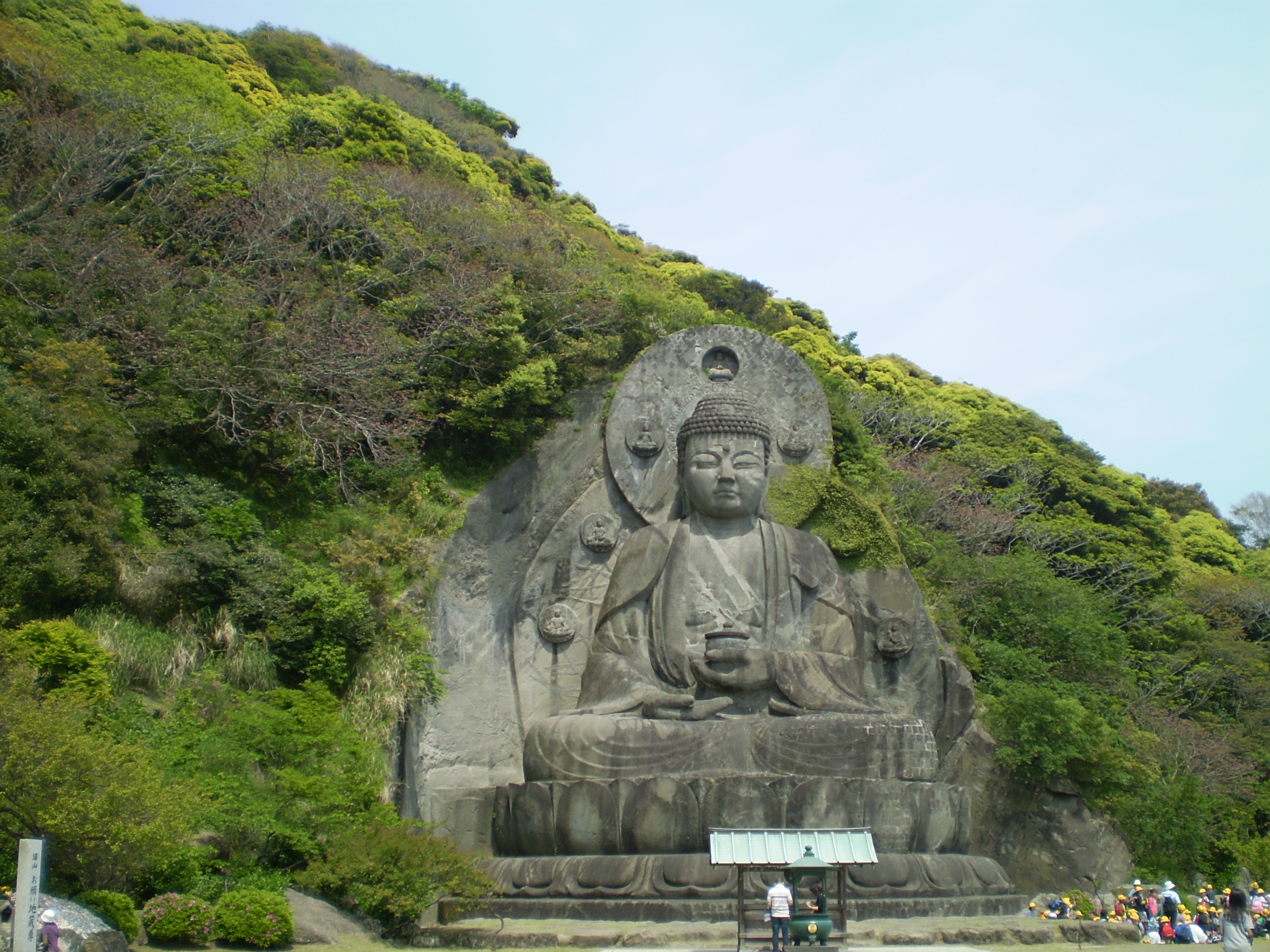
Mount Nokogiri
The name says it all. Nokogiri -- "saw mountain" -- earns its title honestly: centuries of quarrying during the Edo period carved the western face of this 329-meter peak into a jagged sawtooth silhouette visible from across Tokyo Bay. But what the quarrymen left behind became something far stranger and more beautiful than bare rock. On the sheer walls they exposed, artisans carved a 31-meter stone Buddha. Along the switchback trails threading the cliff faces, a master sculptor named Jingoro Eirei Ono and his 27 apprentices spent 21 years placing 1,500 individual stone arhats -- Buddhist disciples, each face unique -- transforming an industrial scar into one of the most extraordinary temple complexes in Japan.
Where the Saw Bites the Bay
Mount Nokogiri straddles the border between the city of Futtsu and the town of Kyonan on the Boso Peninsula, the finger of land that forms the eastern arm of Tokyo Bay. The mountain runs east to west, its western flank dropping precipitously into the water. Two road tunnels and a rail tunnel carrying the JR Uchibo Line punch through the rock at its base, threading south from Futtsu toward Tateyama. At the mountain's western tip, Cape Myogane juts into the bay where the Uraga Channel narrows, and at sunset the silhouettes of container ships and tankers slide past like shadow puppets against the orange sky. From the summit, on clear days, the skyline of Yokohama glimmers across the water to the north.
Stone for a Shogun's Capital
The jagged profile is no accident of geology. During the Edo period, quarrymen carved Nokogiri's high-quality stone and shipped it across the bay to build the structures of Edo -- modern-day Tokyo. The work left dramatic vertical cliff faces and horizontal terraces gouged into the mountainside, marks that remain picturesquely evident today. Where the quarrymen cut deepest, they created the most thrilling viewpoint on the mountain: Jigoku Nozoki, the "Hell Peek," a narrow rock ledge protruding over a roughly 100-meter vertical drop. Visitors lean over a thin metal railing to stare straight down into the forested canyon below. The name captures the feeling precisely -- that lurch in your stomach when the ground falls away and the only thing between you and the void is vertigo.
The Medicine Buddha and 1,500 Faces
On the mountain's southern slopes sits Nihon-ji, a Buddhist temple founded in 725 AD by the priest Gyoki on the orders of Emperor Shomu -- making it one of the oldest temples in the Kanto region. The temple's centerpiece is its colossal Daibutsu, a seated carving of Yakushi Nyorai, the Medicine Buddha, recognizable by the medicine jar in his left hand. The original statue was carved between 1783 and 1786 by the master artisan Jingoro Eirei Ono and his 27 apprentices, standing roughly 27 meters tall. Erosion eventually collapsed it, and the current 31.05-meter version was rebuilt in 1969 -- still the largest pre-modern stone-carved Daibutsu in Japan. Nearby, the Hyaku-shaku Kannon, a 30-meter relief of the Goddess of Mercy carved into a former quarry wall between 1960 and 1966, serves as a memorial to those lost in World War II, illness, and traffic accidents. But it is Ono's 1,500 arhat statues that give the mountain its most haunting character. Carved over 21 years from 1779 to 1798, each stone disciple bears a distinct face and posture, lining the walking paths through the temple grounds. Many were beheaded during the anti-Buddhist movement following the Meiji Restoration, and the headless figures add an eerie poignancy to the forest trail.
The Ropeway and the Ridge
The Nokogiriyama Ropeway lifts visitors from Hamakanaya Station on the JR Uchibo Line to a lookout platform near the top of the temple precinct, offering a panoramic sweep of Tokyo Bay, the Boso Hills, and on exceptionally clear days, the distant cone of Mount Fuji. For those who prefer to earn the view, hiking trails wind up through the forested slopes, passing quarry ruins overgrown with ferns and moss. The combination of industrial archaeology, ancient sacred art, and raw coastal landscape packed into a mountain barely taller than the Eiffel Tower makes Nokogiri one of the most rewarding day trips from Tokyo -- a place where the scars left by human hands became the canvas for human devotion.
From the Air
Located at 35.16N, 139.84E on the western shore of the Boso Peninsula, directly across Tokyo Bay from Yokosuka. The mountain's 329m summit and distinctive sawtoothed quarry face are clearly visible on the coastline. The Nokogiriyama Ropeway cable line runs up the western slope. Tokyo Bay's Uraga Channel narrows nearby, heavy with ship traffic. Nearest airports: Tokyo Haneda (RJTT) approximately 40nm northwest, Kisarazu (RJAH) approximately 15nm north. Approach from over Tokyo Bay for the most dramatic view of the quarried cliff faces. Expect marine haze in summer; autumn and winter offer the clearest visibility.