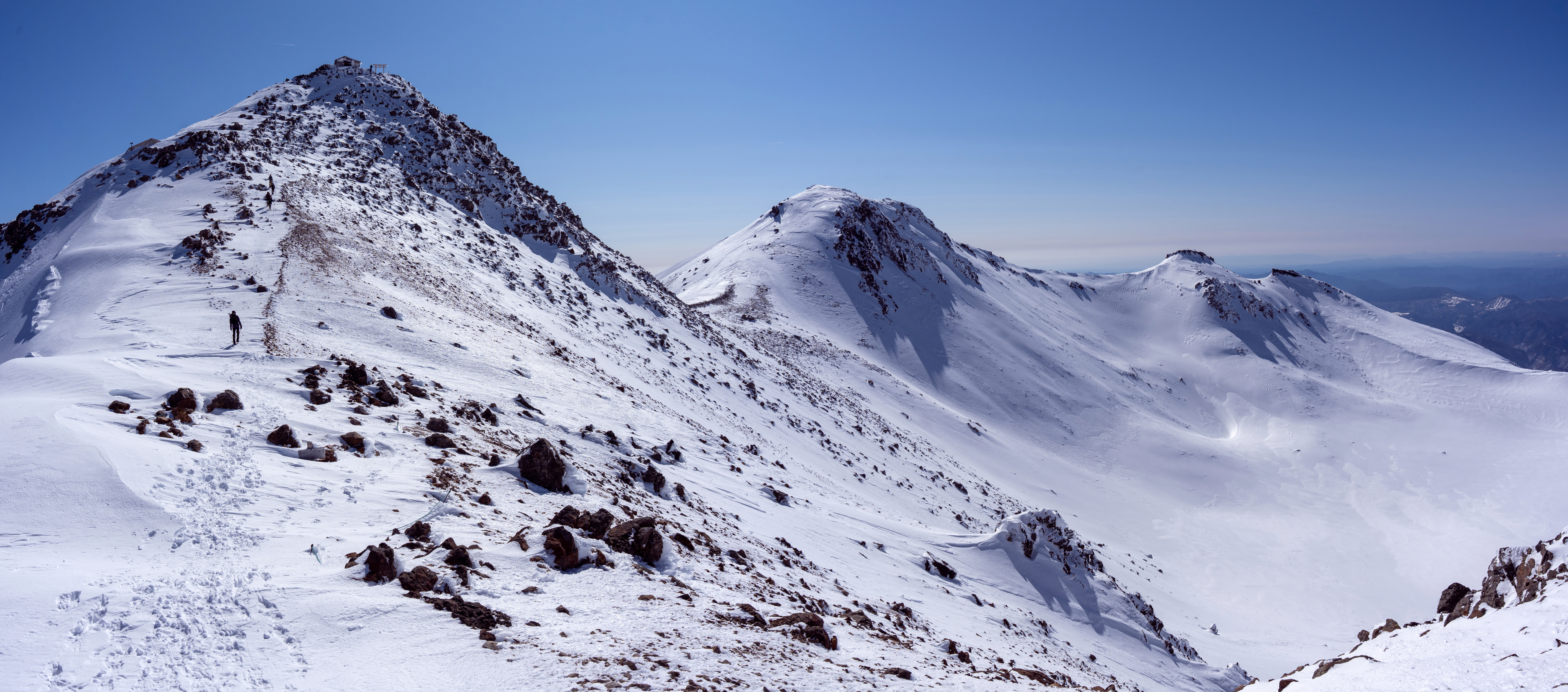
Mount Norikura
The bus climbs above the treeline and the passengers fall quiet. Outside the windows, the Japanese Alps dissolve into a carpet of cloud far below, and ahead, the road -- the highest paved public road in Japan -- keeps rising toward a barren ridgeline at 2,700 meters. Mount Norikura stands at 3,026 meters along the border of Gifu and Nagano prefectures, and it holds a paradox that delights hikers and frustrates purists in equal measure: it is the tallest mountain in Japan that almost anyone can summit in a single afternoon. From the bus terminal, the peak of Kengamine is barely ninety minutes of walking away. Yet this accessibility has never cheapened the view from the top. The panorama of the Northern Alps -- Hotaka, Yari, the whole jagged spine of the Hida Mountains -- remains one of the great rewards of Japanese mountaineering.
The Saddle in the Sky
The mountain's name translates to "riding saddle," a reference to the gentle, curved profile of its summit ridge as seen from the valleys below. That silhouette belies the mountain's true scale: Norikura is not a single peak but a volcanic massif of 23 individual summits spread across the high plateau. The tallest, Kengamine, stands at 3,026 meters, placing Norikura among the elite three-thousanders of the Japanese Alps. The mountain straddles Chubu-Sangaku National Park, designated in 1934, and sits within the Hida Mountains -- the range that Walter Weston, the English clergyman who helped popularize recreational mountaineering in Japan, explored extensively in the 1890s. Weston climbed Norikura in 1892, and his subsequent writings helped ignite a passion for alpine climbing that led to the founding of the Japanese Alpine Club in 1905.
A Monk's Footsteps
Long before Weston arrived, the mountain had its first recorded summit. In the 1680s, the wandering Buddhist monk Enku -- born in what is now Gifu Prefecture -- is said to have reached the peak of Norikura during one of his pilgrimages through the sacred mountains of central Japan. Enku was no ordinary monk. He carved an estimated 120,000 wooden Buddhist statues during his lifetime, hacking them from tree stumps and scrap wood with bold, rough strokes of a hatchet. Many of these figures survive today in temples throughout the Hida region. That a man who spent his days carving prayer into raw timber also made the first known ascent of Norikura feels fitting -- the mountain has always drawn those who seek something elemental.
The Highest Road
What makes Norikura unique among Japan's major peaks is the Norikura Skyline Road, which climbs 14.4 kilometers to a terminus at 2,700 meters above sea level. Private vehicles have been banned above 1,800 meters since the road was restricted to protect the alpine environment, but shuttle buses and taxis run from late spring through October, ferrying visitors up through zones of mountain birch and dwarf pine into the stark, wind-scoured terrain above the treeline. Cyclists are also permitted, and the route has become a legendary hill-climb challenge. From the bus terminal at the top, even casual walkers can reach the summit of Kengamine in about ninety minutes along a well-marked trail. This combination of road access and modest trail difficulty makes Norikura the easiest three-thousander in Japan -- a distinction that draws families, elderly hikers, and first-time mountaineers alongside seasoned alpinists.
Observatory Above the Clouds
The mountain's altitude and clear air have attracted scientists as well as pilgrims. In 1950, the University of Tokyo established a cosmic ray observation station on Norikura's slopes at 2,770 meters, initially housed in a simple hut funded by the Asahi Shimbun newspaper. By 1953, it had grown into a formal research observatory, and today the Norikura Observatory operates under the Institute for Cosmic Ray Research. For decades, researchers here have studied particle interactions at ultra-high energies, solar neutrons, cosmic ray modulation by galactic magnetic fields, and the acceleration mechanisms of cosmic rays in thunderclouds. The station also monitors alpine atmospheric conditions, measuring aerosol transport and greenhouse gas concentrations in air untainted by urban pollution. It is a quietly remarkable fact that one of Japan's most accessible mountains is also one of its most scientifically productive.
A Volcano Sleeping
Norikura is classified as a potentially active volcano by the Japan Meteorological Agency, though its last eruption occurred thousands of years ago. Tributaries flowing from its snowfields feed three major river systems -- the Azusa River flowing into the Shinano, the Takahara, and the Hida -- carrying glacial meltwater down through the valleys of central Honshu. In winter, the mountain buries itself under meters of snow, and the Norikura Plateau on its northern flank in Nagano Prefecture becomes a backcountry skiing destination. In autumn, the alpine meadows blaze with the reds and golds of mountain vegetation turning. Through every season, Norikura offers something that few mountains of its stature can: the feeling of true altitude, earned with almost no effort at all.
From the Air
Mount Norikura (36.106N, 137.554E) rises to 3,026 meters (9,928 feet) in the Hida Mountains of central Honshu. Approach from the east or west for best views of the saddle-shaped summit ridge. The Norikura Skyline Road is visible as a thin line ascending the western slope. Nearby airports include Matsumoto (RJAF) approximately 84 km to the east and Toyama (RJNT) approximately 82 km to the northwest. Be aware of mountain wave turbulence and rapidly changing weather conditions typical of the Northern Alps. Minimum safe altitude in the area should account for surrounding peaks exceeding 3,000 meters.