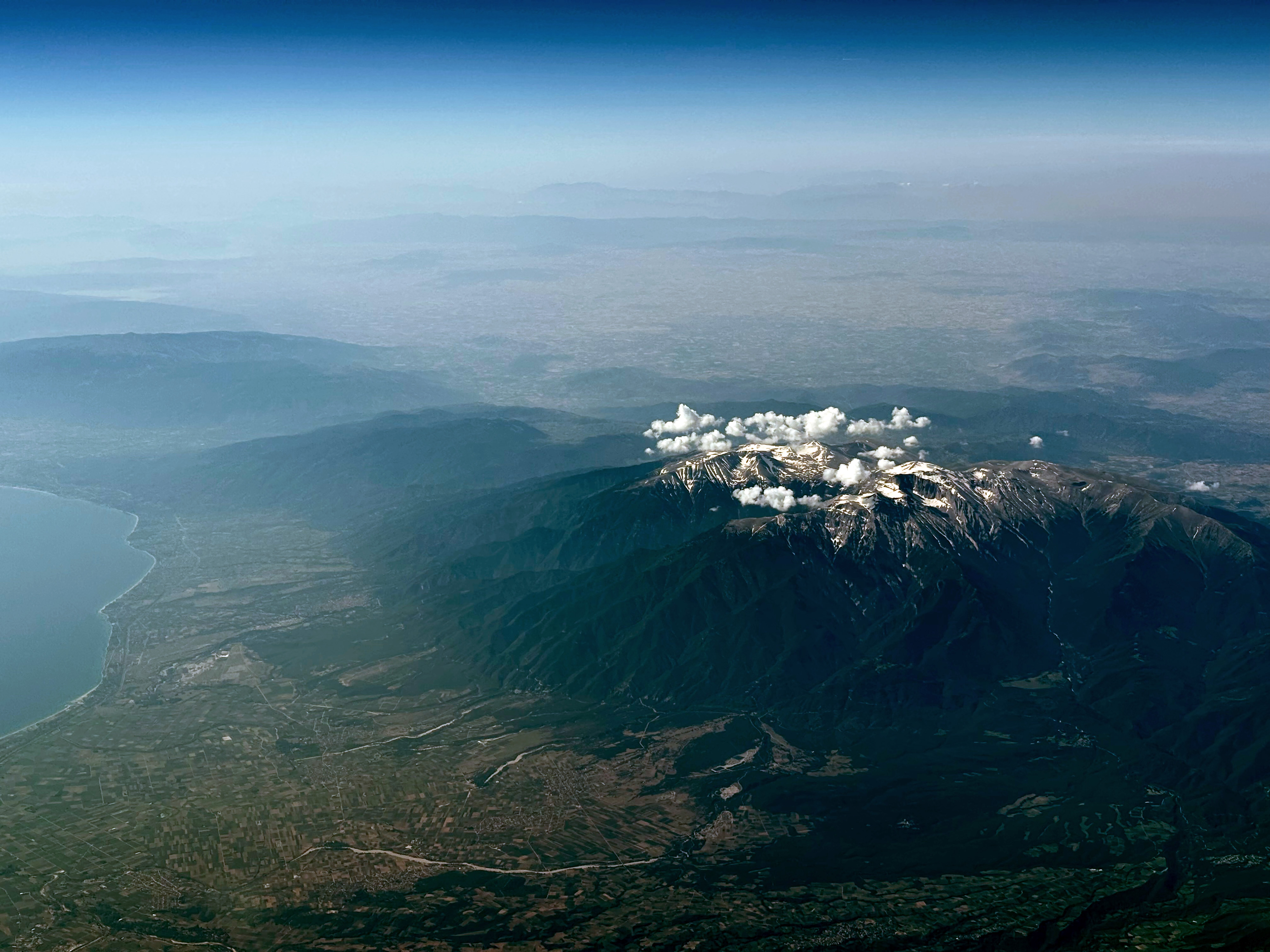
Mount Olympus
Euripides wrote his last tragedies here. Not on the summit, where the gods supposedly quarreled and feasted, but in the court of King Archelaus at the mountain's foot, where the playwright spent his final years composing works that would outlast every temple on the peak above. Mount Olympus has always operated on two levels simultaneously -- the mythological and the actual -- and the actual turns out to be every bit as extraordinary as the stories. At 2,917.7 meters, the peak called Mytikas (meaning 'nose') is the highest point in Greece, an isolated tower of rock rising less than 18 kilometers from the Aegean Sea, its 52 peaks and deep gorges sheltering a biodiversity so rich that the mountain became Greece's first national park in 1938.
The Throne Room of Zeus
The name Olympus predates the Greek language. Robert Beekes, the Dutch linguist who specialized in pre-Greek substrate words, concluded that the word likely originated in an older, pre-Greek tongue and probably meant simply 'mountain.' The Greeks made it mean considerably more. In Homer's telling, Olympus was the seat of the gods, a place where clouds parted to reveal divine palaces. Hesiod described the earth as a footstool for heaven, with Olympus rising between the two. The mountain's physical reality -- sudden weather changes, summit clouds that form and dissolve in minutes, snowfields persisting into summer -- made it easy to believe that something other than geology was at work above the treeline. The Mycenaean Greeks may have used a related word to describe a people or ethnic group, suggesting the mountain's name was entangled with human identity long before Homer gave it divine residents.
52 Peaks and a Kingdom
Olympus is not a single peak but a massif with an almost circular footprint, 26 kilometers in average diameter, 80 kilometers in circumference, covering 500 square kilometers. Its shape was carved by rain and wind into a complex of ridges, gorges, and summits. Mytikas stands highest, but neighboring peaks like Skolio, Stefani (also called the Throne of Zeus for its shape), and Skala each exceed 2,800 meters. The mountain straddles the border between Thessaly and Macedonia, and at its northeastern foot lies Dion, the sacred city of the ancient Macedonians, dedicated to Zeus and the Twelve Olympians. Five centuries of prosperity left behind an archaeological park of 200 hectares, where excavations ongoing since 1928 continue to uncover statues and artifacts from the Macedonian, Hellenistic, and Roman periods.
A Vertical Garden
Since the French botanist Aucher-Eloy first studied its plants in 1836, Olympus has revealed roughly 1,700 species and subspecies -- about 25 percent of all Greek flora on a single mountain. Of these, 56 are endemic to Greece, and 23 grow nowhere else in the world. The vertical range explains much of this diversity. Mediterranean vegetation covers the lower slopes near Litochoro, giving way to deciduous and coniferous forests at mid-elevation, then alpine meadows and bare rock above the treeline. The climate shifts accordingly: hot and dry at the base, severe enough for snow at the peaks year-round, with temperatures ranging from minus 10 to 10 degrees Celsius in winter and from 0 to 20 degrees in summer. Winds are an almost daily occurrence at higher elevations. The Swedish botanist Arne Strid documented this full vertical transect in 1980, tracing the plant communities from Aegean beach to summit in a single study.
Sacred Ground, Still Climbing
At 2,803 meters, the chapel of Prophet Elias holds the distinction of being the highest-elevation Orthodox Christian chapel, built in the 16th century by Saint Dionysios of Olympus, who also founded the region's most significant monastery in the Enipeas gorge at 820 meters. The mountain's spiritual geography spans millennia: from the Bronze Age worship sites near Dion, through the classical temples, past the Byzantine monasteries, to the hikers who now make Olympus the most popular summit in Greece. The usual starting point is Litochoro on the eastern foothills, roughly 100 kilometers from Thessaloniki, where mountain refuges and marked routes accommodate thousands of trekkers annually. Organized huts dot the upper elevations, and multiple routes of varying difficulty lead to the summit -- some requiring only fitness and determination, others demanding proper climbing equipment and experience.
From the Air
Located at 40.08N, 22.35E on the border of Thessaly and Macedonia, approximately 80 km southwest of Thessaloniki. The massif is unmistakable from the air: a roughly circular mountain cluster rising to 2,918 m, only 18 km from the Aegean coast. The town of Litochoro sits on the eastern foothills. Thessaloniki Airport Makedonia (LGTS) is the nearest major international airport, about 80 km to the northeast. Larissa Airport (LGLR) lies to the south. Best viewed at 8,000-12,000 ft AGL to appreciate the full massif, its 52 peaks, and the contrast between the summit snowfields and the nearby sea.