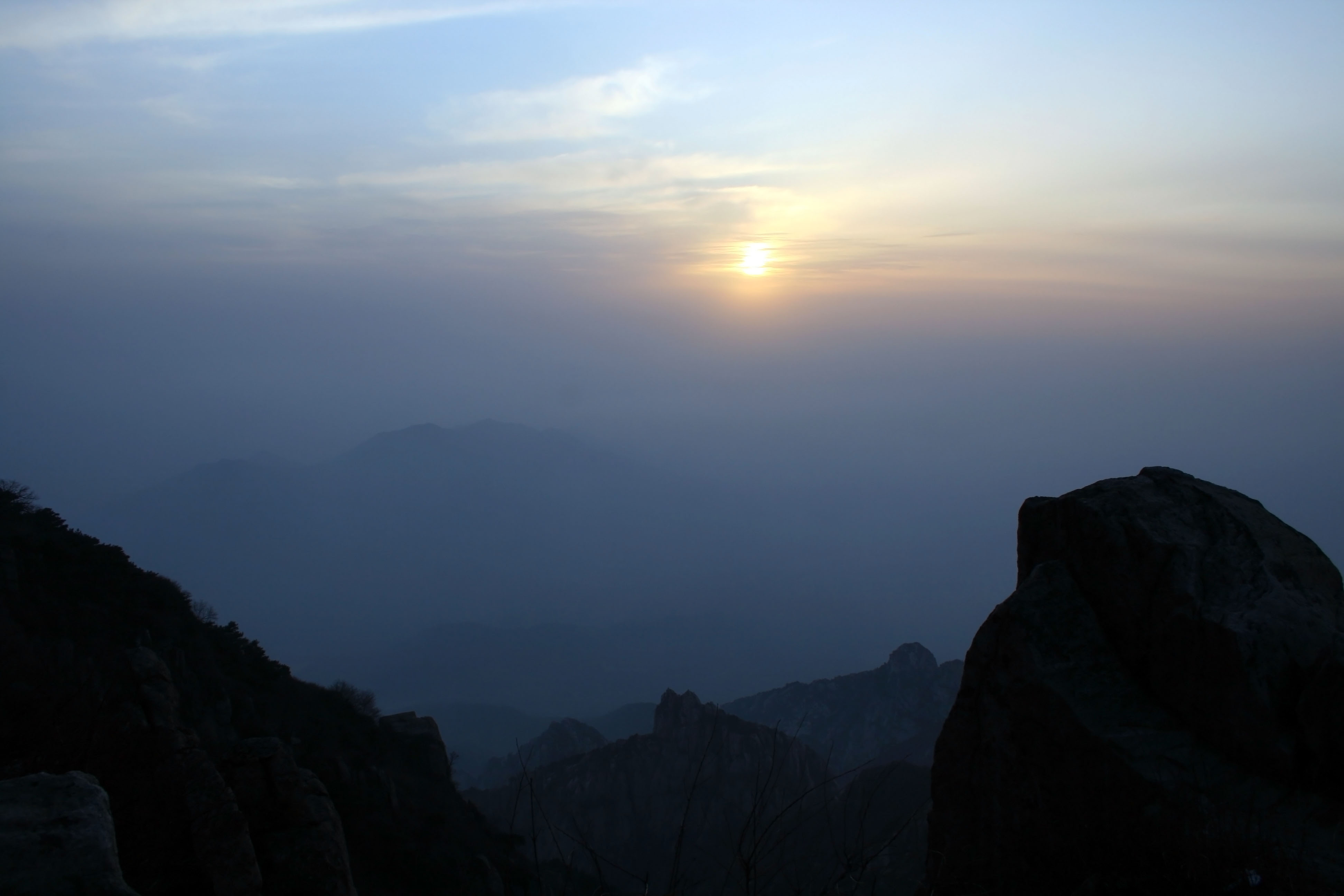
Mount Tai
Every emperor who wanted to prove he was the real emperor climbed Mount Tai. The tradition stretches back to the Xia and Shang dynasties -- so far into the past that it blurs into myth -- and the logic was simple: this mountain, rising from the plains of Shandong Province, was where heaven and earth were closest. To reach its summit was to stand at the threshold of the divine. The Chinese call it the head of the Five Sacred Mountains, the one that faces east and greets the sunrise, and its hold on the national imagination has not loosened in three thousand years. Mount Tai is one of only two sites on Earth that satisfy seven of the ten UNESCO World Heritage criteria. The other is the Tasmanian Wilderness -- raw nature with no human history. Mount Tai is the opposite: a mountain made sacred by the people who climbed it.
Seven Thousand Steps to Heaven
The main path up Mount Tai is bricked the entire way -- a staircase of roughly 7,000 stone steps that takes between four and seven hours to climb, depending on fitness and determination. Along the route, vendors sell water and snacks at progressively higher prices. Ancient gates and archways mark the stages of ascent, and prayers and poems carved into the rock faces accumulate as you climb, thousands of inscriptions spanning centuries of pilgrimage. Near the summit, the stairs grow steeper and the landings fewer. The final stretch passes through the South Gate of Heaven, a stone archway that frames the sky like a doorway at the top of the world. Hikers who start at night reach the summit in time for one of Mount Tai's four famous spectacles: watching the sunrise over the plains of Shandong.
The Emperor's Mountain
Mount Tai's sanctity is political as much as spiritual. Chinese emperors performed the Feng and Shan sacrifices here -- elaborate rituals at the summit and base of the mountain that announced a ruler's mandate from heaven. The practice was so freighted with significance that only the most powerful emperors dared attempt it; to perform the rites and then lose your throne was to invite cosmic humiliation. The mountain became a repository of imperial ambition, each dynasty adding temples, inscriptions, and pathways. Confucius climbed it. Mao Zedong referenced it. The saying goes that anyone who reaches the summit will live to be one hundred. Whether or not that is true, the mountain has outlasted every dynasty that claimed it.
Where Daoism Meets Buddhism
Mountaintop monasteries occupy the summit area, their stone walls and tiled roofs huddled against the wind that sweeps across the peak. Mount Tai is sacred to both Daoism and Buddhism, and the temples reflect this dual heritage. Daoist priests and Buddhist monks have coexisted here for centuries, their separate traditions finding common ground in the mountain's ancient authority. The temple architecture is complemented by the natural spectacles that draw visitors to the summit: the sunrise, the golden light of sunset, the view of the Yellow River shimmering in sunshine on clear days, and the sea of clouds that forms below the peak when conditions are right. These four spectacles have been cataloged and celebrated in Chinese literature for centuries.
A Living Pilgrimage
Mount Tai remains the most climbed mountain in China, and on busy days the main path can feel more like a procession than a hike. Red headbands -- blessings of long life and prosperity -- bob through the crowds. The mountain teahouse offers respite at the halfway point, and the Shandong specialty jian bing, a savory crepe made with egg and green onion, is available from stands along the route. Hotels and hostels at the summit let visitors stay overnight for the sunrise, though prices triple during the October and May holiday seasons. Camping is no longer permitted due to fire concerns. A cable car runs to the summit between 6:30 AM and 5:30 PM, offering an alternative to the stairs, but most Chinese visitors still climb on foot. The mountain demands effort, and the effort is the point. Confucius's birthplace at Qufu is only an hour away by bus -- the natural next stop after ascending the mountain that emperors climbed to prove their worth.
From the Air
Mount Tai is located at 36.27°N, 117.10°E, north of Tai'an city in central Shandong Province. The peak rises to approximately 1,545 meters (5,069 feet) and is clearly visible from cruising altitude. The mountain stands prominently above the surrounding plains, making it an excellent visual landmark. Nearest major airport: Jinan Yaoqiang International (ZSJN), approximately 65 km to the north. The summit complex of temples and buildings is visible from the air. The city of Tai'an at the mountain's base serves as the access point, connected by high-speed rail to Beijing (2 hours) and other major cities.