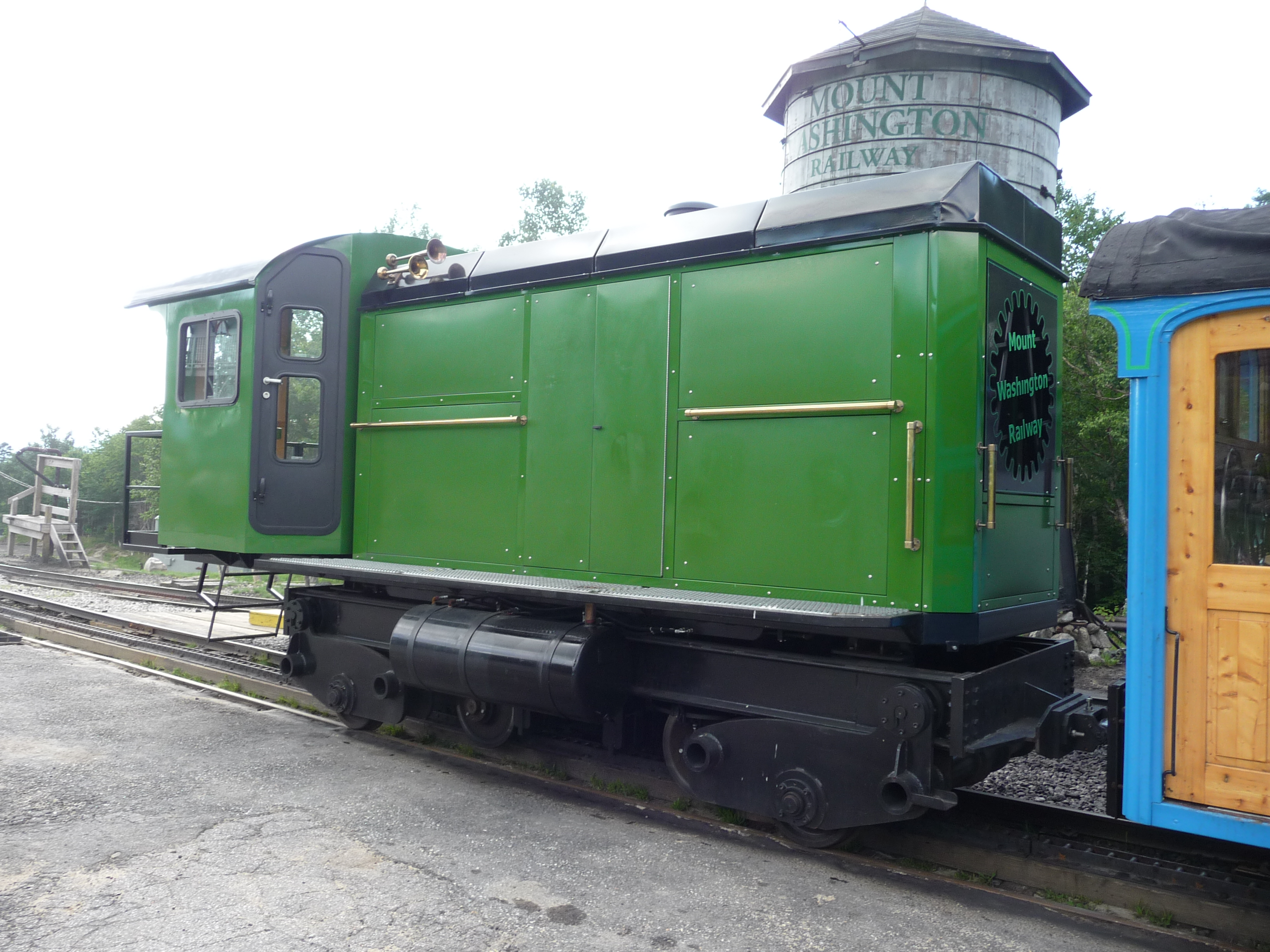
Mount Washington Cog Railway
When Sylvester Marsh petitioned the New Hampshire legislature in 1858 for a charter to build a railroad up Mount Washington, one legislator reportedly suggested he might as well build a railway to the moon. Marsh had nearly died in fierce weather while hiking to the 6,288-foot summit, and the experience convinced him that people deserved a safer way up. Eleven years later, on July 3, 1869, his railway to the moon opened for business -- the world's first mountain-climbing cog railway, hauling passengers up a grade so steep that the locomotive pushes from behind and the floor of the passenger car tilts at angles that make standing feel like a controlled fall. More than 150 years later, the Cog still climbs.
The Crazy Man's Machine
Marsh was a New Hampshire businessman and inventor who had made his fortune in the meatpacking industry in Chicago before returning east. His concept was deceptively simple: a toothed gear wheel on the locomotive engaging a rack rail bolted between the running rails, creating positive traction regardless of grade. He built a prototype locomotive and a short demonstration section of track to prove the idea was sound, then formed the Mount Washington Railway Company in the spring of 1866. Construction proceeded upward through brutal mountain weather. The first paying customers rode on August 14, 1868, before the track had even reached the summit. When the line was completed the following July, Marsh had built a three-mile railroad with an average grade exceeding 25 percent and a maximum grade of 37 percent -- the second steepest rack railway in the world, surpassed only by the Pilatus Railway in Switzerland. The Swiss Consul to the United States visited Marsh during construction, and his reports persuaded the Swiss government to commission Niklaus Riggenbach to build the Vitznau-Rigi-Bahn on Mount Rigi, which opened in 1871. New Hampshire's moonshot inspired the Alps.
Slideboards and Calamity
The railway's early workers invented a contraption that captures the spirit of the place: the 'Devil's shingle,' a wooden slideboard fitted over the cog rack, large enough for a man and his tools. Workers would ride these boards down the mountain after a shift, the average descent taking about 15 minutes. The record was 2 minutes and 45 seconds. The Cog's history is not without tragedy. On July 20, 1929, locomotive No. 1 -- the original engine known as Old Peppersass, brought out of retirement for a 60th anniversary commemorative run -- broke a gear tooth during descent from Jacob's Ladder. The friction brake failed to hold, and the engine careened downhill. The crew jumped to safety with broken bones, but a photographer named Daniel P. Rossiter, riding the engine for publicity shots, was killed. On September 17, 1967, eight passengers died and 72 were injured when locomotive No. 3 derailed at the Skyline switch, about a mile below the summit, after the switch was improperly configured for a descending train.
Iron Bones, New Blood
The Cog designs and builds its own locomotives and passenger coaches at shops near the base of Mount Washington -- a tradition of self-sufficiency that dates to Marsh himself. Each train consists of a single locomotive pushing a single passenger car, the locomotive always on the downhill side. A ratchet-and-pawl mechanism originally prevented rollback during the climb; modern upgrades have replaced it with sprag clutches and disc brake assemblies. In 1941, a nine-motion switch was invented to allow two trains to pass on the single track, and spur sidings were added. By 2004, automated switches powered by solar-recharged batteries enabled more efficient passing loops. The railway's greatest mechanical reinvention came in 2008, when the staff designed and built the Cog's first diesel locomotive, powered by biodiesel. Seven diesel units were completed by 2019. The primary motivation was reducing the coal smoke -- nicknamed 'Cog Smog' -- that the steam engines produced, along with lowering emissions and giving passengers more time at the summit.
The Mountain's Moods
Mount Washington is infamous for some of the worst weather on Earth. The summit recorded a wind speed of 231 miles per hour in 1934, a record that stood for decades. The Cog operates through conditions that would ground most transportation, running winter trains to Waumbek Station since resuming cold-weather operations in 2020, enabled by a new maintenance facility completed in 2021. The Appalachian Trail crosses the Cog's tracks in three places, and the intersection of hikers and rail passengers has produced one of New England's odder traditions: 'Mooning the Cog,' in which hikers wait for a passing train to drop their trousers. Several were arrested in 2007. Access to the base station runs through some of New Hampshire's most scenic terrain -- the main route from Bretton Woods, or the narrow, unpaved Jefferson Notch Road with its hairpin switchbacks climbing to the highest public road pass in the state, between Mount Jefferson and Mount Dartmouth in the Presidential Range.
Still Climbing
Ownership has changed hands several times since Marsh's era. In 1983, a group of New Hampshire businessmen purchased the railway, and Wayne Presby and Joel Bedor of Littleton revitalized operations over three decades. Presby became sole owner in 2017. In 2021, the railway completed two of the largest improvement projects in its history: replacing the existing rail with heavier stock and building a new maintenance facility. A proposed 35-room hotel along the line, to celebrate the 150th anniversary in 2019, was shelved after opposition over its location in the mountain's fragile alpine zone. The railway carries 70 passengers per car in wooden coaches, some of them over a century old, up three miles of track that Sylvester Marsh's neighbors thought impossible. The steam locomotives still run alongside the diesels, trailing plumes of coal smoke against the granite and spruce of the Presidential Range. The Cog is not a museum piece. It is a working railroad, doing what it has done since 1869: pushing uphill.
From the Air
Located at 44.27N, 71.33W on the western slope of Mount Washington in the Presidential Range, New Hampshire. The railway's base station is visible near Bretton Woods, with the track ascending the western face of Mount Washington to near the summit at 6,288 ft. The Mount Washington Hotel, a large white historic resort, is a prominent visual landmark nearby. Nearest airports: Mount Washington Regional Airport (KHIE) approximately 20 nm north, and Portland International Jetport (KPWM) about 80 nm southeast. Recommended viewing altitude: 6,500-8,000 ft MSL to see the track against the mountainside. Exercise extreme caution -- Mount Washington generates severe turbulence, high winds, and rapid weather changes. The summit is above treeline and often obscured by clouds.