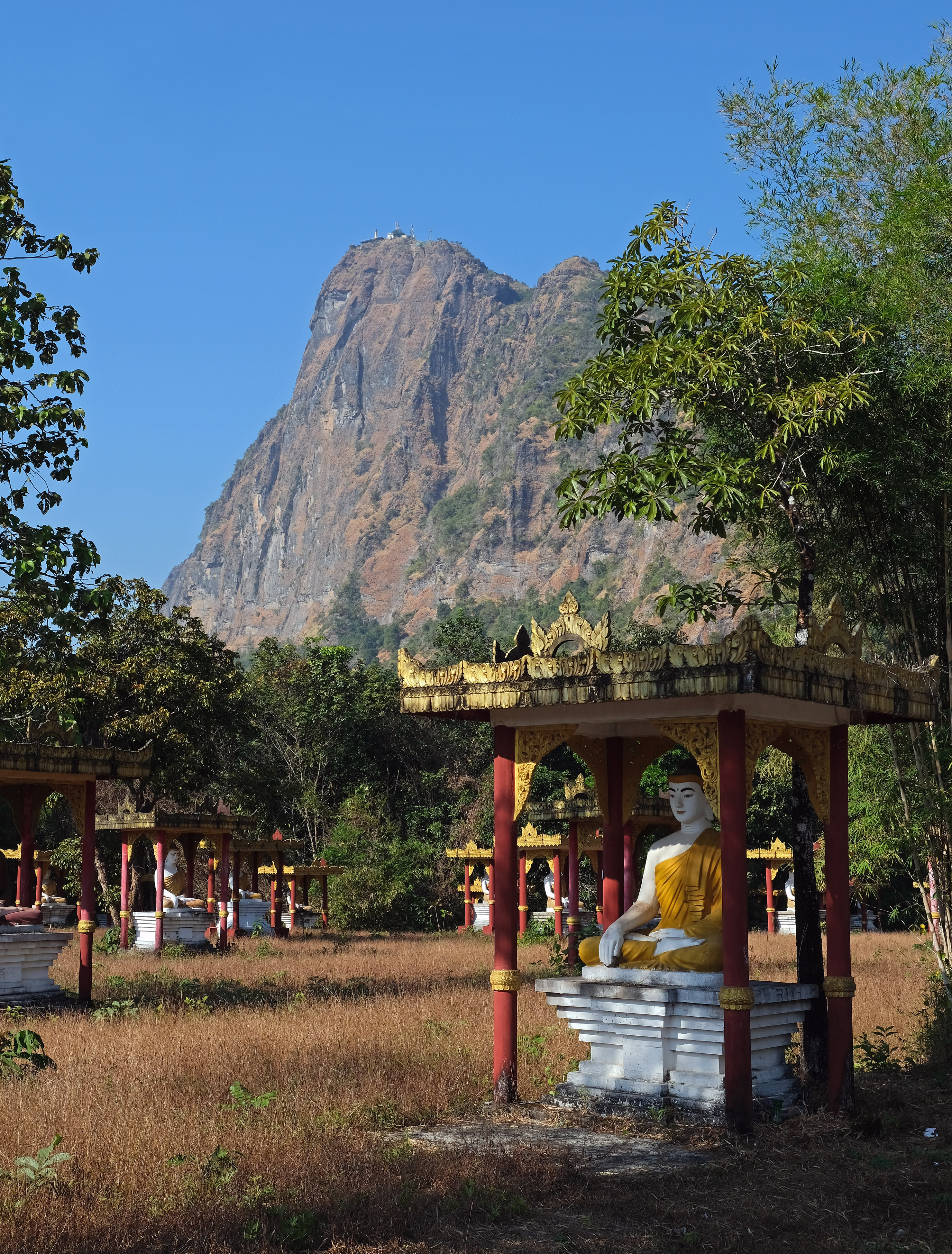
Mount Zwegabin
Hundreds of stone monks sit in perfect stillness along the trail, their robes weathered by monsoon rains, their faces fixed in expressions of serene concentration. They line the path up Mount Zwegabin like silent sentinels, one after another, guiding pilgrims toward a summit pagoda that the faithful believe holds a sacred relic of the Buddha himself. This is not a museum installation or an art project. It is a living pilgrimage route on a 722-meter limestone peak in Myanmar's Kayin State, where devotion has been climbing this mountain for centuries.
Guardians of Stone and Story
In Karen folklore, Zwegabin belongs to a brother and sister who endured cruelty at the hands of their stepfather. Their suffering, the story goes, earned them spiritual powers, and they became the mountain's eternal guardians. The tale is one of endurance and purity, values the Karen people have long associated with this peak that rises abruptly from the flat plains northwest of Hpa-an, the nearest major city just 8.2 kilometers away. The legend is not merely a quaint origin story. It anchors Zwegabin in Karen cultural identity, passed down through generations of oral tradition, binding the mountain to the people who have lived in its shadow for centuries. For both Buddhists and the broader Karen community, this is consecrated ground where the spiritual and the physical are inseparable.
A Landscape Carved by Oceans
The geology tells an older story still. Zwegabin is part of the Zwekabin Range, a series of isolated limestone hills formed from shallow marine deposits laid down during the Carboniferous and Permian periods, hundreds of millions of years ago. Tectonic forces lifted these ancient seabeds skyward, and millennia of erosion sculpted the karst terrain into the steep cliffs, caves, and sinkholes that define the landscape around Hpa-an today. The underlying Paungnyo Formation, overlain by Moulmein Limestone, gives the mountain its dramatic twin peaks and sheer escarpments. From the surrounding plains, which are a patchwork of rice paddies and natural vegetation supporting roughly 155 people per square kilometer, Zwegabin rises like a wall. It is the highest point in the region, and its limestone bones are visible in every cliff face and cave mouth that punctuates the flatlands below.
Where New Species Still Emerge
The forests clinging to Zwegabin's slopes harbor surprises that science is still cataloguing. In 2025, botanists announced the discovery of Globba zwegabinensis, a flowering plant named for the mountain where it was first found. The find underscored what ecologists have long recognized: Kayin State's limestone habitats support exceptional biodiversity, from endemic plant species to a rich array of birds, butterflies, and small mammals that depend on these karst ecosystems. But the biodiversity faces pressure. Tourism-related development and deforestation threaten habitat, and conservationists have pushed for stronger protections. Fauna & Flora International has supported community-based conservation efforts in the area, and Myanmar's Environmental Conservation Department has been reviewing Zwegabin and its surroundings for possible inclusion in the country's protected landscape program. The tension between economic development and ecological preservation plays out here with particular intensity.
The Climb and the Cable Car
The pilgrimage trail to the summit remains Zwegabin's most iconic experience. Past those hundreds of monk statues, through forest that turns its deepest green during the monsoon months from May to October, the path ascends to the Zwegabin Mountain Hair Relic Pagoda at the top. The pagoda is believed to date to the same era as Kyaiktiyo Pagoda, the famous Golden Rock, and many travelers combine both sites on a wider pilgrimage route through Kayin and Mon States. Since Myanmar's political opening in 2010, international visitors have joined the pilgrims in growing numbers. The best conditions come between November and February, when cool, dry weather and clear skies make the hike most comfortable, though crowds peak during this same window. Development has followed the tourists. The Myanmar Native Land Public Company has announced plans to invest $12 to $15 million in bungalows, shopping facilities, and a cable car project. Eco-friendly restrooms and rest shelters have appeared near the summit. Whether these additions enhance or erode what makes Zwegabin remarkable is the question that hangs over the mountain's future.
Faith on the Summit
Every year, thousands of pilgrims arrive during religious festivals to pay homage at the Hair Relic Pagoda, to meditate, and to offer prayers at the peak. The sacred relics, combined with the mountain's deep roots in Karen folklore, make Zwegabin something more than a scenic hike or a geological curiosity. It is a place where cultural identity and religious devotion have been reinforcing each other for generations. The Karen people see their own values reflected in this mountain: endurance in the face of hardship, protection of what matters, the purity that comes from staying true to one's traditions. Community-based tourism projects now attempt to channel the growing visitor economy in ways that support local livelihoods without overwhelming the site. It is a delicate balance, one that will determine whether Zwegabin's next chapter honors or diminishes the centuries of meaning that have accumulated on its slopes.
From the Air
Mount Zwegabin sits at 16.824N, 97.668E in Kayin State, Myanmar, rising to 722 meters above sea level. The dramatic limestone karst peak is visible from altitude against the flat surrounding plains northwest of Hpa-an. The nearest significant airport is Hpa-an Airport (VYPA). Expect tropical weather patterns with monsoon conditions May through October and clearer skies November through February. The Zwekabin Range's isolated limestone hills create a distinctive visual pattern from cruising altitude.