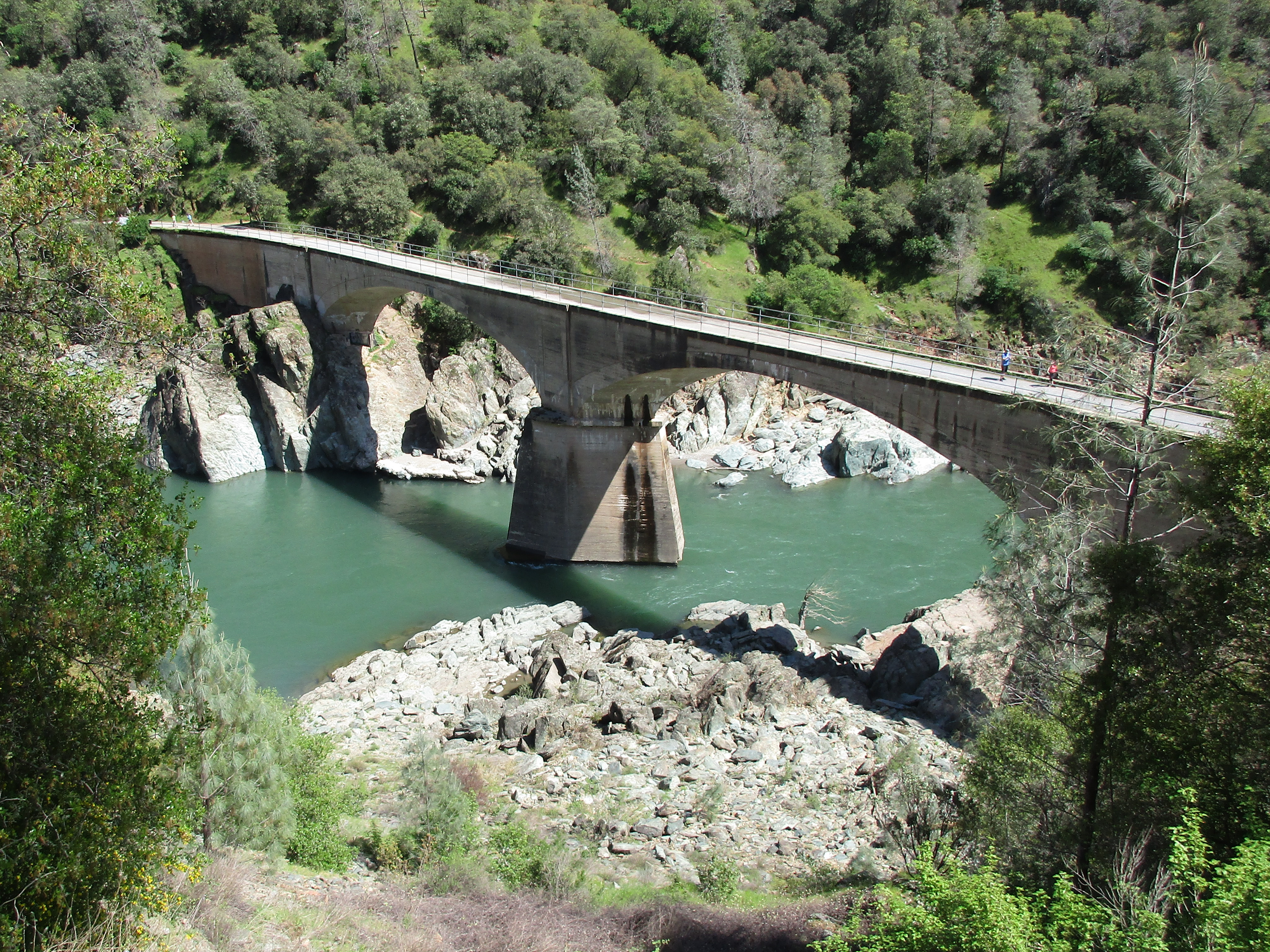
No Hands Bridge
Most riders dismounted before crossing. The bridge hung 80 feet above the North Fork of the American River, a narrow concrete railroad deck with no guardrails, and the horses knew it. But Ina Robinson would drop her reins every time, letting her mount carry her across with no hands on the leather. The gesture became legend, and by the time the bridge earned its nickname, nobody called it the Mountain Quarries Bridge anymore. They called it No Hands Bridge.
Eight Hundred Men and a River to Cross
In 1910, the Pacific Portland Cement Company needed to move limestone. Their quarry sat near the town of Cool, seven miles from the Southern Pacific Railroad mainline in Auburn, and between the two lay the American River canyon, a deep gash in the Sierra Nevada foothills. The company hired John B. Leonard, a structural engineer who had become one of Northern California's foremost advocates for reinforced concrete, and gave him a problem that demanded innovation. Leonard designed a triple-arch bridge with hollow concrete boxes for its bases, their 18-inch-thick walls reinforced with twisted steel bars and filled with uncrushed rock, all anchored directly to the bedrock at the canyon floor. Eight hundred men spent two years building it. When the Mountain Quarries Bridge opened on March 23, 1912, its 482-foot span made it the longest concrete arch bridge in the world. The total cost was $300,000, roughly $10 million in today's dollars.
Limestone, Locomotives, and a World at War
For nearly three decades, the bridge carried some of the heaviest locomotives of the era. Trains loaded with quarried limestone rumbled across the triple arches daily, feeding the cement works that supplied a rapidly growing California. The bridge had been engineered for precisely this punishment, and it absorbed it without complaint. But by 1940, the economics had shifted. Trucks proved cheaper and more flexible than a seven-mile railroad, and the Mountain Quarries Railroad ceased operations. Two years later, with the country deep in World War II, the trestles and track were torn up and the metal was sent to the war effort. The bridge stood alone in the canyon, stripped of its purpose but too massive to remove, a concrete monument to an industry that had moved on.
The Flood That Proved the Bridge
On December 23, 1964, the partially completed Hell Hole Dam failed on the Rubicon River high in the Sierra. Thirty thousand acre-feet of water and 700,000 cubic yards of rock tore down the canyon, merging with the Middle Fork of the American River and slamming into the North Fork near Auburn. The floodwaters reached Folsom Lake, sixty miles downstream, in four hours. Five bridges upstream were obliterated, including two suspension bridges and the Highway 49 crossing. No Hands Bridge, a half-century-old relic built for freight trains, held firm on its footings. Leonard's decision to anchor the foundations directly into bedrock, and his use of massive hollow arches that could flex under pressure, proved prophetic. The bridge that the railroad had abandoned stood where newer structures could not.
The Final Miles
Today No Hands Bridge sits at the heart of the Auburn State Recreation Area, and it has become sacred ground for endurance athletes. The Western States 100-Mile Endurance Run, one of the most prestigious ultramarathons in the world, crosses the bridge in its closing miles, runners arriving battered and elated after a hundred miles through the Sierra backcountry. The Tevis Cup, a 100-mile horse ride that predates the running event, follows the same trail. Ina Robinson, the fearless horsewoman who gave the bridge its nickname, was also the first woman to complete the Tevis Cup, finishing in its second year, 1956. Hikers, equestrians, and joggers cross the bridge daily now, their footfalls tracing the path where locomotives once hauled stone. In 1999, the pier foundations were repaired and the bridge reopened to the public. It was listed on the National Register of Historic Places in 2004 and designated a California State Historical Landmark in 2014.
Concrete and Memory
From the air, No Hands Bridge is a pale arc against the dark green of the canyon, three graceful curves spanning the river 150 feet below the ridgeline. It looks almost delicate from altitude, a thread of white stitching two counties together. But the bridge is anything but fragile. It has outlasted the railroad that built it, the dam that tried to destroy it, and the decades of neglect that followed. The canyon walls still hold the scars of quarrying, and the river still carves its path through Gold Country, indifferent to the human ambitions that rise and fall along its banks. No Hands Bridge endures because John B. Leonard built it to carry the weight of industry. That it now carries the weight of memory and miles is a kind of grace the engineer never planned for.
From the Air
No Hands Bridge sits at 38.9128N, 121.04W in the American River canyon between Auburn and Cool, California. Best viewed at 2,000-3,000 feet AGL where the triple concrete arches are visible spanning the North Fork. The bridge appears as a pale arc against dark canyon foliage. Auburn Municipal Airport (KAUN) is approximately 3 miles north. Sacramento Executive Airport (KSAC) lies 30 miles southwest. The canyon can channel winds; morning flights offer the best visibility before valley thermals develop.