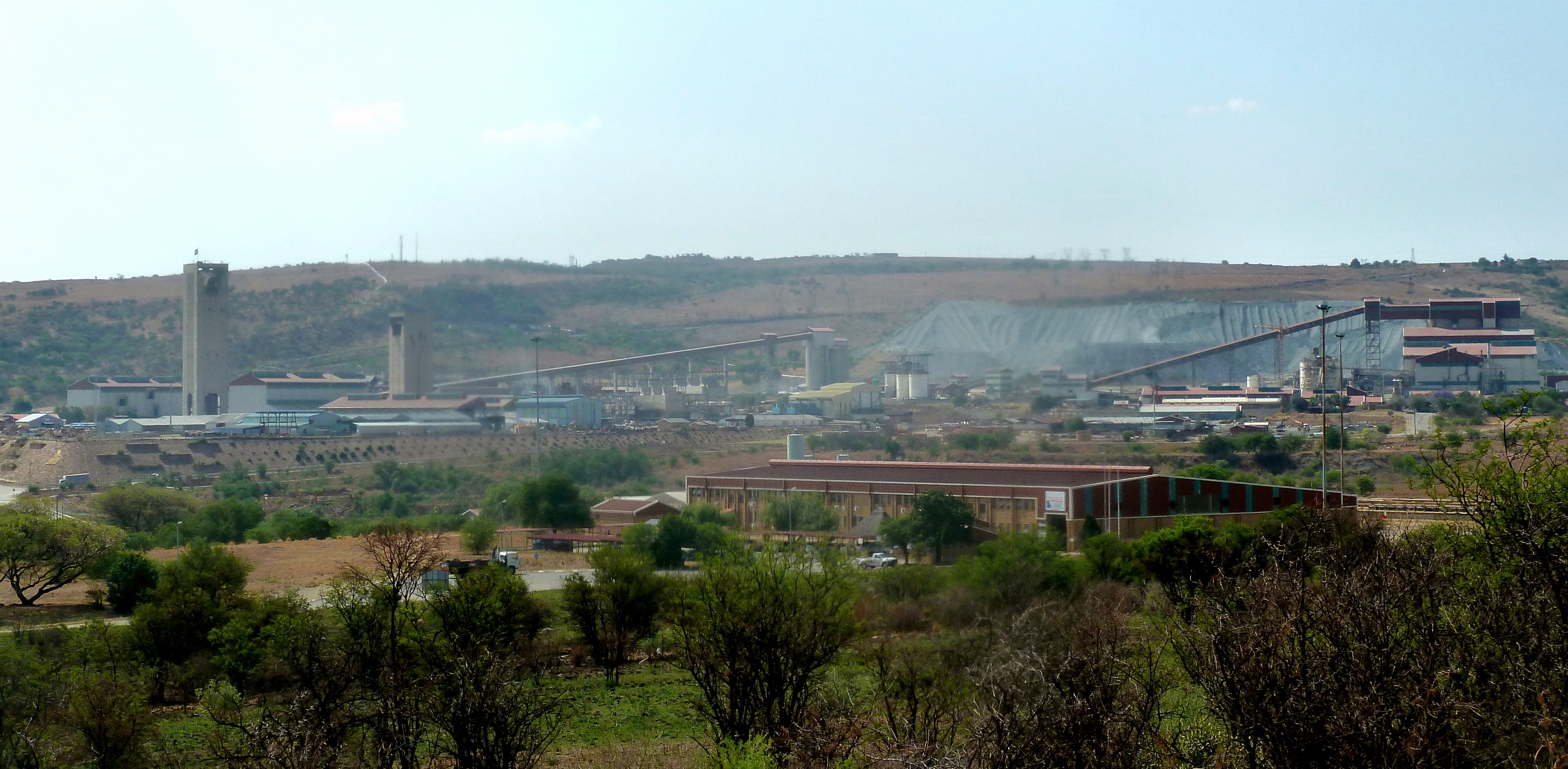
Mponeng Gold Mine
In 2008, researchers collecting groundwater samples from kilometers deep inside Mponeng Gold Mine found something alive. The bacterium Desulforudis audaxviator -- named for a passage in Jules Verne's Journey to the Centre of the Earth ("Descend, bold traveller, and attain the centre of the Earth") -- was thriving in complete darkness, sustained by the radioactive decay of surrounding rock. It was the first known ecosystem with a single species, utterly independent of the sun. That life could exist in such conditions was remarkable enough. That humans had dug deep enough to find it said something about Mponeng itself: a mine where the ambition to reach gold has pushed infrastructure, engineering, and human endurance to their absolute limits.
Following the Gold Rush Down
The story begins in the 1850s, when Pieter Jacobus Marais panned gold from a river in the Witwatersrand and Henry Lewis found a quartz-and-gold vein on a nearby farm. Those discoveries triggered the Witwatersrand Gold Rush of 1886 and turned the basin into the site of the largest gold mineralization on Earth -- responsible for over 40 percent of all gold ever mined. Mponeng is a late chapter in that saga. After five years of shaft sinking beginning in 1981, the mine officially started operations in 1986 as Western Deep Levels No. 1 Shaft. The name Mponeng came into use in 1999. Current depths reach roughly 3.8 kilometers, making it the deepest mine in the world from ground level, with plans to push beyond 4.2 kilometers in the coming years.
Working in a Pressure Cooker
A trip from the surface to the deepest working level takes over an hour. At the bottom, the rock temperature reaches 66 degrees Celsius -- hot enough to cause fatal heatstroke without intervention. The mine pumps slurry ice underground to cool the tunnel air below 30 degrees. Excavated areas are packed with a mixture of concrete, water, and rock that serves double duty as backfill and insulation. Tunnel walls are reinforced with flexible shotcrete laced with steel fibers and held in place by diamond-mesh netting. Over 5,400 metric tons of rock are excavated each day. In 2017, an Ecuadorian marathon runner completed a half marathon within the mine -- a publicity stunt, perhaps, but one that underscored the sheer scale of the underground workings. The vertical stress at depth can reach 80 to 100 megapascals, equivalent to the pressure roughly 10 kilometers beneath the ocean surface.
When the Earth Pushes Back
Removing mass quantities of rock changes the stress dynamics underground, especially where pre-existing faults run through the geology. Mponeng experiences more than 1,000 seismic events per day -- most of them tiny, but collectively they pose a constant threat to equipment, tunnel integrity, and human life. Rock bursts can collapse drifts and stopes without warning. Three workers were killed in a fall-of-ground incident in 2020. Between 2007 and 2008, the JAGUARS research network -- a system of accelerometers and piezoelectric acoustic emissions sensors placed below the Ventersdorp Contact Reef -- recorded nearly 500,000 seismic events, some with frequencies up to 200 kilohertz. Understanding these micro-earthquakes has become a research priority, with Mponeng serving as an unintentional laboratory connecting small-scale physics to real-world seismology.
The Price of Gold
Mponeng produced 7,449 kilograms of gold in 2023. The economics are razor-thin: as of 2022, all-in production costs were approximately $1,771 per ounce, while gold prices hovered around $2,080 per ounce. The mine barely breaks even. The environmental toll extends well beyond the balance sheet. The Witwatersrand Basin hosts over 270 tailings storage facilities covering 18,000 hectares, and a 1998 study identified gold mining as South Africa's largest single source of pollution. Residents of surrounding communities have reported windblown dust carrying elevated levels of silica and uranium. Harmony Gold, which acquired Mponeng from AngloGold Ashanti in 2020, now monitors air quality from the tailings facilities. Mining accounts for roughly 8 percent of South Africa's GDP, a figure that carries the weight of both economic necessity and environmental consequence.
From the Air
Located at 26.44S, 27.43E in the Witwatersrand Basin, Gauteng Province, South Africa, about 75 km west of Johannesburg. From the air, the mine complex is identifiable by its headgear, processing plant, and the extensive tailings storage facilities that surround it. The neighboring TauTona and former Savuka mines are nearby. Nearest airports: Lanseria International Airport (FALA), approximately 40 km northeast; OR Tambo International Airport (FAOR), approximately 85 km east. Best viewed from 3,000-5,000 feet AGL where the scale of mining operations and the pale expanse of tailings dumps contrast sharply with the surrounding highveld grassland.