Muaro Jambi Temple Compounds
Eighty mounds rise from the jungle floor along the Batang Hari River, and most of them have never been opened. The Muaro Jambi temple complex covers 12 square kilometers of lowland Sumatra, stretching 7.5 kilometers along the riverbank in Jambi province. Only eight temple sanctuaries have been excavated, only nine restored. The rest wait beneath the trees, their red-brick walls held together by roots and soil, their contents unknown. Built by the Melayu Kingdom between the 7th and 13th centuries CE, this is one of the largest and best-preserved ancient temple complexes in Southeast Asia. It may also be the place where the Srivijaya empire began.
The Srivijaya Question
For decades, historians assumed Srivijaya, the great maritime empire that controlled trade across Southeast Asia from the 7th century onward, was based in Palembang in South Sumatra. But Palembang has yielded remarkably few archaeological remains for a supposed imperial capital. Muaro Jambi, by contrast, has a concentration of temples and artifacts that far exceeds anything found in the Palembang area. This discrepancy has led some scholars to argue that Muaro Jambi, not Palembang, was Srivijaya's original seat of power. The case is circumstantial but compelling: the site's scale, its position on a major trade river, and its dating to the 7th century all align with what is known about Srivijaya's rise. The question remains open, and the 80 unexcavated mounds scattered through the surrounding jungle could eventually provide an answer.
Red Brick and Restraint
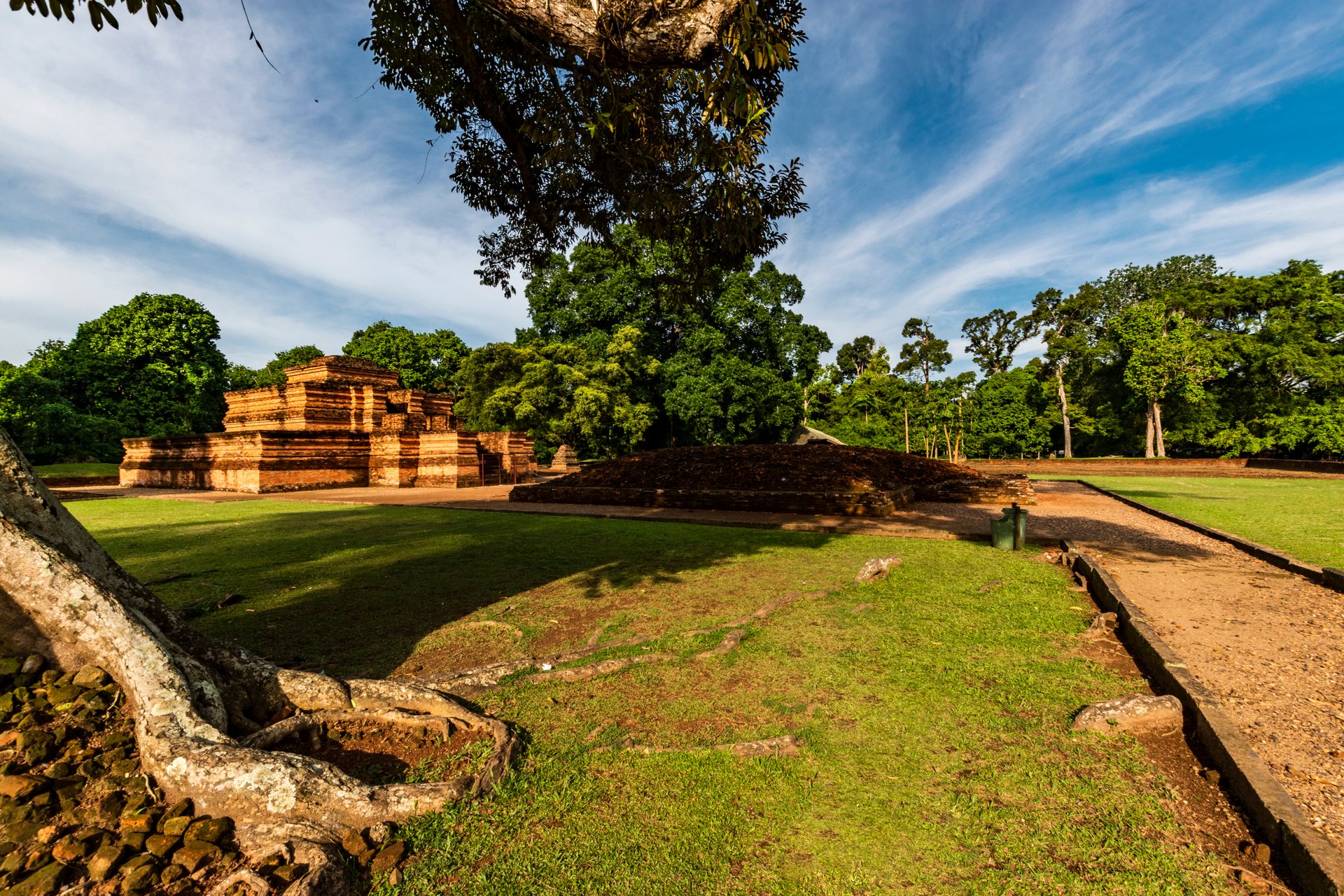
Visitors expecting the ornate stone carvings of Borobudur or Prambanan will find something different here. The temples of Muaro Jambi are built from red brick and are strikingly unadorned. Where Java's temples display elaborate relief panels, carved deities, and intricate geometric patterns, these structures rely on form alone. The three most significant intact temples - Candi Tinggi, Candi Kedaton, and Candi Gumpung - are solid, geometric volumes that rise from cleared ground in the forest. Candi Gumpung served as a Buddhist sanctuary, while the others blend Hindu and Buddhist elements. A small on-site museum houses a few pieces of sculpture recovered from the grounds, but the overwhelming impression is of architecture stripped to its essentials. The wooden buildings that once surrounded the temples, housing the city's population, have vanished entirely, leaving only the brick cores of the sacred structures.
The River Kingdom's Rise
Muaro Jambi's story begins with destruction elsewhere. In 1025, the Chola dynasty of southern India launched a devastating naval raid against Srivijaya, sacking its capital and breaking its hold over the Strait of Malacca trade routes. The attack did not wipe out Sumatran civilization, but it shattered the old power structure. In the vacuum that followed, smaller kingdoms expanded. The Melayu Kingdom, operating from its base along the Batang Hari River, grew to become the dominant economic force in Sumatra during the 12th and 13th centuries. The river was the key. The Batang Hari is Sumatra's longest, draining the western highlands where gold and forest products originated, and flowing east to the sea where ships from China, India, and the Malay world converged. Muaro Jambi sat at the crossroads, collecting wealth from both directions.
What the Jungle Holds
The conservation area around Muaro Jambi remains largely covered by thick jungle. Of the 80-plus mounds identified through surveys, most have never been excavated. Each mound represents a potential temple, monastery, or civic structure, its brickwork intact beneath layers of soil and vegetation. Trees grow through collapsed walls. Roots grip foundations that have held for a thousand years. The scale of what remains unexamined is extraordinary - this is not a site where the major discoveries have all been made and catalogued. It is a site where the major discoveries may still be waiting. The nine restored temples offer a glimpse of the complex in its prime, but they represent only a fraction of what was here when the Melayu Kingdom thrived. Walking between the cleared temples and the jungle-covered mounds, the contrast is vivid: order and ruin, separated by a few meters and seven centuries of neglect.
Twenty-Six Kilometers from Modern Jambi
The temple complex sits 26 kilometers east of the modern city of Jambi, close enough to visit in a day trip but far enough to feel remote. The site occupies a flat stretch of riverbank where the Batang Hari runs wide and slow. During the wet season, the river swells and the surrounding land floods, a cycle that the original builders clearly understood and designed around. The temples are raised on platforms that keep their foundations above the waterline. Today, the restored temples attract visitors and school groups, while researchers continue to map and study the unexcavated sections. Indonesia has submitted Muaro Jambi for consideration as a UNESCO World Heritage Site, a recognition that would bring international attention and funding to a place that has been quietly holding its secrets for over a millennium.
From the Air
Muaro Jambi is located at approximately 1.48S, 103.63E, along the south bank of the Batang Hari River in eastern Sumatra. The temple complex stretches 7.5 km along the river and covers 12 square kilometers, making the broader site area potentially visible from altitude. Look for a cleared area with restored brick structures amid surrounding jungle along the wide Batang Hari. Sultan Thaha Airport (WIPA) in Jambi city is approximately 26 km to the west. The Batang Hari River serves as a strong visual reference, flowing east toward the Strait of Malacca.