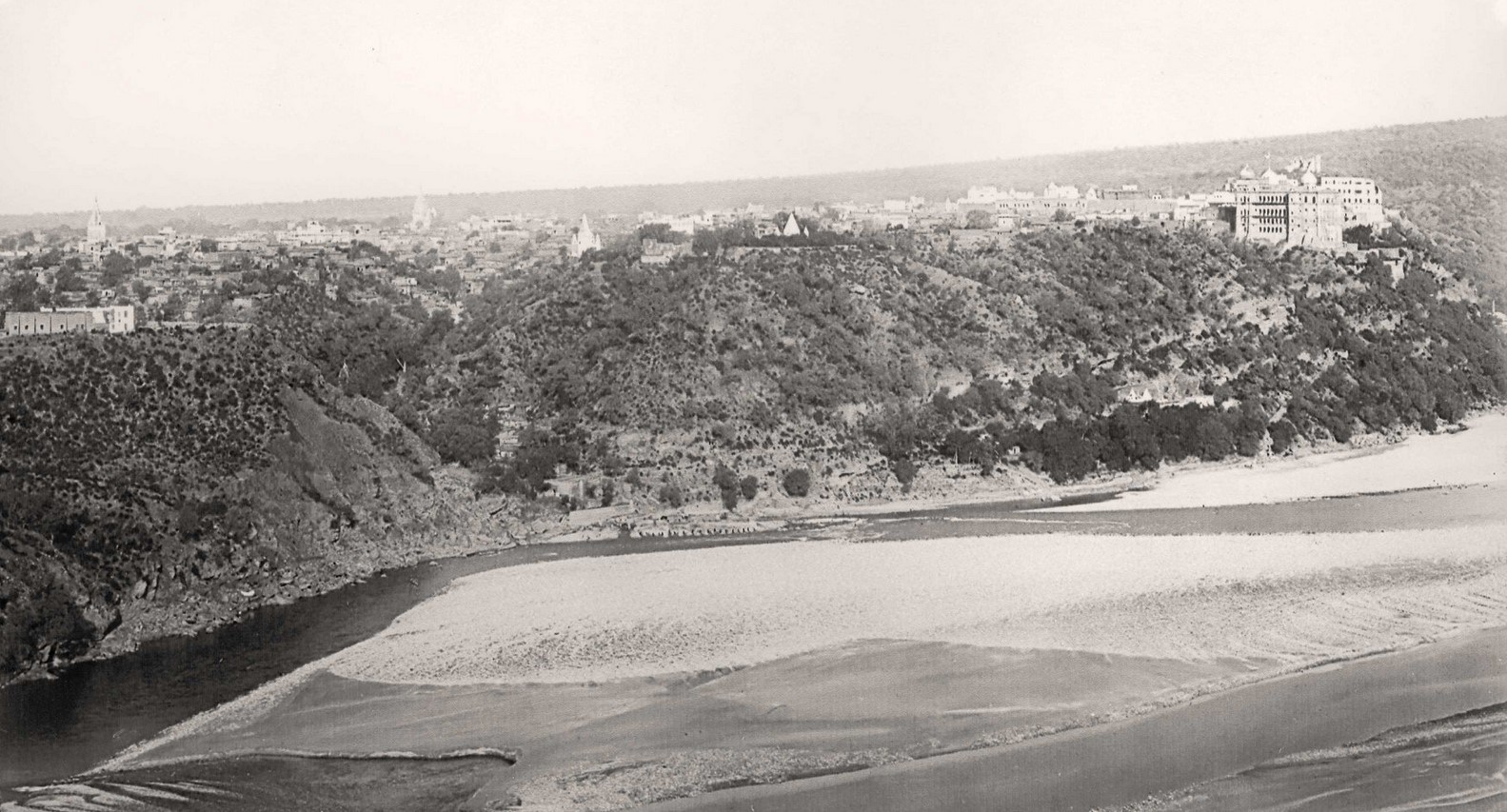
Mubarak Mandi Palace
In 1710, Raja Dhruv Dev consulted his astrologers and decided to move. The older palace at Purani Mandi no longer suited his ambitions, so he chose a promontory overlooking the Tawi River and began building what would become Mubarak Mandi. For the next 150 years, every Dogra ruler who inherited the complex added something -- a courtyard here, a hall of mirrors there, a round tower with baroque arches capped by Islamic domes. By the time Maharaja Hari Singh abandoned it for the newer Hari Niwas Palace in 1925, Mubarak Mandi had grown into one of northern India's most architecturally eclectic palace compounds, a place where Rajasthani balconies looked out over Mughal gardens and European columns supported rooftops that could have belonged to a different continent entirely.
A Dynasty's Living Canvas
The Dogra dynasty ruled Jammu and Kashmir as maharajas from the early 19th century until Indian independence in the mid-20th century, and Mubarak Mandi was their seat of power through most of that reign. Raja Dhruv Dev founded the complex; his son Raja Ranjit Dev expanded it with additional structures, though real authority during Ranjit Dev's rule rested with his prime minister, Mian Mota. Maharaja Gulab Singh added the marble platform in the central courtyard where he held public court, the Diwan-e-Aam, a deliberate echo of Mughal imperial tradition. Each successive ruler treated the palace not as a finished work but as a canvas, layering new architectural ambitions over old ones until the complex sprawled across its hilltop like a city in miniature.
Halls of Mirrored Light
The palace's individual buildings read like a catalog of royal needs. The Darbar Hall, also called the Grey Hall, hosted formal ceremonies, cabinet meetings, and -- on festive nights -- transformed into a ballroom. Its intricate woodwork and chandeliers declared Dogra authority to visiting dignitaries who waited in the arcaded corridors of the adjacent Army Headquarters, where carved stone columns and late-Mughal pebble work lined the exterior. The Pink Palace, named for the color of its walls, now houses the Dogra Art Museum, whose most celebrated exhibits include Pahari miniature paintings from Basohli and a gilded bow and arrow once belonging to Mughal Emperor Shah Jahan. Then there is the Sheesh Mahal, the Palace of Mirrors, where small mirrors embedded in walls and ceilings fractured lamplight into a constellation of reflections, reserved for special occasions and honored guests.
The Gol Ghar and Its Ghosts
Perhaps no single structure captures Mubarak Mandi's character better than the Gol Ghar, the Round House. Perched above the Tawi River, this circular building fuses baroque arches and columns with Islamic domes in a combination that should clash but instead achieves a strange harmony. Or it did, before a fire in 1984 gutted its interior and an earthquake in 2005 cracked what remained. Today the Gol Ghar stands in advanced dilapidation, its roofless shell open to the sky. Behind it, the Zenana Mahal once sheltered the royal women in seclusion. The Maharani Palace served the queens with more intimate and elaborate design than anything in the public wings. It now houses the Central Reserve Police Force. Seven terraced gardens once descended from the eastern side of the complex, each separated by walls, accessible from the palace buildings above -- though little of their original layout survives.
Crumbling Grandeur
Mubarak Mandi's greatest threat is time itself. After Hari Singh moved the royal household to Hari Niwas Palace in 1925, the complex lost its primary purpose and began a slow decline. Natural disasters accelerated the damage: the 1984 fire consumed the Gol Ghar, and the 2005 Kashmir earthquake shook walls that had stood for centuries. Neglect filled the gaps between catastrophes. The central courtyard, where Gulab Singh once held public court on an elegant marble platform, is now a park -- the platform gone, the original entrance gates reduced from two to one. Restoration efforts are ongoing, driven by the recognition that Mubarak Mandi is not merely a ruin but an irreplaceable record of how Dogra rulers absorbed and reinterpreted the architectural traditions of Rajasthan, the Mughal courts, and colonial Europe, fusing them into something that belongs to Jammu alone.
From the Air
Located at 32.74°N, 74.87°E on a hilltop overlooking the Tawi River in old Jammu city. The palace complex is visible from moderate altitude as a dense cluster of heritage structures near the river bend. Nearest airport is Jammu Airport (VIJU), approximately 8 km to the southeast. Recommended viewing altitude: 5,000-8,000 feet AGL. The Tawi River provides a clear navigation reference as it curves past the palace promontory.