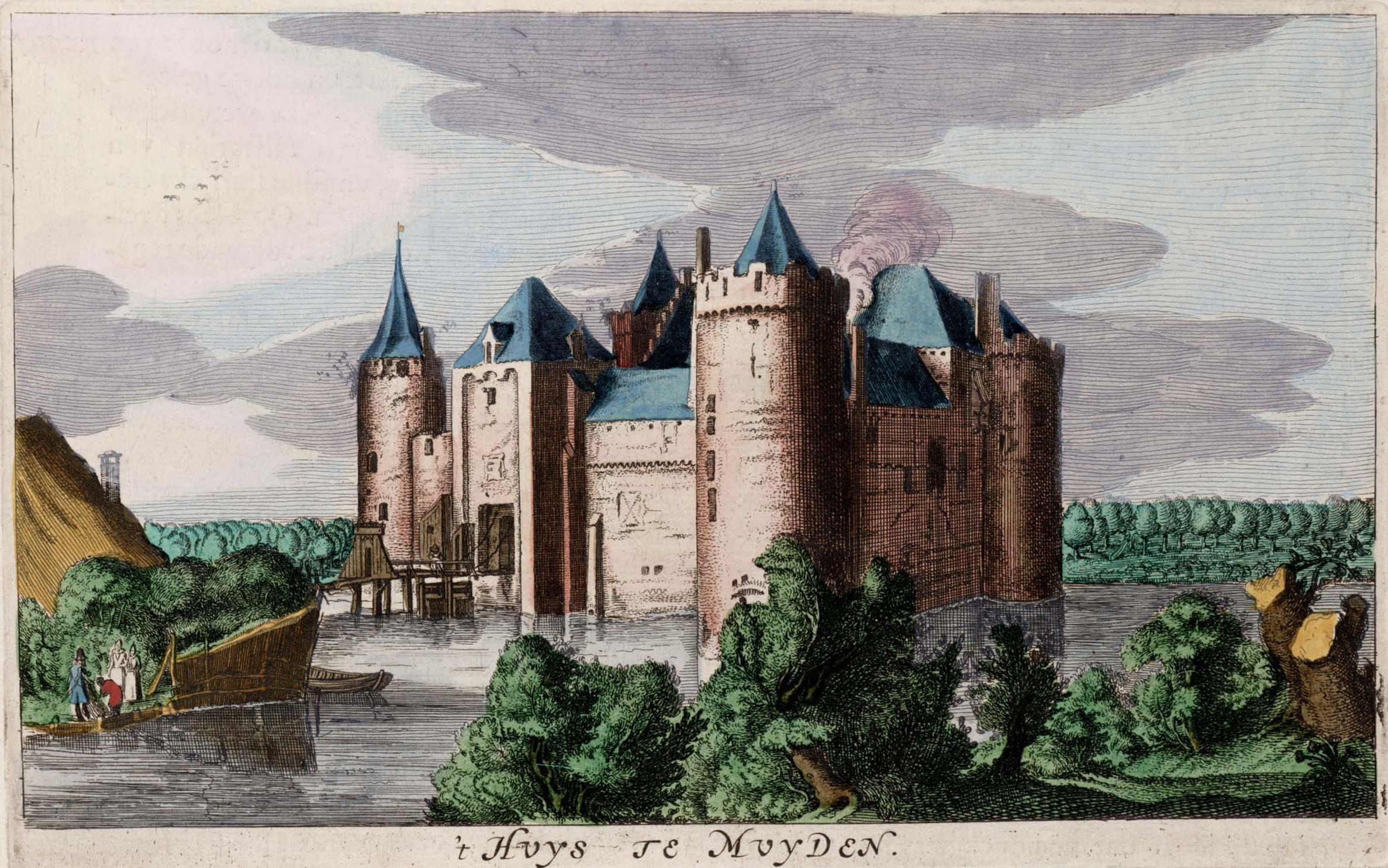
Muiden Castle
Stand on the bank of the Vecht where it meets what was once the open Zuiderzee, and the Muiderslot rises out of the water as if drawn from a child's picture book. Four round corner towers, brick walls more than a meter and a half thick, a wide moat that mirrors the whole thing in still weather. It is, in person, exactly as small as a real castle usually is — only about thirty meters on a side — and exactly as picturesque as a fairy-tale one. Television crews use it for medieval scenes because it is, in fact, medieval. The water has been doing its work on these stones since 1280.
Floris V Builds a Tollgate
The castle's first life was thoroughly commercial. In 1280, Count Floris V of Holland gained control over land at the mouth of the Vecht — territory that had been part of the See of Utrecht — and he understood immediately what he had been handed. The Vecht was the river road to Utrecht, one of the wealthiest trade towns in the medieval Low Countries, and every barge of cloth, salt, herring, and grain that wanted to reach those markets had to pass this exact point. Floris built a stone castle there to collect the toll. The footprint is small by castle standards: roughly 32 by 35 meters, brick walls well over a meter and a half thick, a moat surrounding the whole. It did not need to be a fortress to hold against an army. It needed to be a fortress that no skipper would risk pushing past without paying.
Twenty Stab Wounds
Floris V was a count who made enemies easily, and on a June afternoon in 1296 those enemies came for him. Gerard van Velsen, Herman van Woerden, and Gijsbrecht IV of Amstel — three of his own nobles — conspired with several others to kidnap the count. The alleged grievance is dark: contemporary accounts say Floris had raped Gerard van Velsen's wife. They seized him and brought him here, to the small castle by the river, and imprisoned him in his own walls. He tried to escape. On 27 June 1296, Gerard van Velsen personally stabbed Floris V to death — by tradition twenty times, methodically, in something between an execution and a frenzy. A year later the castle itself was conquered by Willem van Mechelen, the Archbishop of Utrecht, and by 1300 it had been demolished. The first Muiden Castle, the one Floris had built to collect tolls, lasted exactly twenty years.
The Muiderkring
What stands today is a rebuilding, expanded and gardened, with an outer earthworks defense system added when the archbishop's men took over. The castle had centuries of useful Dutch life ahead of it. But its golden age, the era that Dutch schoolchildren still memorize, came after 1609 — when the poet, playwright, and historian Pieter Corneliszoon Hooft was appointed bailiff of Muiden and made the castle his home. Hooft gathered around him, in the candlelit halls of the *Muiderslot*, the brightest literary minds of the Dutch Golden Age. The group came to be called the Muiderkring — the *Muiden Circle*. Joost van den Vondel, the greatest Dutch playwright, came to dine and argue. The polymath Hugo Grotius, the legal philosopher whose work would help invent international law, joined the conversations. Composers performed, poets read aloud, the conversation ran late on Rhenish wine and the sound of frogs in the moat. For a generation, this small castle at the mouth of the Vecht was the centre of Dutch intellectual life.
The King Who Said No
The eighteenth century treated the Muiderslot badly. It served briefly as a prison, then was simply abandoned. By 1825 the building had decayed so far that it was offered for sale — explicitly for demolition. The crown of the Netherlands had only been Dutch again for a decade, but King William I evidently understood the symbolic value of saving a thirteenth-century castle most of his subjects had nearly forgotten. He intervened, the demolition was cancelled, and the building was preserved — though it took another seventy years to gather enough money for proper restoration. Today the Muiderslot is one of the most-visited castles in the Netherlands, a national museum whose 17th-century interiors have been carefully recreated room by room. Several halls hold a collection of arms and armour. Hooft's study has been laid out as if he had just stepped away from a half-written letter — quill in the inkstand, a chair pushed back, the moat outside still throwing its silver back at the windows.
From the Air
Muiden Castle stands at 52.33°N, 5.07°E, where the Vecht river empties into the IJmeer (the former Zuiderzee). From altitude the castle reads as a compact square brick block ringed by a perfect rectangular moat at the river mouth, framed by the green of the Muiderbos parkland and the open water of the IJmeer to the north. Amsterdam is roughly 15 km west; the Hilversum airfield (EHHV) lies south; Schiphol (EHAM) sits west across the polder.