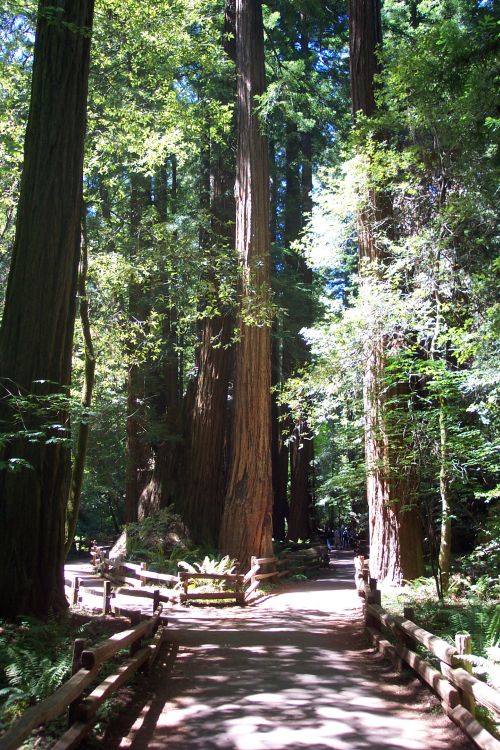
Muir Woods National Monument
William Kent refused to let the forest bear his name. In 1908, when President Theodore Roosevelt offered to call it Kent Monument, the congressman insisted the 298 acres of ancient redwoods he had just donated to the nation honor someone else: John Muir, the wandering naturalist whose writings had awakened America to its wild places. The irony runs deep. Kent and Muir later became bitter enemies over the flooding of Hetch Hetchy Valley, but by then the forest in Marin County's Redwood Canyon already bore Muir's name, preserved forever from the water company that had tried to condemn the land for a reservoir.
Survivors of Deep Time
The coast redwoods growing in this canyon carry a lineage stretching back more than 200 million years, to the Jurassic period when their ancestors spread across the entire Northern Hemisphere. Today, only 5% of the original old-growth coast redwood forest remains, compressed into a narrow strip along 450 miles of California coastline. The trees in Muir Woods range from 500 to 800 years old, with the patriarch reaching at least 1,200 years. Each began as a seed no larger than a tomato seed, yet some now stand over 250 feet tall. The tallest tree in the monument punctures the fog that rolls through the canyon, the same fog that sustains these giants through California's bone-dry summers with its persistent drip.
The Women Who Saw First
Before William Kent purchased the canyon in 1905, influential women from San Francisco had already recognized its worth. In 1904, the Forestry chapter of the California Club, a women's organization, began mobilizing to save the forest from private development. Alice Eastwood, a Canadian-American botanist who served as Head of the Department of Botany at the California Academy of Sciences for over 50 years, spearheaded a drive to raise $80,000 to buy the land from the North Coast Water Company. Laura Lyon White, an activist and wife of a Bank of California banker, helped facilitate the eventual purchase. Elizabeth Thacher Kent worked alongside her husband to protect the canyon. When the monument opened in 1908, it became the first successful use of the Antiquities Act to protect natural resources from a private donation.
A Forest That Shapes Its Understory
Beneath the redwood canopy, three tree species have evolved remarkable adaptations to survive in perpetual shade. The California bay laurel develops an unusually strong root system, allowing it to physically lean toward any opening in the canopy where light breaks through. The bigleaf maple has evolved the largest leaf of any maple species, broad collectors designed to capture what little filtered sunlight reaches the forest floor. The tanoak takes a different approach entirely, developing unique internal leaf structures that extract maximum energy from minimal light. Together, they create an understory ecosystem where the rules of photosynthesis bend to the redwoods' dominance.
The Salmon's Last Stand
Redwood Creek, flowing through the monument to Muir Beach, marks the near-southern limit of coho salmon habitat on Earth. The fish here have never been stocked, giving them distinctive DNA found nowhere else. After two years in the Pacific, they return to spawn in December and January, when winter rains breach the sandbar at Muir Beach. Between 2007 and 2009, not a single salmon was observed in the creek. The coho's three-year life cycle meant extinction loomed within a single generation. National Park Service restoration efforts at Muir Beach came almost too late. In January 2010, an estimated 45 coho finally swam upstream again, creating 23 redds. Statewide, the coho population stands at just 1% of 1940s levels, vanished from 90% of their former streams.
From the Air
The monument occupies a tight canyon on the southwestern slopes of Mount Tamalpais, about 12 miles north of the Golden Gate Bridge. From above, the redwood canopy appears as a dark green ribbon threading through the lighter chaparral of the surrounding hills. The fog that sustains the trees often fills the canyon in the morning, creating a river of white from which only the tallest crowns emerge. Nearby airports include San Francisco International (KSFO) to the south, Oakland (KOAK) to the east, and the smaller San Carlos (KSQL). The monument sits within the Class B airspace of San Francisco, so coordination is required for low-altitude passes. On clear days, the contrast between the ancient forest and the sprawling Bay Area beyond creates one of the most striking views in Northern California.
From the Air
Located at 37.89N, 122.57W in a canyon on Mount Tamalpais, approximately 12nm north of the Golden Gate Bridge. Best viewed at 2,000-3,000 feet AGL on clear mornings. The redwood canopy appears as a distinct dark green patch against surrounding terrain. Within San Francisco Class B airspace. Nearby airports: KSFO (15nm SE), KOAK (20nm E), KSQL (20nm SE). Morning fog often fills the canyon.