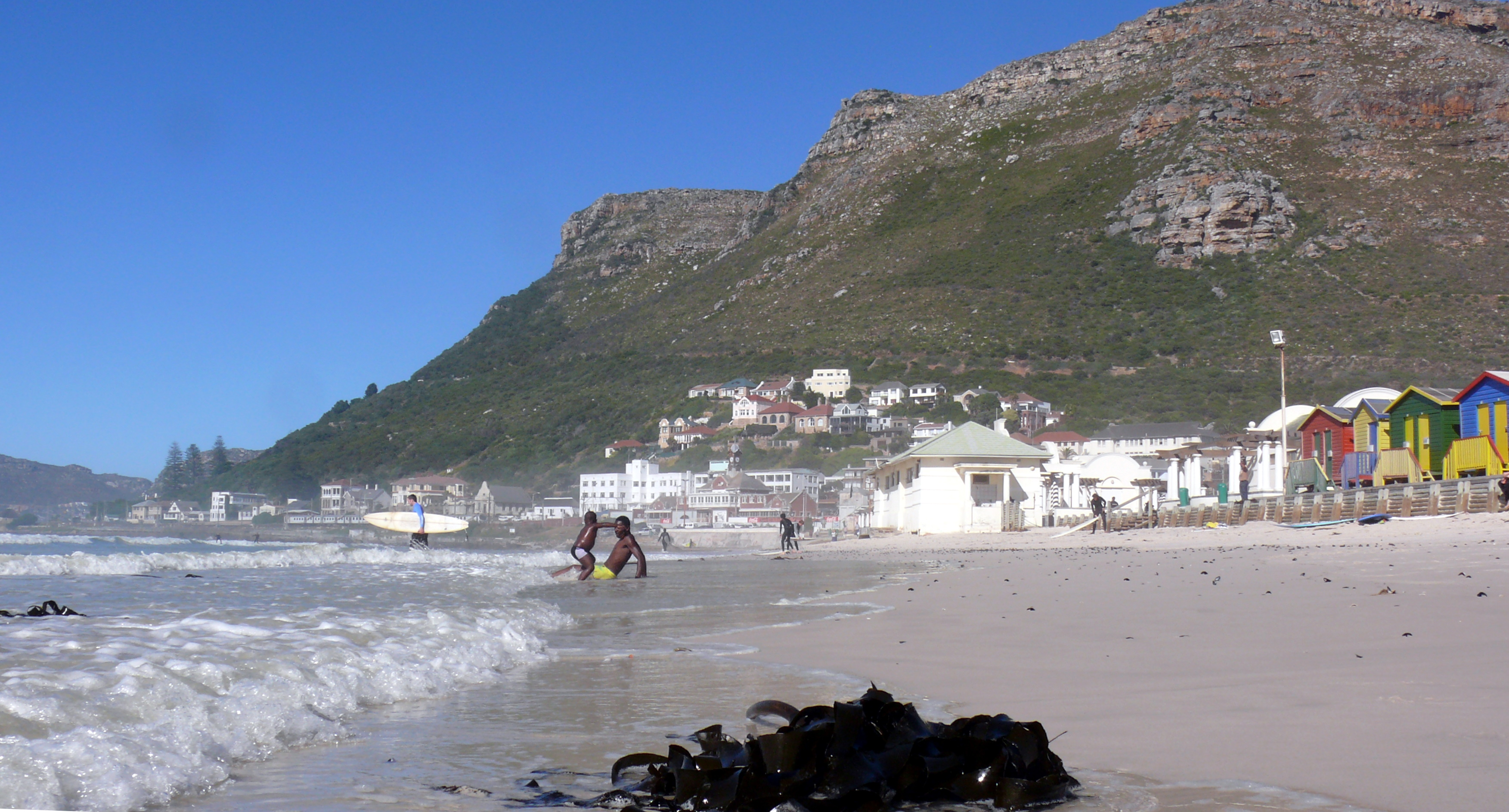
Muizenberg
The beach huts give it away. Lined up along the sand in bold primary colors -- red, blue, yellow, green -- the Victorian-era changing rooms at Muizenberg appear on nearly every South African postcard, every tourism campaign, every Instagram grid tagged with Cape Town. But Muizenberg was famous long before it was photogenic. This suburb on the southern coast of the city, where the Cape Peninsula begins its long reach toward the Cape of Good Hope, has been drawing swimmers and surfers to its warm, shallow waters for more than a century. Cecil Rhodes kept a cottage here. A battle that helped decide the fate of the Cape Colony was fought on this beach in 1795. Today, it is a place where surf schools outnumber banks and the most important daily question is whether the swell is up at Surfer's Corner.
Surfer's Corner and the Gentle Break
Muizenberg's wave is not dramatic. It does not barrel or thunder. What it does, consistently and generously, is roll in long, forgiving lines across a sandy bottom -- the kind of wave that lets a beginner stand up on the first day and keeps an experienced surfer coming back for the pure pleasure of a clean ride. Surfer's Corner, the stretch of beach where most of the action concentrates, is lined with surf schools, board rental shops, and the cheerful chaos of wetsuits drying on railings. In summer, when the False Bay water warms to swimmable temperatures, the beach fills with families, kitesurfers launch from Sunrise Beach to the east, and the whole coastal strip takes on a festival energy. There is also a supertube water slide and a putt-putt course near the beach -- holdovers from an earlier era of seaside entertainment that somehow never went out of style here.
The Walkway South
A scenic coastal walkway runs from Muizenberg south to the neighboring village of St James, tracing the edge of the sea past tidal pools and rocky outcrops. The path is barely a kilometer long, but it packs in views that shift with every turn: False Bay opening to the east, the Hottentots Holland Mountains across the water, the railway line running so close to the shore that you can wave to commuters passing at eye level. St James, at the walkway's end, has its own set of colorful bathing boxes and a tidal pool carved from the rocky shoreline. From there, the coastal road continues to Kalk Bay and its fishing harbor, Fish Hoek and its protected swimming beach, and eventually to Simon's Town and Cape Point. Muizenberg is the gateway to all of it, the point where the Cape Peninsula begins to narrow and the landscape grows wilder with every kilometer south.
Layers Beneath the Sand
Before the surf schools and the beach huts, before Cecil Rhodes built his seaside retreat, this stretch of coastline witnessed a skirmish that redirected southern African history. In August 1795, British forces engaged Dutch defenders at Muizenberg during their campaign to seize the Cape Colony. The battle was brief but consequential, leading within weeks to the Dutch surrender and the beginning of British control over the Cape. Rhodes Cottage, the modest house where the mining magnate spent his final days, still stands along the main road and operates as a small museum. Muizenberg Peak and the surrounding cliffs above the town offer rock climbing and hiking with views that stretch from the Strand in the east to the mountains of the peninsula in the south -- a reminder that this seaside suburb sits at the intersection of mountain, city, and ocean.
Where the Peninsula Begins
Muizenberg marks a geographic threshold. To the north lies the urban sprawl of the Cape Flats. To the south, the Cape Peninsula extends like a spine toward the continent's edge. The M3 freeway ends here, merging with the coastal M4 that threads through the False Bay villages all the way to Cape Point. The Metrorail train from Cape Town arrives in about 45 minutes, running through Claremont and Wynberg before descending to the coast. For visitors based in Cape Town, Muizenberg is the first taste of the peninsula's slower pace -- a place where the winelands of Stellenbosch are 45 minutes east by car, the penguins of Boulders Beach are half an hour south, and the day's most pressing decision is whether to ride one more wave before lunch.
From the Air
Muizenberg is located at 34.11°S, 18.47°E on the northern shore of False Bay, where the Cape Peninsula begins. The colorful beach huts at Surfer's Corner are visible from low altitude along the beachfront. The suburb sits at the junction of the M3, M4, and M5 roads. Nearest airport: Cape Town International (FACT), approximately 25 km north. Best viewed at 2,000-4,000 ft AGL approaching from the northeast across False Bay. The Muizenberg mountains rise behind the town to the west.