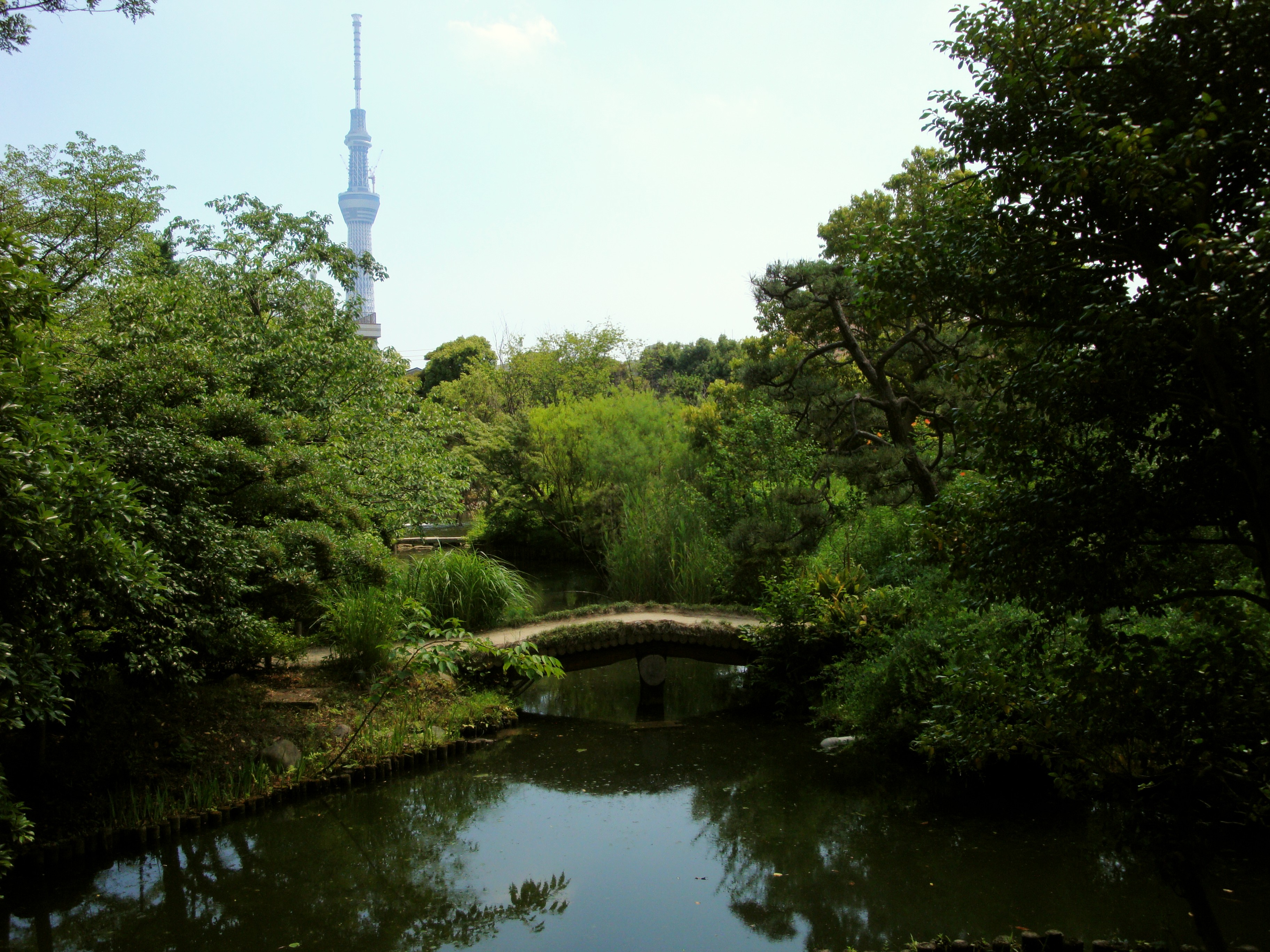
Mukojima-Hyakkaen Garden
The name means "a garden with a hundred flowers that bloom throughout the four seasons," and for more than two centuries, that promise has held. Mukojima-Hyakkaen sits in Sumida ward, on a patch of land near the Sumida River that has been continuously cultivated since 1804. It is the only flower garden from the Edo period that still exists in Tokyo -- not a feudal lord's manicured estate, but a merchant's garden, created by a man who made his fortune in antiques and spent it planting poetry into the soil.
An Antiques Dealer's Gift
In 1804, Sahara Kiku, a wealthy antiques dealer originally from the Sendai Domain, purchased a plot of land near the Sumida River called the Taga Yashiki. He planted 360 ume plum trees, many of them gifts from friends including the celebrated poet Ota Nanpo and the writer Shibutsu Okubo. The garden began as a conscious imitation of the famous plum orchards at Kameido, initially called the Shin-Umeyashiki, or new plum estate. By 1806, it had been renamed Hyakkaen. Over the next quarter century, Sahara expanded his vision. He collected plants mentioned in the Man'yoshu, Japan's oldest anthology of poetry, and in the Chinese Shi Jing, the Classic of Poetry. Each bloom was a literary reference made tangible -- verses you could smell and touch.
The Merchant's Literary Salon
Sahara did not build his garden merely to admire flowers. He established a literary salon, inviting poets, painters, and calligraphers to gather among the blossoms. Over thirty stone monuments were erected throughout the garden, each inscribed with poems composed by members of this artistic circle. The garden became a gathering place for the bunjin -- writers and artists of refined literary taste -- and reflected the growing cultural ambition of Edo's merchant class. The daimyo lords had their strolling gardens designed by master landscapers. Sahara's garden was different: democratic in spirit, created not by aristocratic decree but by bourgeois aspiration. The paths wound past ponds, rustic buildings, and zig-zag bridges, all shaped by the sensibility of a self-made man who believed beauty should grow from literature.
Destruction and Defiance
The garden's survival is itself a story of persistence against improbable odds. After the Meiji Restoration, industrialization polluted the water supply and the garden declined. The Great Sumida River Flood of 1910 submerged it. In 1938, the owner donated the garden to Tokyo City, and it opened to the public as a paid-admission garden in 1939. Then came the Great Tokyo Air Raid of March 1945, which reduced the garden to ash. Officials considered the site a total loss and proposed converting it into a baseball stadium. But the garden was restored in 1949, barely four years after its destruction, the plum trees and poetry stones rebuilt from memory and surviving records.
A National Treasure in Bloom
In 1978, the Japanese government designated Mukojima-Hyakkaen as both a National Place of Scenic Beauty and a National Historic Site. Today the garden covers about 10,886 square meters and contains roughly 230 species of plants. In early spring, the ume trees blossom in waves of white and pink, just as they did when Sahara first planted them. The garden sits in contrast to the modern density of Sumida ward, with the Tokyo Skytree visible above the treetops -- a 634-meter broadcasting tower looming over a garden that has not fundamentally changed its purpose in over two hundred years. Visitors still walk the same paths past the same poetry stones, reading verses that were old when the garden was young.
From the Air
Located at 35.7242N, 139.8156E in the Sumida ward of eastern Tokyo. The garden is a small green rectangle near the Sumida River, difficult to distinguish from altitude but situated in the distinctive bend of the river near the Tokyo Skytree (634 m), which serves as a prominent visual landmark. Nearest major airport is Tokyo Haneda (RJTT), approximately 20 km to the south-southwest. Narita International (RJAA) is 55 km to the northeast. Best viewed below 2,000 ft AGL.