Mülheim an der Ruhr
In 1927 a twenty-six-year-old woman named Clarenore Stinnes left Frankfurt in a stock Adler Standard 6 with two mechanics and a Swedish film cameraman. Two years and twenty-nine thousand miles later she rolled back into Berlin as the first person to drive around the world. She had crossed the Andes, the Gobi, and the iced-over Bering Strait by ice road. Mulheim does not put up many statues to its own. But there is a kind of audacity that comes from this Ruhr city - a city of about 170,000 between Essen and Duisburg - that turns up again and again in stories about its people.
City on the River
Mulheim sits in the Ruhr valley west of Essen, where the river of the same name carves more than fifty metres down through the northern foothills of the Rhenish Massif. The geology mattered: erosion exposed the coal seams that built the Ruhr economy, and from those seams the early miners drove horizontal adits into the hillsides. As the workable coal got deeper to the north, the adits became shafts, and the shafts became the deep-mine economy of the wider Ruhrgebiet. Mulheim was granted city rights in 1808 and crossed a population of 100,000 a century later. Between 1878 and 1929 it absorbed neighbouring towns - Broich, Heissen, and others - to take its modern shape: nineteen districts spread across both banks of the Ruhr, fourteen on the right bank and five on the left.
The Chemist Who Changed Everything
In 1943 a chemist named Karl Ziegler became director of what is now the Max Planck Institute for Coal Research, on a quiet street in Mulheim. He had no idea that his work on metal-catalysed reactions would, within fifteen years, change the materials economy of the world. In 1953 Ziegler and his colleagues discovered that titanium-based catalysts could turn ethylene gas into long, regular chains of polyethylene at low pressure and temperature - a process so simple and so cheap that it transformed plastics overnight. (Combined with Giulio Natta's parallel work on polypropylene, it earned them both the 1963 Nobel Prize in Chemistry.) Ziegler died in 1973. His institute - now joined by a second Max Planck Institute, for Chemical Energy Conversion - is still working on the next set of catalysts in the same buildings he ran.
The Brothers Who Invented Aldi
Karl and Theo Albrecht inherited their mother's small grocery shop in Essen after the Second World War, and by 1946 they had begun the operation that would become Aldi. In 1960 they split the company into two parts - Aldi Nord and Aldi Sud - reportedly over a disagreement about whether to sell cigarettes. The two brothers ran their territories separately for the rest of their lives, almost never gave interviews, and built one of the most successful retail businesses in modern Europe. Aldi Sud, the southern half of the empire, established its corporate headquarters in Mulheim, where it still operates. Karl Albrecht died in 2014, Theo in 2010; together they were for years the wealthiest people in Germany. The empire they built, sprawled across continents under the same minimalist brand discipline, runs in part from offices on a Mulheim street that gives almost no hint of what is decided there.
Other Mulheim Stories
The list of people Mulheim has produced is unexpectedly long. William Rittenhouse, born in the town in 1644, sailed for the New World and founded the first paper mill in North America in 1690. Hugo Stinnes (1870-1924), the industrialist and politician who built one of the most powerful business empires in Weimar Germany, was born here - and his daughter Clarenore is the one who drove around the world in an Adler. Helge Schneider, the comedian, musician, and filmmaker who has been confounding German audiences for forty years, was born in Mulheim in 1955. So was Hannelore Kraft, the former Minister-President of North Rhine-Westphalia. Not all Mulheim stories are heroic: the SS officer Werner Best, the Holocaust perpetrator Ferdinand aus der Funten, and the Nazi-affiliated industrialist Fritz Thyssen were also born here, and the city carries those names with the same archival honesty it carries the others.
What Is Here Now
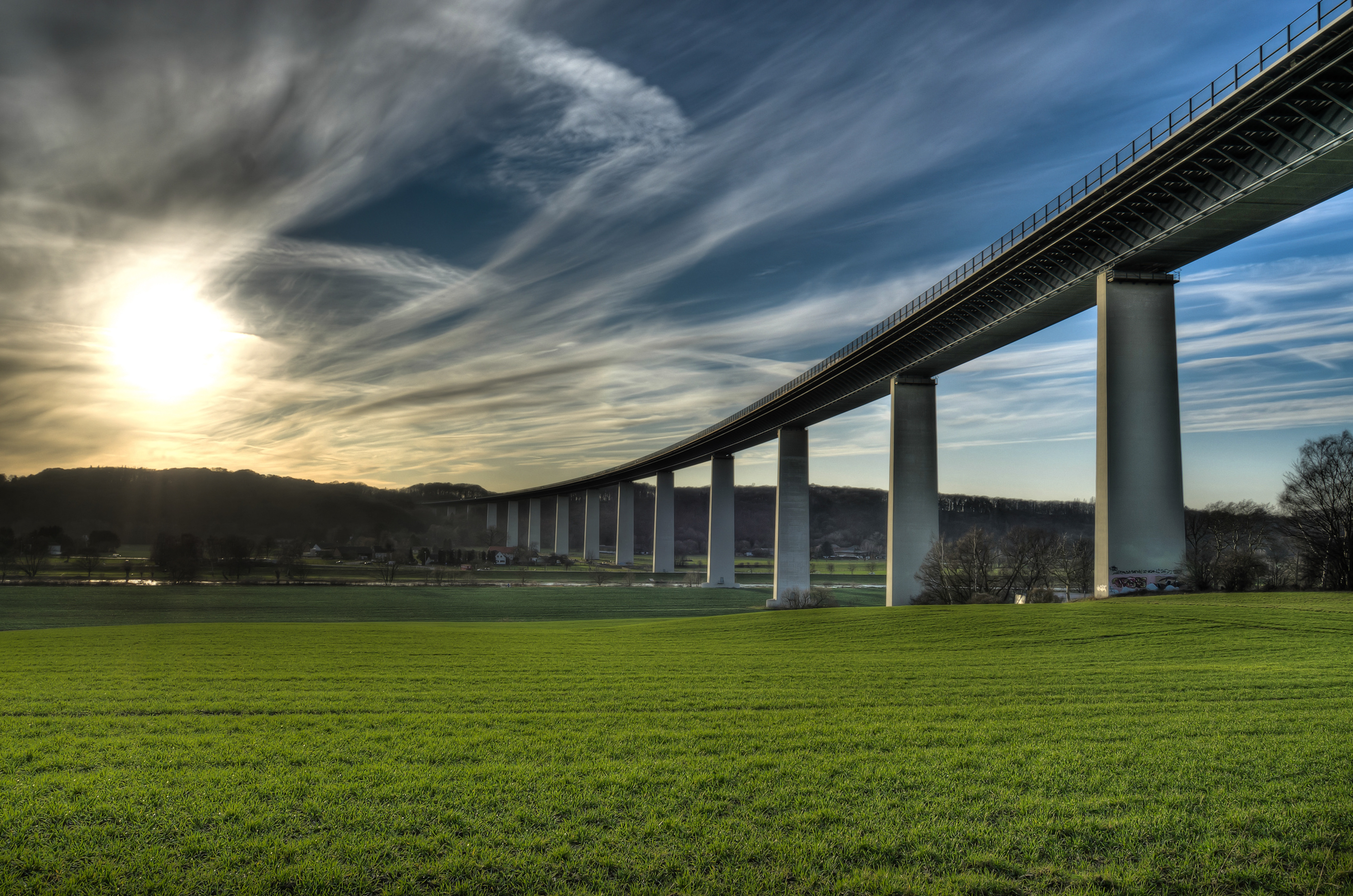
The mines closed long ago. The city has reinvented itself as a logistics hub - sitting at the centre of the dense Rhine-Ruhr transport network - and as a research town built around its two Max Planck institutes, the Ruhr West University of Applied Sciences, and the IWW water research centre. Siemens Energy, founded as a corporate split-out in 2020, is now the city's largest employer. ThyssenKrupp Presta assembles steering columns here. Europipe makes large-diameter pipe for projects including the Nord Stream gas line. Walk through the MuGa park along the Ruhr or past Schloss Broich - the medieval castle on the riverbank, parts of it dating to the ninth century - and you can see the older Mulheim under the modern one. The Mintarder Ruhrtalbrucke, the long autobahn bridge that strides across the Ruhr valley at the southern edge of the city, is one of the longest bridges in Germany and the easiest landmark to find from the air.
From the Air
Mulheim an der Ruhr lies in the western Ruhr at 51.428 N, 6.883 E, between Duisburg to the west, Essen to the east, and Oberhausen to the north. The Ruhr river winds through the city centre; the long Mintarder Ruhrtalbrucke autobahn bridge crosses the valley at the city's southern edge and is the most distinctive landmark from altitude. Nearest airports: Essen-Mulheim (EDLE), a small general-aviation field shared with Essen, lies in the city itself; Dusseldorf International (EDDL/DUS) is 30 km southwest. The U18 light-rail line, the autobahn corridors (A3, A40, A52), and the rail freight yards toward Duisburg's port form clear linear patterns at altitude. Best viewed at 2000-3500 ft AGL.