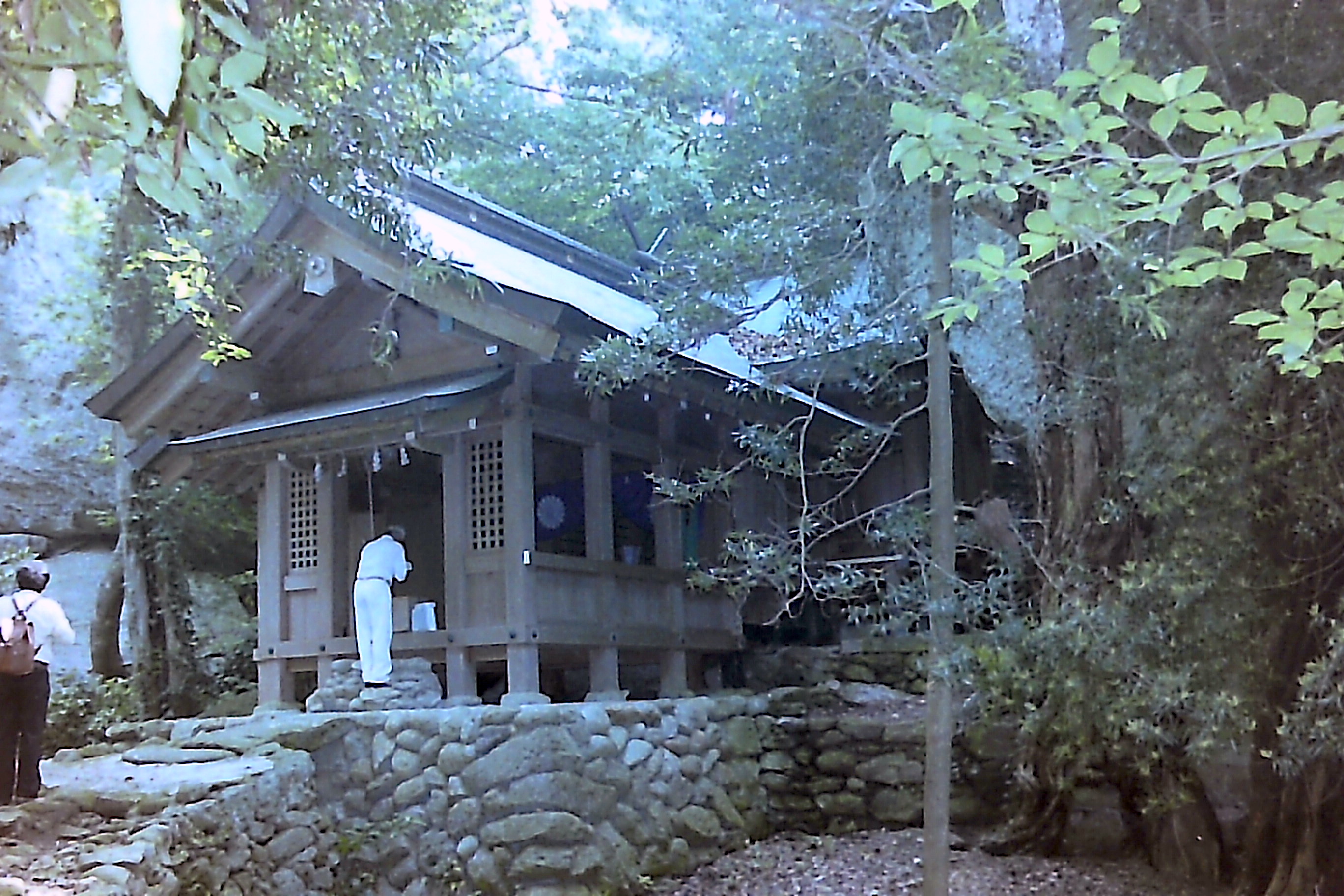
Munakata Taisha
Draw a straight line on a map from the Kyushu mainland through the island of Oshima to the remote island of Okinoshima in the Genkai Sea, and you trace the path of an ancient maritime corridor between Japan and the Asian continent. On each of those three points sits a shrine. Together they form Munakata Taisha, one of Japan's oldest religious complexes, documented in both the Kojiki and the Nihon Shoki -- the country's foundational mythological texts. The head of approximately 6,000 Munakata shrines scattered across Japan, this triple sanctuary has guarded sailors crossing to Korea since before written records began. In 2017, Okinoshima and its associated sites earned UNESCO World Heritage status, but the island's strictest rule predates any international committee: the shrine occupies the entire island, and no woman is permitted to set foot there.
Born from a Shattered Sword
The mythology is vivid. According to the Kojiki, the sun goddess Amaterasu and her brother Susanoo once made a divine vow. Amaterasu bit Susanoo's sword into pieces, and from the fragments three goddesses were born -- the Munakata goddesses. Amaterasu commanded them to descend to the Tsukushi Munakata Islands in the Genkai Sea, where they would watch over her imperial grandson Ninigi no Mikoto. Each goddess took her station: one on the mainland at Hetsu-gu, one on Oshima at Nakatsu-gu, and one on remote Okinoshima at Okitsu-gu. The Chikuzen Fudoki adds detail -- sacred jewels and a mirror distributed among the three shrines. Empress Jingu is said to have prayed at Munakata before her expedition to the Three Kingdoms of Korea, and the miraculous protection she received established the custom of imperial offerings. The Yamato court held the shrine in such esteem that whenever the capital relocated, a branch shrine was established within the palace.
Eighty Thousand Treasures from a Forbidden Island
Okinoshima sits 49 kilometers offshore, a speck in the Genkai Sea that functions as both shrine and archaeological vault. Between the fourth and tenth centuries, seafarers conducted elaborate rituals on the island, leaving offerings to ensure safe passage to Korea and China. Three major excavations between 1954 and 1971 unearthed approximately 80,000 artifacts -- bronze mirrors from China and Korea, gilt-bronze horse equipment, Haji ware pottery, sancai ceramics, beads, swords, and fragments of glass bowls believed to originate from Sassanid Persia. The collection was designated a National Treasure of Japan, the largest such designation by quantity in the country. Men who visit the island must first undergo a purification ceremony, and everything on Okinoshima -- every pebble, every twig -- is considered sacred and may not be removed. What the island preserves is not just objects but evidence of a trade network that stretched from the Korean Peninsula to the Persian Gulf.
The Clan That Married Into Empires
The Munakata clan served the shrine as hereditary priests while simultaneously governing the surrounding district, a dual role that gave them unusual influence. According to a stone monument recording the clan's history, two generations of Munakata leaders married daughters of Chinese merchants, anchoring the shrine's connections to continental trade. Munakata Tokuyoshi went further, marrying his daughter Amago no Musume into the harem of Emperor Tenmu. Their son, Prince Takaichi, born in 654, fought alongside his father in the Jinshin War and rose to become Grand Minister of State. From the Kamakura period onward, the clan transformed into samurai and grew into powerful regional lords, but the Sengoku period's civil wars pulled them into conflicts between the Ouchi, Otomo, and Shoni clans. The shrine was burned and rebuilt repeatedly. The current main hall at Hetsu-gu, with its sweeping thatched roof, dates to 1578, rebuilt by Grand Priest Munakata Ujisada. The prayer hall was reconstructed in 1590 by Kobayakawa Takakage, lord of Chikuzen Province.
Guardian of All Roads
For most of its history, Munakata Taisha was the guardian of maritime safety -- the deity sailors prayed to before crossing the treacherous Genkai Sea. That role has expanded. Today the shrine is widely worshipped as a protector of all transportation, including land travel and road safety. Japanese drivers affix Munakata charms to their dashboards alongside those from other traffic safety shrines. The evolution makes a kind of theological sense: if a goddess can calm the sea between Kyushu and Korea, a highway should pose little difficulty. Hetsu-gu, the mainland shrine in the city of Munakata, is the most visited of the three -- known locally as 'Tajima-sama' -- and both its main hall and prayer hall are designated Important Cultural Properties. The Shinpo-kan treasure hall on its grounds displays a rotating selection of the Okinoshima artifacts. Six separate collections within the hall hold National Treasure status. What began as a seafarer's prayer has become something broader: a place where the ancient and the practical overlap, where Sassanid glassware and car charms coexist.
From the Air
Munakata Taisha's main shrine Hetsu-gu (33.83N, 130.51E) is located on mainland Kyushu in Fukuoka Prefecture. Okinoshima, the most remote shrine, lies 49 km offshore in the Genkai Sea. Fukuoka Airport (RJFF) is approximately 50 km to the southeast. Kitakyushu Airport (RJFR) is a similar distance to the east. The shrine complex is not visible from altitude, but the island of Okinoshima is identifiable as a small, forested island in the Genkai Sea between Kyushu and Korea.