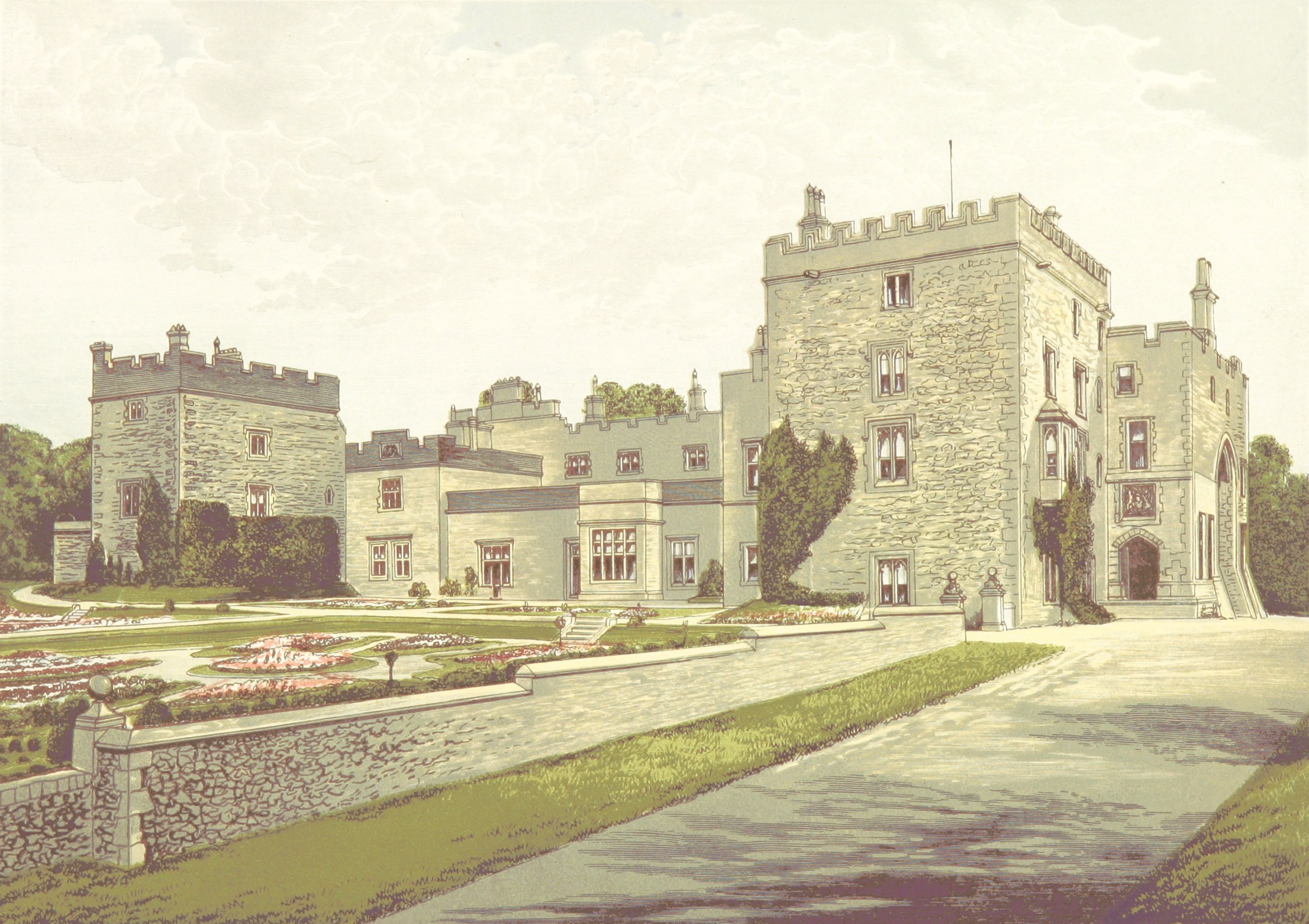
Muncaster Castle
Thomas Skelton was not a funny man. The 17th-century jester of Muncaster Castle, employed by the Pennington family, is reputed to have beheaded a carpenter's son on a rival's orders and hidden the severed head under a pile of wood shavings. He reportedly sent travelers he disliked down paths that led into quicksand. His portrait still hangs in the castle -- holding his will, as if daring anyone to challenge his legacy. Skelton may be the most memorable resident of Muncaster, but the castle on the River Esk in Cumbria has been home to the Pennington family for at least 800 years, accumulating stories that range from royal fugitives to wartime art heists along the way.
Roman Foundations, Border Fortress
The name Muncaster contains the Latin word castra -- fort or encampment. The castle likely sits on foundations dating to the Roman era, possibly a castellum associated with the nearby Roman fort of Glannoventa at Ravenglass. The Muncaster estate was granted to Alan de Penitone in 1208, and the oldest surviving structures include the Great Hall and the 14th-century pele tower, a type of squat defensive tower unique to the English-Scottish border region. Living on a contested frontier shaped the castle's architecture and its inhabitants' instincts: the Penningtons learned early to be both welcoming and watchful.
The Luck of Muncaster
After the Battle of Hexham in 1464, the defeated Henry VI fled north and found shelter at Muncaster Castle. Sir John Pennington took in the fugitive king, and in gratitude Henry gave him a Venetian glass drinking bowl with a blessing attached: 'As long as this bowl remains unriven, Penningtons from Muncaster never shall be driven.' The bowl, known as the Luck of Muncaster, still exists -- and the Penningtons still live at the castle, making good on Henry's prophecy across more than five centuries. The delicate glass cup is one of the finest examples of medieval Venetian craftsmanship to survive in England.
Turners, Manets, and Van Goghs in the Cellar
Muncaster's remote position in the Lake District made it an unlikely art repository, but during the Second World War some 700 works from the Tate Gallery were transferred to the castle for safekeeping. Paintings by Turner, Manet, and Van Gogh sat in a Cumbrian castle while bombs fell on London -- a surreal arrangement that persisted until the end of hostilities. Between 1860 and 1866, the architect Anthony Salvin had extensively remodelled the castle for the Barons Muncaster, and Edwin Lutyens was consulted about further modifications in 1916, though only his war memorial was built. By the time Phyllida Gordon-Duff-Pennington and her husband Patrick took charge in the late 20th century, the castle was a 'crumbling relic.' They spent three decades restoring it into a viable tourist destination.
Owls, Voles, and Mountain Views
Today Muncaster Castle draws over 90,000 visitors a year, drawn by its gardens, its owlery, and its setting. The gardens are designed to frame views of the Esk Valley and the Lake District mountains beyond -- a landscape that shifts from intimate riverside woodland to vast mountain panorama within a few steps. An aviary houses owls and other raptors from Britain and overseas, with daily flying displays. There is an indoor maze themed on the life of a field vole, a whimsical touch in a castle that has always balanced gravity with eccentricity. Peter and Iona Frost-Pennington now manage the estate, with their son Ewan serving as operations director -- continuing a family presence that stretches back to the 13th century and shows no sign of ending.
From the Air
Muncaster Castle is at 54.35N, 3.38W overlooking the River Esk, about a mile east of Ravenglass on the Cumbrian coast. The castle sits between the coast and the western Lake District fells. Ravenglass, where the Roman fort of Glannoventa was located, is visible at the river mouth. The Ravenglass and Eskdale Railway runs nearby. Nearest airports: Barrow/Walney (EGNL, 15nm south) and Carlisle (EGNC, 40nm northeast). The castle's elevated position above the Esk Valley is visible at low altitude.